
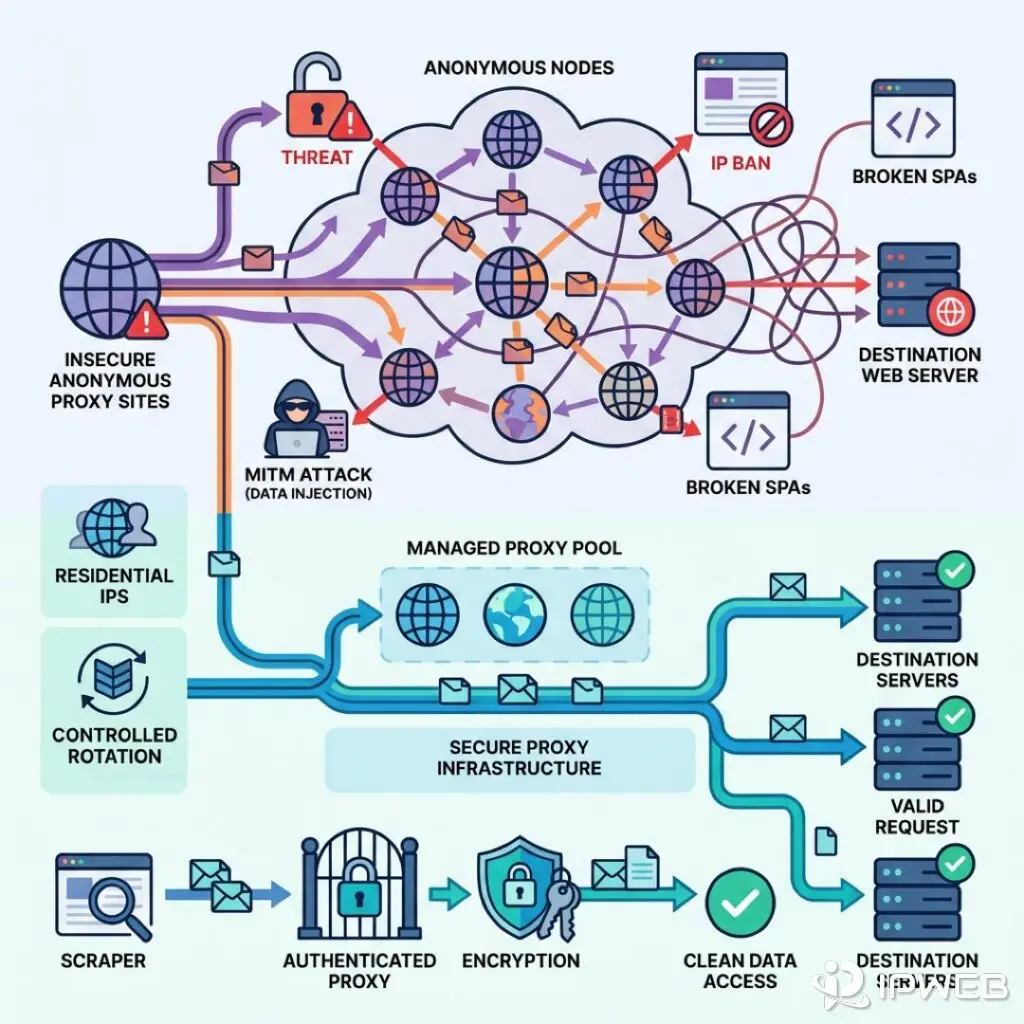
Teams often test scrapers or seller accounts through a free online anonymous proxy. A browser-based proxy feels frictionless — no system proxy settings to configure. But under the hood, it locks you into shared datacenter IPs and server-side TLS termination. That setup breaks the moment you automate at scale.
- Security: Free proxy sites terminate TLS on the server and re-render pages. This exposes your tokens, API keys, and session cookies to the operator.
- IP pollution: Public proxies route thousands of users through the same datacenter IPs. This trashes your fraud scores and triggers WAFs.
- Account association: Amazon and eBay easily detect the shared IP footprint of an anonymous web browser online. This leads to instant cross-account suspensions.
- The alternative: High-anonymity residential proxies provide isolated, legitimate ISP connections. They navigate anti-bot systems without compromising your data.
- 1. What is an Online Anonymous Proxy?
- 2. The Architecture Flaws of Web-Based Proxies
- 3. 4 Critical Risks of Using an Anonymous Proxy Site in Production
- 4. Why Web Scrapers Fail with an Anonymous Browser Online
- 5. 3 Steps to Audit an Anonymous Web Browser Online for Leaks
- 6. Comparison: Anonymous Proxy Sites vs. Dedicated Residential Proxies
- 7. How to Replace Web Proxies with Enterprise Infrastructure
- 8. Frequently Asked Questions (FAQ)
1. What is an Online Anonymous Proxy?
Web-Based Proxies vs. Protocol-Level (HTTP/SOCKS5) Routing
A web-based proxy runs entirely at Layer 7. Type a URL into an anonymous proxy site, and the server fetches the page, rewrites links, and sends HTML back inside its own UI. That is nothing like client-side HTTP/SOCKS routing — where your scraper opens a tunnel and speaks to the API directly. For forward-proxy mechanics and scale limits, see how an anonymous web proxy works and why it fails at scale.
Web proxies parse and rewrite raw HTML on the server to fix internal links. This process frequently breaks JavaScript execution and corrupts CSS. It also fails entirely when handling complex single-page applications (SPAs). If you run headless browsers like Puppeteer or Playwright, this architecture is unusable. It blocks direct, programmatic interaction with the target server's API endpoints.
The Illusion of the "Anonymous Browser Online"
The concept of an "anonymous browser online" suggests that a web portal masks your identity. But IP masking is only one basic layer of modern web anonymity. Web-based proxies do absolutely nothing to spoof or isolate deep browser fingerprints.
When an ad verification script executes, it reads your local machine's hardware profile. For example, tracking scripts exploit the HTML5 Canvas API to generate a unique hash based on your GPU and graphic drivers. Ad networks also check for mismatches between the IP's MaxMind geolocation and the browser's local timezone. Because the web proxy merely acts as a viewport, your actual hardware fingerprint and local system time remain fully exposed. This renders the setup useless for verifying localized programmatic ads.
2. The Architecture Flaws of Web-Based Proxies
Header Leaks (X-Forwarded-For and Via)
True anonymity requires strict manipulation of HTTP headers, just as developers learn when analyzing Chrome Incognito vs proxy header differences. Public proxy sites are notoriously poorly configured. They often operate as transparent proxies rather than elite, high-anonymity proxies.
During the routing process, these servers frequently append the X-Forwarded-For (XFF) header. According to MDN Web Docs, XFF is the standard header for identifying a client's originating IP address. When a target server inspects the incoming HTTP request, it reads the XFF header. It instantly detects the proxy intervention and logs your true origin IP.
Reliance on Recycled Datacenter Subnets
Free proxy sites rely on minimizing infrastructure overhead. They operate almost exclusively on bulk, recycled datacenter IPs. These IPs belong to known hosting providers rather than residential Internet Service Providers (ISPs).
Modern anti-bot systems categorize Autonomous System Numbers (ASNs) upon connection. A request from a datacenter ASN tied to a public proxy site immediately gets a high risk score. Cloudflare's Bot Management machine learning models analyze request fingerprints and behavioral signals to detect bot traffic. They easily flag abuse routed through these shared networks.
3. 4 Critical Risks of Using an Anonymous Proxy Site in Production
1. TLS Termination and Payload Injection
Route traffic through a free anonymous proxy site, and you send sensitive data through an unknown third-party server. A web proxy does not preserve end-to-end HTTPS. It fetches the target on your behalf, terminates TLS at the proxy, and re-renders the page inside its own interface. The proxy already sees your plaintext headers and body content.
The operator can read your Authorization: Bearer <token> headers, OAuth credentials, and session cookies server-side. They can also inject malicious JavaScript payloads directly into the returned HTML before your browser builds the page.
2. Shared IP Pollution and High Fraud Scores
IP fraud scores dictate how target servers treat incoming connections. Because an online anonymous proxy is entirely public, thousands of users route traffic through the exact same IP address simultaneously. This includes bad actors executing brute-force credential stuffing or scraping aggressively without rate limits.
The IP quickly picks up a bad reputation in databases like IPQualityScore. Hit an e-commerce platform with a polluted IP, and you will spin in CAPTCHA loops or face hard blocks.
3. Cross-Account Linkage in E-commerce
For Amazon, eBay, or TikTok Shop sellers, account isolation is non-negotiable. Logging into a merchant center through a public anonymous web browser online is a fast way to get accounts linked. Anti-fraud teams track exactly which IPs touch which logins.
Log into your store using a shared proxy exit IP, and the platform's backend links your account to every other user on that address. If one of those users gets banned for policy violations, your account goes down with them through cascading ban logic. This completely breaks the isolation that professional anti-detect browsers provide.
4. Server-Side Request Logging
Despite marketing claims of "no-log" policies, virtually all web-based proxies maintain server-side request logs. These logs capture your target URLs, timestamp data, and raw request payloads. If you scrape proprietary data, routing traffic through a public proxy exposes your entire extraction logic. You hand over custom GraphQL queries and internal API keys to the proxy operator.
4. Why Web Scrapers Fail with an Anonymous Browser Online
Modern WAFs — Cloudflare, DataDome, Akamai — do not stop at rate limits. They score the ASN on connect. A public anonymous proxy ASN reads as datacenter abuse by default. Run Puppeteer through a web proxy, and the WAF serves a JS challenge the proxy cannot solve. You stay blocked.
Public proxy sites also choke your bandwidth. Scraping needs steady latency. Re-rendering HTML through a web viewport adds massive latency spikes. This triggers ERR_CONNECTION_TIMED_OUT errors in your async workers.
5. 3 Steps to Audit an Anonymous Web Browser Online for Leaks
If you must verify a proxy connection, rely on deterministic testing rather than marketing claims. Follow these steps to audit your setup:
- Check IP fraud score: Route your browser traffic through the proxy and navigate to the 008ip IP anonymity checker. Check the risk score, ASN type, and geolocation accuracy. A score above 30 indicates a polluted IP that will burn out in production.
- Test for header leaks: Inspect your HTTP request headers using a secure echo server. Look for
X-Forwarded-FororX-Real-IP. If your origin IP appears there, the proxy is transparent. AViaheader indicates a proxy hop but does not carry your client IP. Treat it as a separate anonymity leak signal. - Evaluate WebRTC and DNS leaks: Execute a leak test or inspect
chrome://webrtc-internals. Check if the browser's STUN/TURN servers leak your local machine's true IP address via WebRTC channels.
6. Comparison: Anonymous Proxy Sites vs. Dedicated Residential Proxies
To understand why enterprise teams abandon web proxies, review the technical differences below:
| Feature | Online Anonymous Proxy Site | Dedicated Residential Proxies |
|---|---|---|
| Routing Layer | Application Layer (Web Interface) | Protocol Layer (SOCKS5/HTTP) |
| IP Type | Recycled Datacenter (High Risk) | Legitimate ISP Residential (Low Risk) |
| Session Control | None (Shared Public Sessions) | Sticky Sessions (Up to 24 hours) |
| TLS Integrity | No end-to-end TLS (proxy terminates HTTPS) | End-to-End Encryption Maintained |
| Concurrency | Low (Throttled Bandwidth) | High (API-driven concurrent threads) |
| E-commerce Suitability | Unusable (Instant Account Bans) | Enterprise-Grade (Isolated Accounts) |
7. How to Replace Web Proxies with Enterprise Infrastructure
Integrating Residential IPs with Anti-Detect Browsers
To achieve real proxy anonymity for production and multi-account management, combine protocol-level proxies with an anti-detect browser like AdsPower or Multilogin. Instead of using a web interface, configure the anti-detect browser profile to route through a dedicated SOCKS5 residential proxy. This ensures your hardware fingerprints are properly spoofed. Meanwhile, your network footprint mimics a real user on a clean ISP connection.
Implementing API-Driven Proxy Rotation for Scrapers
For data extraction, abandon web proxy URLs and implement an API-driven proxy gateway. Integrate high-anonymity rotating residential proxies directly into your scraping framework's network arguments. This lets you navigate WAF ASN blocks and handle thousands of concurrent requests without connection drops.
Ready to scale up your infrastructure? Explore IPWeb's rotating residential proxy network. You get access to millions of clean, unpolluted IPs designed for rigorous ad verification and e-commerce operations.