
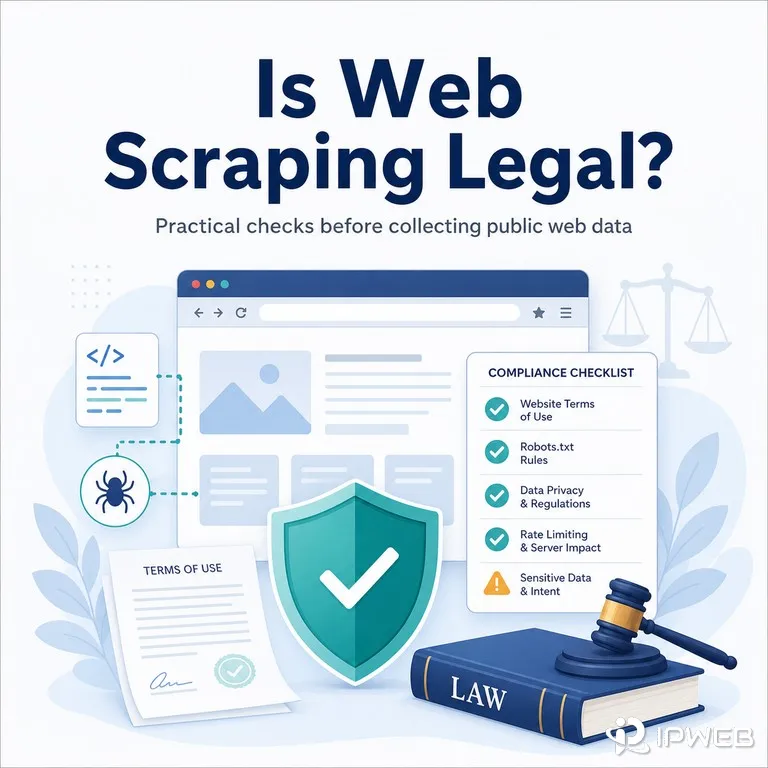
Web scraping can be legally acceptable in some situations and risky or prohibited in others. The answer depends on the source, the type of data, how access happens, the website’s terms, privacy rules, contract obligations, jurisdiction, and what the collected data will be used for.
The safest way to assess a project is not to ask whether “web scraping” is legal in the abstract. A more useful question is whether a specific team can collect specific data from a specific source, for a specific purpose, using a specific access method.
This article provides a practical risk-review framework for business and technical teams. It is general information, not legal advice.
Readers who need a technical introduction can first review what web scraping is and how it works, including page retrieval, field extraction, validation, storage, and the difference between scraping and crawling.
Web scraping is not automatically legal or illegal. Some public data workflows may be acceptable, while others may create contractual, privacy, intellectual property, computer access, security, or ethical risk. Review the source rules, data type, access method, robots.txt signals, request behavior, jurisdiction, and intended use before collecting data.
- Web scraping is not automatically legal or illegal.
- Public visibility does not automatically create unrestricted collection or reuse rights.
- Robots.txt is an important instruction for automated clients, but it does not resolve every legal question.
- Login requirements, paywalls, personal data, sensitive data, and access controls increase the need for review.
- The source, collection method, jurisdiction, and intended use should be assessed together.
- A proxy changes the network route; it does not create legal permission.
Why There Is No Universal Answer
The term “web scraping” covers many different activities. A small internal workflow that collects non-sensitive public facts from pages that permit automated access is very different from a system that collects personal data at scale, ignores explicit source rules, overwhelms servers, accesses account-only content, or republishes protected material.
The level of risk may change based on:
- Whether the page is public, account-based, paywalled, or access-controlled.
- Whether the collected information is factual, personal, sensitive, copyrighted, or confidential.
- Whether the source publishes terms or automated-access instructions.
- Whether the collection affects the source’s infrastructure or users.
- Whether the data is used internally, republished, sold, combined, or used to make decisions about people.
- Which laws, contracts, and regulatory requirements apply to the organizations and individuals involved.
Broad claims such as “all public data is safe to scrape” or “all scraping is illegal” are both too simple. The practical approach is to evaluate the exact collection method, data, source, and use case before the project grows.
What to Check Before Scraping
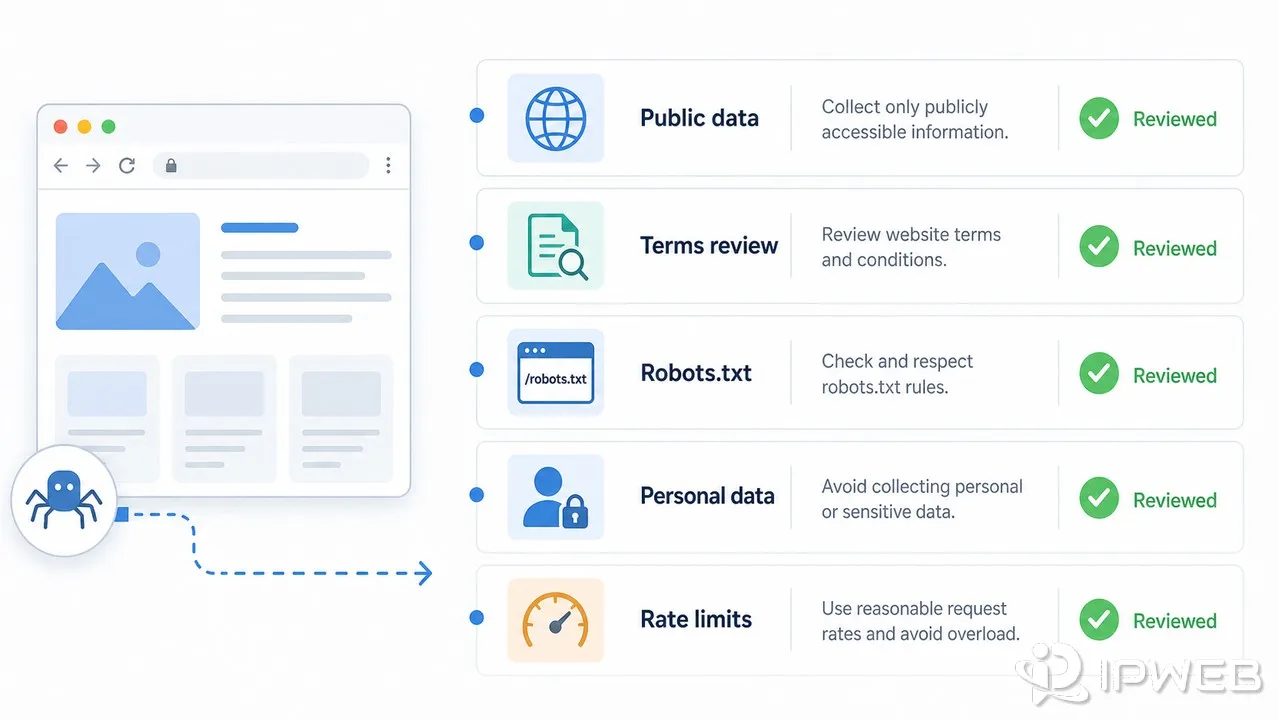
A basic review should answer several questions before engineering work begins. If the answers are unclear, the workflow should remain limited until the team has a stronger legal, policy, security, or business decision.
| Review Area | Question to Ask | Safer Direction |
|---|---|---|
| Data type | Is the data public, personal, sensitive, copyrighted, confidential, or account-based? | Prefer non-sensitive public facts and avoid collecting unnecessary personal data. |
| Source rules | Do the website terms, robots.txt file, API policy, or published instructions address automated access? | Respect published source instructions and escalate unclear conflicts for review. |
| Access method | Does the workflow require a login, subscription, paywall, access token, or technical restriction to be overcome? | Use only access rights and credentials that clearly permit the intended activity. |
| Server impact | Could the request frequency burden the source or interfere with normal service? | Use reasonable request rates, limited retries, caching, and diagnostic logging. |
| Intended use | Will the data be analyzed internally, republished, sold, used for profiling, or used in decisions about people? | Match the level of review to the effect and sensitivity of the use case. |
| Retention | How long will the data be stored, and is every collected field still needed? | Set retention rules and remove fields that do not serve the documented purpose. |
Public Data Does Not Mean Risk-Free
Public visibility is only one factor in a legal and policy review. A page can be publicly viewable and still contain copyrighted text, personal information, protected compilations, commercial restrictions, or terms that address automated collection and reuse.
Risk may also change after collection. Information that appears harmless on one page may become more sensitive when it is collected at scale, combined with other sources, republished, sold, or used to profile identifiable people.
For business teams, the practical lesson is to collect only what the project needs. If a workflow only needs product availability, it should not collect reviewer names. If it only needs titles and status codes for an SEO audit, it should not store full page text.
Data minimization can reduce storage costs, security exposure, compliance complexity, and the amount of information that must be reviewed or deleted later.
Robots.txt, Terms, and Request Rates
Robots.txt is a policy signal that communicates which paths automated agents are asked to access or avoid. The Robots Exclusion Protocol defines how those rules are expressed. Google also explains how robots.txt is used to manage crawler access in its robots.txt documentation.
Web crawling and web scraping may appear in the same workflow, but they perform different functions. The web scraper vs web crawler comparison explains the difference between discovering URLs and extracting structured fields from selected pages.
Robots.txt is important, but it does not by itself resolve contractual, privacy, copyright, access-control, or data-reuse questions. Treat it as one review input rather than a complete permission decision.
| Signal | What It Tells You | What It Does Not Settle |
|---|---|---|
| Robots.txt | Which paths automated agents are instructed to access or avoid. | Full legal permission, privacy compliance, copyright status, or reuse rights. |
| Website terms | Contractual or policy rules published for users or account holders. | Whether every term applies or is enforceable in every situation and jurisdiction. |
| Request limits | How much automated traffic the source may permit or tolerate. | Whether the underlying data may be collected, stored, republished, or sold. |
| Login or paywall | That access may depend on an account, subscription, license, or contract. | Permission to automate collection beyond the access that was granted. |
| Official API | That the source provides a structured access method with documented rules. | Permission to use the data outside the API terms or documented scope. |
When an official API, export, feed, or partner program provides the required information, it may be easier to maintain and review than extracting the same fields from page content.
When the appropriate technical method is still unclear, the guide to choosing the right web scraping tool compares visual scrapers, developer libraries, crawling frameworks, browser automation, and managed data services.
Personal Data and Sensitive Data
Personal data changes the risk profile. Names, emails, profile details, location signals, account information, photographs, usernames, and other identifiers may create privacy obligations depending on where the people are located, where the organization operates, and how the information will be used.
Public availability does not automatically remove privacy obligations. Collecting, organizing, storing, combining, analyzing, or reusing information about identifiable people may still count as personal data processing under applicable law.
Sensitive categories, children’s data, health information, financial information, precise location data, biometric information, and protected characteristics require especially careful review.
International privacy regulators have also warned that large-scale scraping of publicly accessible personal information can create privacy and security risks. Teams can review the UK Information Commissioner’s Office statement on data scraping and publicly accessible personal information for additional regulatory context.
Before collecting personal data, teams should document:
- Why each field is needed.
- Which legal or policy basis supports the activity.
- Who can access the data.
- How long the data will be retained.
- How inaccurate information will be corrected.
- How deletion, objection, or other privacy requests will be handled when applicable.
If a project cannot answer these questions, it may not be ready for production collection.
Copyright and Database Rights
Facts and protected expression are not always treated the same way. A public page may contain factual values such as a price or address alongside photographs, product descriptions, articles, reviews, creative layouts, and other potentially protected material.
Extracting a limited factual field for internal analysis can present a different risk profile from copying full descriptions, photographs, articles, reviews, or a substantial database and republishing them elsewhere.
Database rights, copyright rules, licensing terms, and permitted-use exceptions vary by jurisdiction. Teams planning large-scale extraction, republication, resale, or the creation of a competing database should obtain qualified legal review rather than relying on a general technical article.
Safer Web Scraping Practices
A safer workflow is built around restraint, documentation, review, and clear diagnostic records. It collects less data, makes fewer unnecessary requests, preserves decision records, and escalates uncertainty before the project becomes difficult to change.
- Define the business purpose before collecting data.
- Collect only the fields required for that purpose.
- Review website terms, robots.txt, published policies, and official API options.
- Avoid login-only, paywalled, confidential, or access-controlled data without clear permission.
- Use reasonable request rates and avoid burdening the source.
- Use limited retries, caching, and scheduled request windows where appropriate.
- Do not attempt to defeat technical restrictions or security controls.
- Validate outputs and remove unnecessary personal or sensitive data.
- Protect stored data with appropriate access controls and retention rules.
- Keep records of source URLs, timestamps, review decisions, and data-handling rules.
- Reassess the project when the source, data fields, scale, or intended use changes.
Teams using IPWeb infrastructure should also review the Acceptable Use Policy before starting or expanding an automated public-data workflow.
Technical infrastructure can support responsible collection, but it cannot make an unsafe workflow safe by itself. Proxies, browsers, queues, retries, and storage systems are implementation components. The underlying questions about permission, data type, source rules, intended use, and applicable law still need to be answered.
A proxy changes the visible network route of a request. It does not create permission, override website terms, authorize access to restricted data, remove privacy obligations, or make prohibited reuse acceptable.
When to Ask a Lawyer
Teams should seek qualified legal review when a project involves:
- Personal or sensitive data.
- Account-based, subscription, paywalled, or access-controlled content.
- Large-scale or continuous collection.
- Full articles, photographs, reviews, or other protected content.
- Republication, resale, licensing, or creation of a competing database.
- Profiling or automated decisions about identifiable people.
- Competitive disputes or formal complaints from the source.
- Unclear or conflicting website terms.
- Multiple countries or regulatory jurisdictions.
- A project that would be expensive or difficult to reverse after launch.
A lawyer can assess contract, privacy, intellectual property, computer access, consumer protection, database rights, and jurisdiction-specific questions that a general technical checklist cannot resolve.
Legal review is most useful before the workflow becomes difficult to unwind. It is easier to change a data plan before launch than to delete a large dataset, rebuild a product feature, or explain a collection practice after a complaint.
Frequently Asked Questions
Final Thoughts
The practical answer to “Is web scraping legal?” is a review process, not a slogan.
Start with the exact source, exact data, exact access method, exact jurisdiction, and exact intended use. Review public visibility, website terms, robots.txt instructions, personal data, copyright, access controls, request behavior, retention, and downstream reuse together.
If a workflow collects narrowly defined public facts, respects source instructions, avoids unnecessary personal data, uses reasonable request rates, and serves a documented business purpose, its risk may be easier to evaluate. If it depends on restricted access, ignores source rules, collects sensitive information, or republishes protected content, pause the project and obtain qualified legal review before proceeding.