
A proxy may keep the IP stable, the browser may remain connected, and the automation script may be running exactly as expected. Then a CAPTCHA appears—and the entire workflow pauses.
That is where CaptchaAI fits.
CaptchaAI adds a dedicated CAPTCHA-handling layer to proxy-based and browser automation workflows. It works alongside the proxy, browser profile, and automation software already in use, so teams can handle supported CAPTCHA challenges without rebuilding their complete setup.
The Missing Layer in Proxy Automation
A proxy and a CAPTCHA solver solve two different problems.
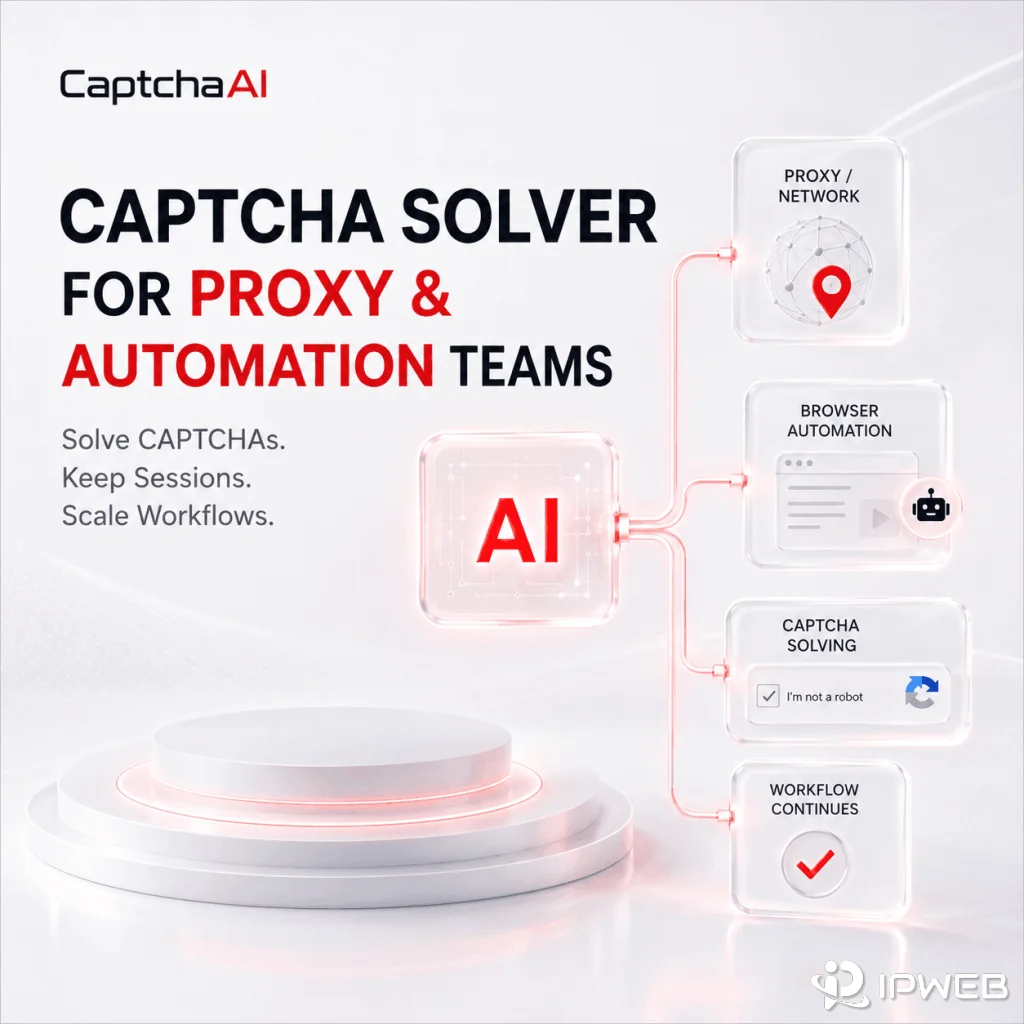
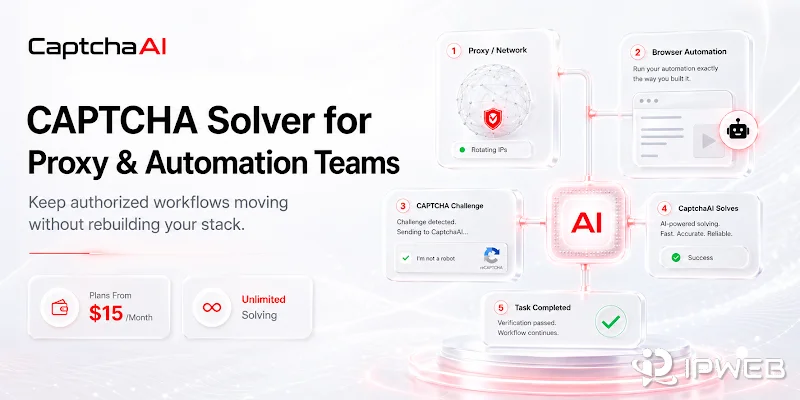
The proxy controls the network route and IP address. The automation platform manages navigation, cookies, browser actions, and task logic. CaptchaAI processes the supported CAPTCHA and returns the required result to the workflow.
By keeping these responsibilities separate, automation teams can add CAPTCHA handling to an existing infrastructure rather than replacing the tools they already depend on.
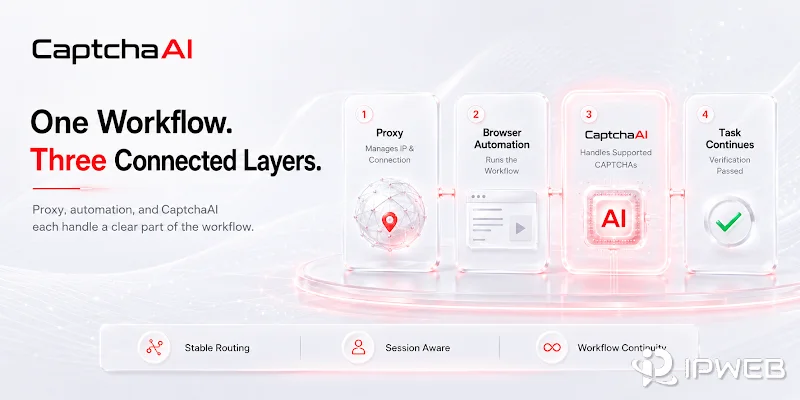
Keep the Same Session When IP Matching Is Required
Some browser-based challenges are connected to the IP address and session that originally loaded the page. In these cases, changing the proxy, cookies, User-Agent, or browser context before applying the result may cause the target website to reject it.
CaptchaAI supports HTTP, HTTPS, SOCKS4, and SOCKS5 proxies for compatible workflows. Authentication can be handled through IP allowlisting or username-and-password credentials. Proxy functionality is disabled by default and must be enabled through CaptchaAI support.
Proxy use is currently supported for reCAPTCHA v2, while the official proxy documentation states that reCAPTCHA v3 should not be submitted through a proxy.
The practical rule is simple: when a challenge requires IP matching, keep the proxy and browser session consistent from the moment the CAPTCHA appears until the result is applied.
Connect CaptchaAI to the Tools You Already Use
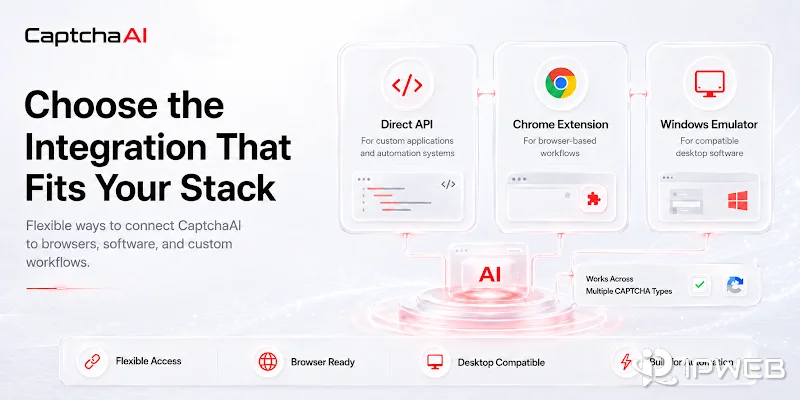
Automation teams do not all work through the same environment, so CaptchaAI provides several integration options.
Direct API
The API is suitable for custom scripts, SaaS platforms, backend services, task queues, browser automation systems, and internal tools. Developers remain in control of submission, result retrieval, retries, logging, and concurrency.
Chrome Extension
For browser-based workflows, the CaptchaAI extension can detect and process supported CAPTCHAs directly inside Chrome. This is useful when the workflow is managed primarily through browser profiles rather than a custom backend.
Windows Emulator
The CaptchaAI Emulator provides a compatibility layer for supported Windows applications that already work with other CAPTCHA-solving services. It allows teams to route compatible requests through CaptchaAI without rebuilding the application’s CAPTCHA module.
Handle Different CAPTCHA Families Through One Account
A proxy workflow may encounter an image CAPTCHA on one website, reCAPTCHA on another, and a Cloudflare or GeeTest challenge elsewhere.
CaptchaAI supports normal image and text CAPTCHAs, Grid Image, reCAPTCHA v2 and v3 variants, reCAPTCHA Enterprise, Cloudflare Turnstile, Cloudflare Challenge, GeeTest v3, BLS CAPTCHA, CaptchaFox, Friendly Captcha, and Lemin. Its documentation also lists support for more than 27,500 image-based CAPTCHA formats.
Using one account for multiple supported CAPTCHA families helps teams avoid maintaining separate integrations, balances, and providers for every project.
Scale by Concurrent Workload, Not Total Solve Volume
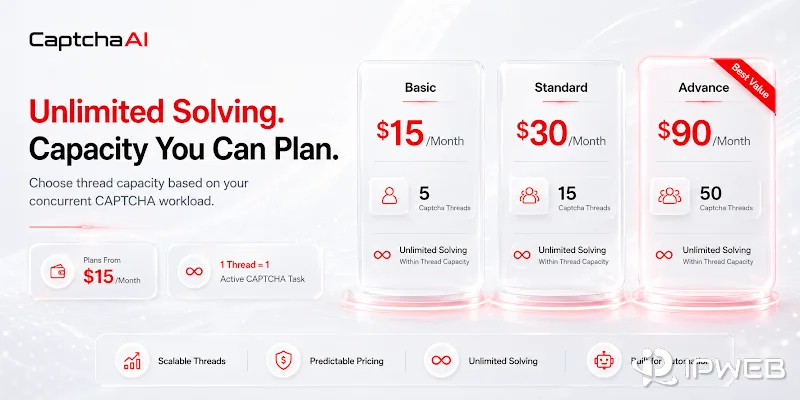
CaptchaAI uses thread-based subscriptions instead of charging separately for every completed CAPTCHA.
One Captcha Thread handles one active task at a time. Once that task is completed, the thread becomes available for the next request. Every plan includes unlimited CAPTCHA solving within the selected thread capacity, with no daily solve limit.
Current entry plans include:
- Basic: $15/month — 5 Captcha Threads
- Standard: $30/month — 15 Captcha Threads
- Advance: $90/month — 50 Captcha Threads
Larger plans provide 100, 150, 200, or up to 5,000 concurrent threads for higher-volume workloads.
Unlimited solving refers to the total number of tasks that can be processed during the subscription. The thread count still controls how many CAPTCHA tasks can run simultaneously.
For automation teams, this makes capacity easier to plan: choose a plan around peak concurrency rather than trying to predict the total number of CAPTCHAs that may appear throughout the month.
Test the Complete Workflow Before Scaling
New users can start with a three-day free trial that includes five concurrent threads and unlimited solving within that capacity. The trial can be used to test CAPTCHA coverage, proxy compatibility, session handling, integration behavior, and real peak concurrency before moving to a paid plan.
A reliable automation setup depends on every component performing the right role:
- The proxy maintains the connection.
- The automation platform executes the task.
- CaptchaAI handles supported CAPTCHA challenges.
Start with CaptchaAI
Free three-day trial: https://captchaai.com/trial
Join the CaptchaAI Community
Telegram: https://t.me/+C1iW_dYUsC41NjM8
Discord: https://discord.gg/HKSDdkGqSK
This type of workflow should only be used in owned, client-authorized, or contractually permitted environments.