
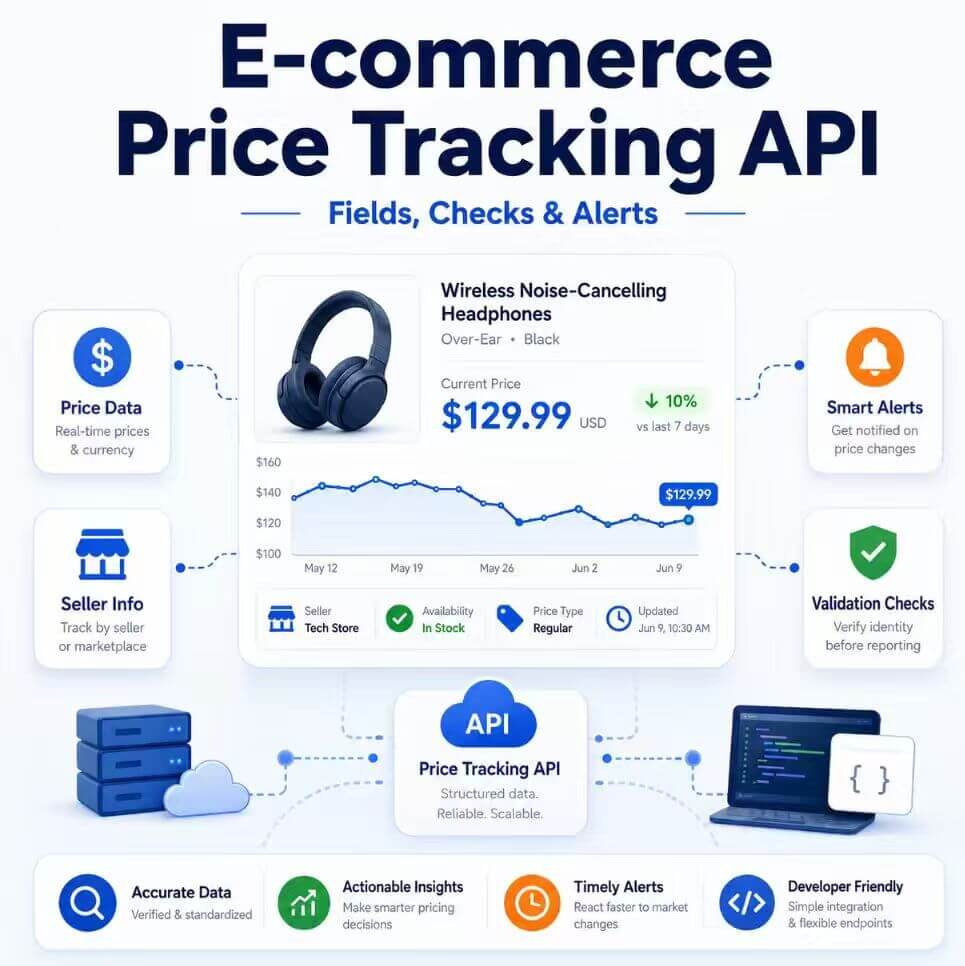
Price tracking sounds simple until the same product has multiple sellers, variants, discounts, shipping rules, currency formats, coupon states, and regional availability. A useful price tracking API does more than return a number. It preserves enough context to explain exactly what was observed.
An e-commerce price tracking API should return product identity, canonical URL, price, currency, seller, availability, shipping context, promotion state, timestamp, and source metadata. Reliable tracking also requires validating that each price belongs to the correct product variant, seller, region, and page state.
- A price without product, seller, region, currency, and timestamp context is weak evidence.
- Product matching matters as much as price extraction.
- Official APIs, scraping APIs, custom scrapers, and manual QA serve different roles.
- Shipping, tax, coupon, subscription, and membership conditions should remain separate fields.
- Regional proxies support cross-location public-page testing, although IP geolocation alone cannot confirm the final price.
What a Price Tracking API Needs to Return
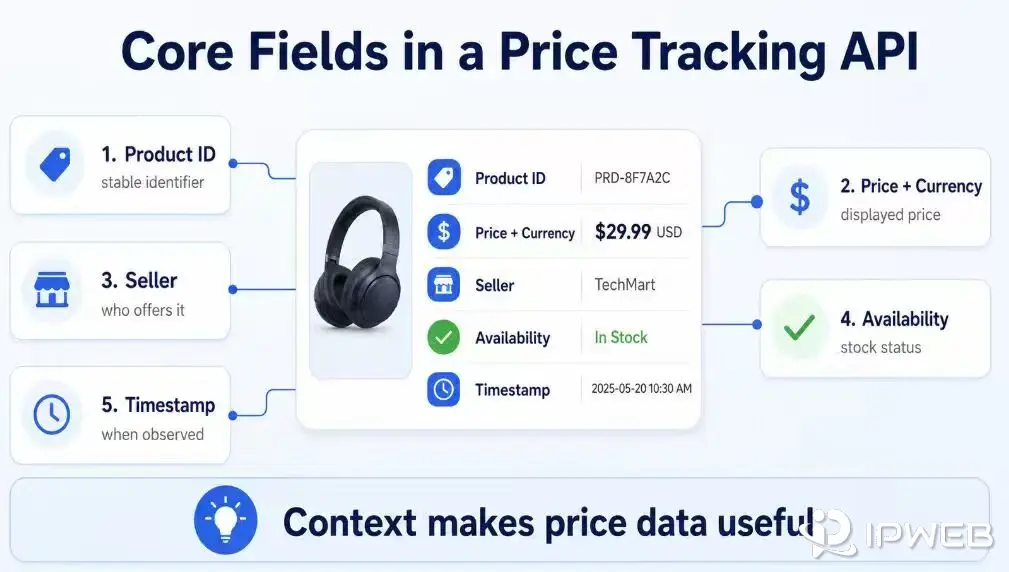
A reliable price tracking API should return enough information for a person or system to identify the exact product offer and compare it with a later observation. The schema should distinguish the product from the seller-specific offer, because one item may have several merchants, conditions, shipping options, or promotion states.
| Field | Why it matters | Example check |
|---|---|---|
| Product identifier | Prevents comparisons between different products or variants | Store SKU, ASIN, GTIN, MPN, or a stable internal ID |
| Requested and canonical URL | Preserves the source page after redirects or tracking parameters | Store both the requested URL and the final canonical product URL |
| Variant attributes | Separates size, color, pack quantity, condition, and configuration | Confirm the selected attributes before comparing two records |
| Price and currency | Supports consistent regional and historical comparisons | Store a numeric amount and an ISO currency code |
| Seller or merchant | Prevents seller changes from being reported as product price changes | Store the seller ID, display name, and offer condition |
| Availability | Explains missing, delayed, or changed prices | Use states such as in stock, out of stock, preorder, or unavailable |
| Shipping and tax context | Prevents incomplete comparisons of the final payable amount | Record whether shipping and tax are included, excluded, or unknown |
| Promotion state | Distinguishes base prices from coupons, subscriptions, bundles, and member offers | Store promotion type, eligibility conditions, and displayed expiration |
| Region and delivery context | Explains location-dependent prices, inventory, and shipping estimates | Keep country, delivery region, postcode state, and language when permitted |
| Timestamp | Makes change detection and freshness checks possible | Store the observation time in UTC |
| Source and validation status | Makes incomplete or uncertain observations visible | Keep source type, response state, parsing confidence, and validation result |
Product and offer fields should remain distinct. The Schema.org Product type describes the item, while the Offer type represents seller-specific details such as price, availability, shipping, and offer conditions. Official commerce APIs may use different field names, but the same separation is useful in a monitoring database.
A Practical Response Structure
The exact schema depends on the source, but a normalized response can follow this pattern:
{
  "product_id": "SKU-4832-BLUE-M",
  "canonical_url": "https://example.com/products/sku-4832",
  "variant": "Blue / Medium",
  "seller": {
    "id": "seller-27",
    "name": "Example Store"
  },
  "price": {
    "amount": 29.99,
    "currency": "USD",
    "type": "sale",
    "shipping_included": false
  },
  "availability": "in_stock",
  "promotion": {
    "type": "coupon",
    "eligibility": "public"
  },
  "region": "US-CA",
  "observed_at": "2026-07-28T09:30:00Z",
  "validation_status": "verified"
}
Do not replace missing information with assumptions. Use explicit values such as null, unknown, or not_displayed so downstream reports can distinguish missing data from a genuine zero value.
Use consistent enum strings instead of free-text values for status fields in production so validation logic remains predictable across records.
Why Product Matching Is the Core Problem
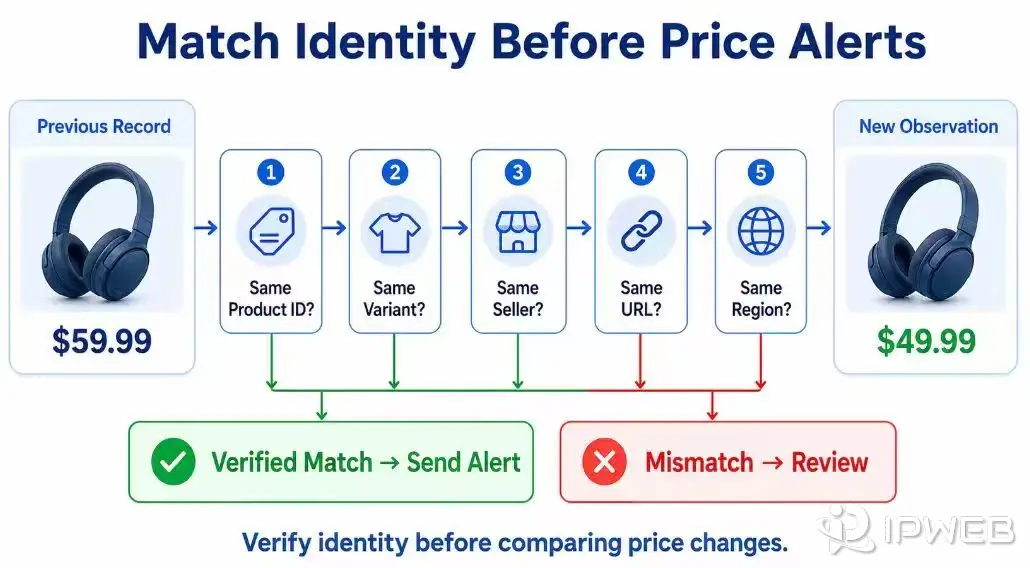
Price changes are meaningful only when the workflow compares the same product state. A title can change, a different size may become selected by default, a marketplace can switch the featured seller, and a product URL can redirect to another model or bundle.
Use the strongest identifiers available. A GTIN, MPN, SKU, ASIN, or stable product ID is normally more dependable than a title alone. Variant attributes should still be stored because one identifier may represent a family of selectable options rather than one exact offer.
The API should also expose matching confidence and the reason for uncertainty. If Monday's record and Tuesday's record cannot be linked to the same product variant and seller, the price difference should be marked as unverified instead of triggering an automatic alert.
API, Scraper, or Manual QA?
An official API or partner feed is usually the cleanest source when it provides the fields, coverage, and usage rights the workflow needs. For example, the Google Merchant API product documentation treats product identifiers, price, availability, and product status as structured resources that can be updated or retrieved programmatically.
A third-party scraping API or custom scraper is useful when the required evidence exists only on permitted public pages, such as a visible coupon, seller swap, subscription label, or delivery message. A broader explanation of the extraction and validation stages is available in IPWeb's web scraping workflow guide.
Use this source comparison to assign one primary role to each method instead of treating them as interchangeable.
| Method | Best for | Main limitation | Recommended role |
|---|---|---|---|
| Official API or feed | Supported product, inventory, and offer fields | May omit visible page-only promotions or competitor data | Primary source when coverage is sufficient |
| Third-party scraping API | Normalized observations from permitted public product pages | Depends on page state, rendering, and source rules | Scalable source for page-level fields |
| Custom page scraper | Source-specific extraction and custom evidence | Higher maintenance when layouts or scripts change | Use when the schema is narrow and controlled |
| Manual QA | High-impact changes, conflicts, and unusual records | Does not scale | Exception handling and sample validation |
A mature workflow may combine all four. Keep the source type, source URL, collection method, timestamp, and validation result in every record so the database never presents observed page data as if it came from an official feed.
Validation Checks Before Using Price Data
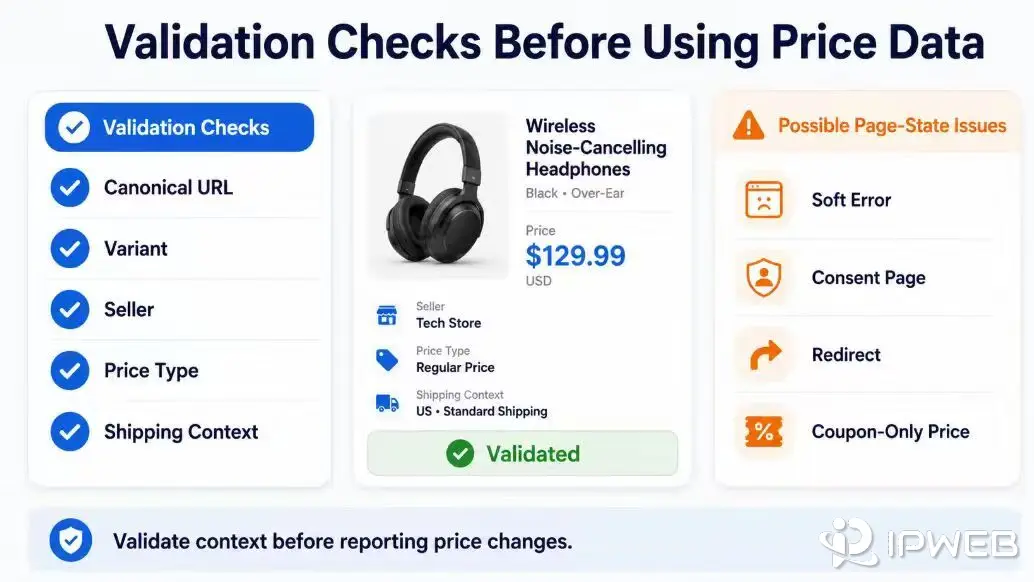
Before a price record enters reporting, validate the following conditions:
- Does the requested or canonical URL still resolve to the expected product?
- Did the selected size, color, quantity, bundle, or condition change?
- Is the seller the same merchant or marketplace offer?
- Is the currency stored as a separate normalized field?
- Is the value a base price, sale price, subscription price, member price, or coupon-adjusted price?
- Are shipping, tax, and delivery-region conditions recorded separately?
- Did the page return a consent screen, soft error, unavailable message, or redirect?
- Does an unusual price change exceed a defined validation threshold?
- Was a high-impact change rechecked against the source page or a second permitted source?
Validation rules should produce explicit outcomes such as verified, needs_review, source_unavailable, or product_mismatch. Clear states are more useful than silently accepting an incomplete price.
Price Tracking API Limits
A price tracking API can normalize observations, but it cannot guarantee that every visitor sees the same final price. The displayed amount may depend on the selected variant, seller, delivery address, account state, cookies, membership status, inventory location, taxes, and promotion eligibility.
Official APIs may omit visible coupons, shipping estimates, or marketplace offer changes. Public-page workflows have different limits, including layout changes, JavaScript rendering, consent screens, temporary errors, regional availability, and source-specific access rules.
Freshness is another limit. “Real time” should describe a measured collection interval, not an assumption that the source and database are synchronized continuously. Record the observation time and define how old a value can be before it becomes stale for the intended decision.
Treat every API response as a contextual observation rather than a universal price. Preserve the conditions behind the record and mark incomplete values as unknown instead of estimating them.
Where Proxies Fit in Regional Price Checks
Regional proxy routing can support permitted comparisons of public product pages across countries, states, and cities.
Workflows that require rotating residential routes and broad geographic coverage can use a dynamic residential proxy to supply region-specific network context for these tests.
The proxy should not be treated as proof of the final local price. A marketplace may still use the delivery postcode, account profile, cookies, language, seller inventory, tax rules, or membership status. Store those variables separately and verify the actual page state.
Proxy infrastructure also does not repair incorrect selectors, failed product matching, invalid credentials, missing fields, or source-side errors. Choose the data schema and validation rules first, then add regional routing only when the approved workflow genuinely requires it.
Common Failure Modes
False Price Changes
A system reports a price drop, but the page actually switched the product variant, featured seller, region, quantity, or stock state. Require identity and offer checks before generating an alert.
Incomplete Final-Price Context
A dashboard stores $29.99 without recording whether shipping is excluded, tax is calculated later, or the amount requires a subscription or coupon. Keep each component separate.
Successful Response, Wrong Page
A normal HTTP response may contain a consent page, unavailable notice, login prompt, regional landing page, or soft error. Validate the final URL, expected product fields, and page state rather than relying on the status code alone.
Unexplained Missing Data
Good APIs make uncertainty visible. They return the source URL, response state, validation status, parsing confidence, and error reason instead of silently storing an empty or weak number.
Frequently Asked Questions
Final Thoughts
A dependable price tracking API is a product-and-offer validation system, not merely a price extractor. The record must explain which product, variant, seller, region, promotion, and page state produced the value.
Define the schema first, keep sources separate, expose uncertainty, and validate high-impact changes before they reach an alert or dashboard. When every price includes its context, the data becomes suitable for decisions rather than just collection.