
Raw web pages are rarely ready for retrieval-augmented generation, structured extraction, or model evaluation. Navigation, cookie banners, repeated templates, JavaScript-loaded content, missing metadata, and inconsistent page structures all create noise before the content reaches an AI system.
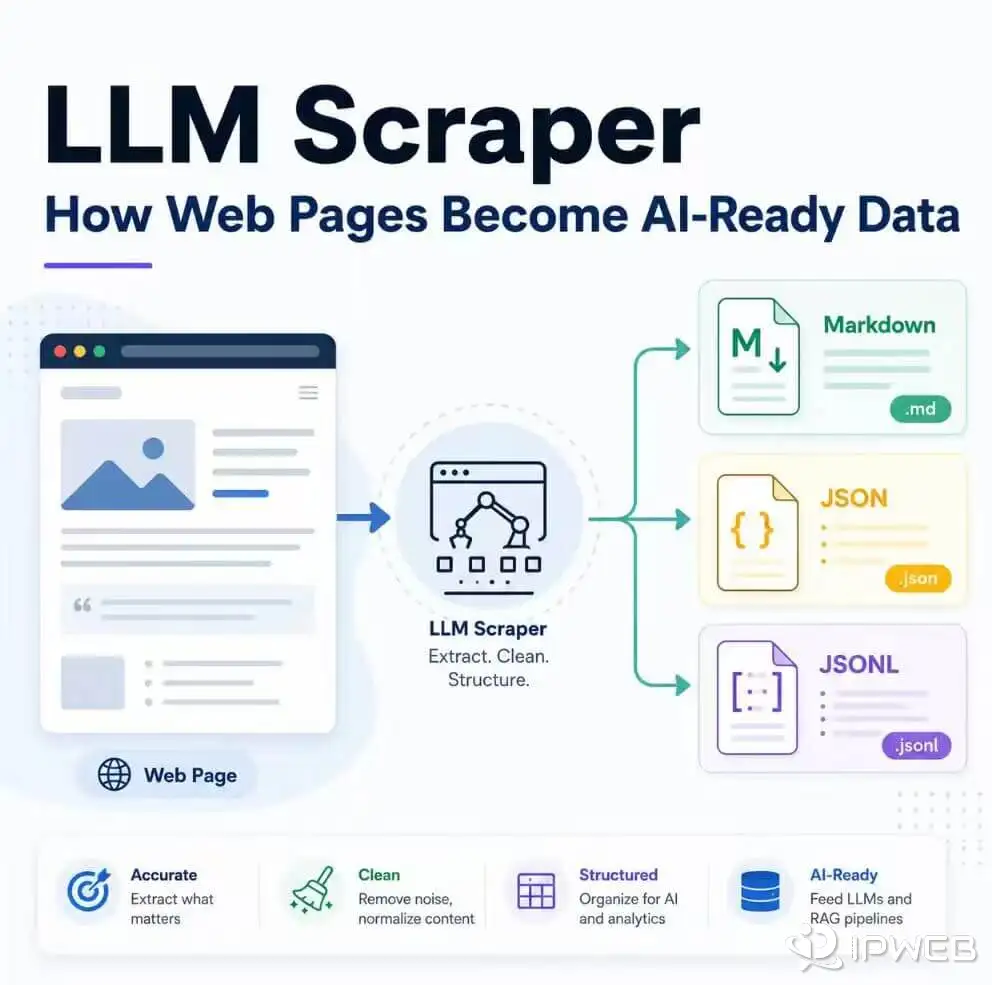
An LLM scraper addresses that gap. The term is informal rather than a standardized protocol, and it commonly describes either an LLM-powered extraction tool or a web-content pipeline that prepares source-grounded data for downstream large language model applications.
An LLM scraper collects web content and transforms it into cleaner, structured input for AI workflows. Some implementations use an LLM to identify or normalize fields, while others use conventional scraping and parsing before converting the result into Markdown, JSON, JSONL, or document chunks. The useful output is not simply “text for an AI”; it is validated content with preserved source context, predictable structure, and a clear downstream purpose.
- “LLM scraper” may refer to LLM-assisted field extraction or to a pipeline that prepares scraped content for LLM applications.
- A reliable workflow separates page retrieval, rendering, extraction, normalization, metadata capture, chunking, and validation.
- Markdown is useful for readable document ingestion, while JSON or JSONL is better when a fixed schema matters.
- LLM extraction can handle semantic variation, but deterministic selectors remain useful for stable, repeatable fields.
- Scraping tools do not decide whether collection is permitted; source rules, privacy obligations, and intended use still require review.
What Is an LLM Scraper?
An LLM scraper is best understood as a workflow category, not one fixed technical architecture. It usually combines ordinary web scraping components with an AI-oriented output layer.
One implementation may fetch a page, remove boilerplate, preserve headings, and return Markdown for a RAG system. Another may send page content to a language model with a schema and receive structured product, company, or article fields. A third may use a hybrid approach: selectors handle stable elements, while an LLM interprets fields whose wording or layout changes across sources.
The distinction matters because the label alone does not tell you how the data was collected, whether JavaScript was rendered, which parts were generated by a model, or how the result was validated. Those details determine whether the output is reliable enough for production use.
How Web Pages Become AI-Ready Data
A dependable LLM-scraping pipeline turns a page into AI-ready data through a sequence of testable stages. Skipping a stage may produce content that looks clean but is incomplete, duplicated, wrongly attributed, or difficult to retrieve later.
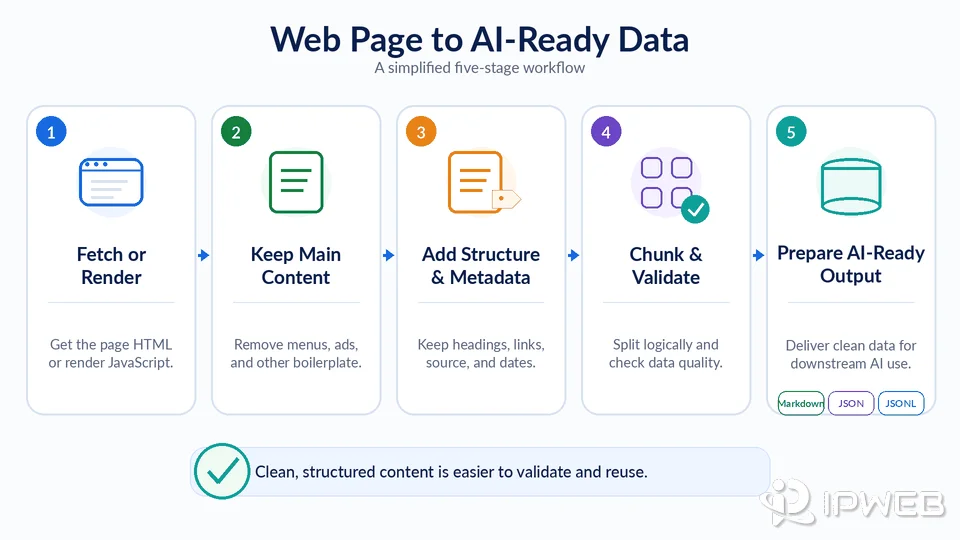
- Retrieve or render the page. Start with a normal HTTP response when possible. Use browser rendering only when required content appears after JavaScript runs.
- Select the main content. Remove navigation, cookie notices, repeated sidebars, related-content blocks, and other page elements that do not belong in the target record.
- Preserve useful structure. Keep headings, paragraphs, lists, links, tables, and section order so the output still reflects the source document.
- Normalize the record. Standardize whitespace, dates, currencies, field names, encodings, and empty values without silently changing the source meaning.
- Attach source metadata. Record the source URL, canonical URL when available, title, capture time, language, region context, and parser version.
- Chunk and deduplicate. Divide long documents at meaningful boundaries, preserve enough local context, and prevent repeated templates or duplicate URLs from entering the index.
- Validate and store. Check required fields, content completeness, source attribution, and parser behavior before the record reaches a vector store, database, or evaluation set.
When retrieval and JavaScript rendering are the main infrastructure bottlenecks, the IPWeb Web Scraping API can provide a hosted collection layer. The downstream team still owns parsing rules, metadata design, chunking, validation, and the permitted use of the collected data.
LLM Extraction vs Traditional Parsing
LLM extraction is not automatically better than CSS selectors, XPath, regular expressions, or embedded structured data. The better method depends on how stable the page is, how precise the schema must be, and how much variation exists across sources.
| Method | Best fit | Main strength | Main limitation |
|---|---|---|---|
| Selectors or rules | Stable pages with known fields | Fast, deterministic, and easy to test | Breaks when structure changes |
| LLM extraction | Semantically similar content with varied layouts | Can map different wording into one schema | Higher cost and less deterministic output |
| Hybrid workflow | Production pipelines with mixed page types | Uses rules for stable fields and an LLM for ambiguous content | Requires clear routing and validation logic |
Use deterministic extraction for identifiers, prices, dates, canonical URLs, and fields already exposed in structured data when those sources are reliable. Use an LLM when the task requires semantic interpretation, such as classifying a product description, mapping varied job titles into categories, or extracting a summary from differently structured articles.
For schema-based model extraction, validate the returned object against the expected field types and required properties. A syntactically valid JSON response can still contain a wrong source value, a missing field, or a model-generated interpretation that was not present on the page.
Output Formats That Matter
The best output format depends on what the downstream AI system will do with the record. Tools such as Firecrawl expose formats including cleaned Markdown and structured JSON, which reflects the two most common output paths: document-oriented ingestion and schema-oriented extraction.
| Output | Best for | What to preserve | What to validate |
|---|---|---|---|
| Clean text | Simple classification or analysis | Main readable content | Boilerplate removal and encoding |
| Markdown | RAG, documentation, and knowledge bases | Headings, links, lists, tables, and section order | Broken structure and missing source metadata |
| JSON | Structured extraction and application logic | Named fields, types, and null handling | Schema validity and source-field accuracy |
| JSONL | Batch evaluation, training preparation, and large record sets | One consistent record per line | Duplicate IDs and inconsistent schemas |
| Raw HTML | Auditing and later reprocessing | Original response and page structure | Storage size, scripts, and sensitive content |
Raw HTML is valuable as an audit artifact, but it is usually too noisy for direct retrieval. Clean output should still retain a path back to the source so a reviewer can verify what the model or parser received.
HTML-to-Markdown and JSON Example
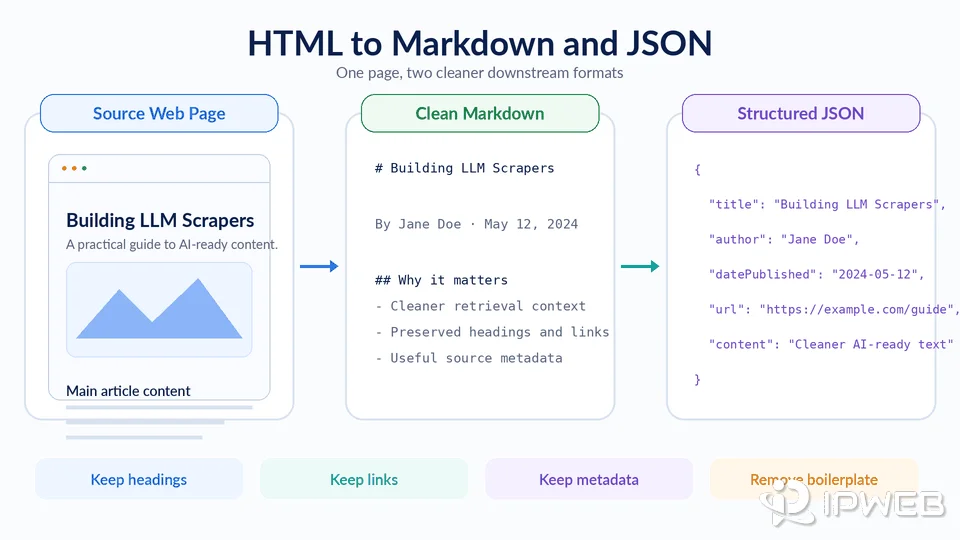
Consider a public article page containing navigation, a title, publication metadata, body text, related links, and a footer. The AI-ready version should keep the meaningful content and provenance while excluding repeated layout elements.
Source HTML
<article>
  <h1>Quarterly Market Update</h1>
  <p class="byline">By Taylor Chen · July 30, 2026</p>
  <p>Demand increased across three regional markets...</p>
  <table>...</table>
</article>
Clean Markdown
# Quarterly Market Update

By Taylor Chen · July 30, 2026

Demand increased across three regional markets...

| Region | Change |
|---|---:|
| North | 8% |
Structured JSON
{
  "source_url": "https://example.com/quarterly-update",
  "title": "Quarterly Market Update",
  "author": "Taylor Chen",
  "published_at": "2026-07-30",
  "captured_at": "2026-07-30T09:15:00Z",
  "language": "en",
  "main_text": "Demand increased across three regional markets...",
  "parser_version": "article-parser-2.1"
}
The example is intentionally simple. A production record may also need canonical URL, region or language context, content hash, source-specific identifiers, validation status, and a reference to the stored raw response.
When to Use an LLM Scraper
Use an LLM scraper when the downstream system needs source-grounded documents or fields rather than raw pages. Common fits include documentation ingestion, product research, market tracking, knowledge-base construction, content classification, entity extraction, and evaluation datasets.
The approach is especially useful when multiple websites express the same concept with different labels or layouts. An LLM can help normalize those variations into a common schema, provided that the source values are retained and checked.
A conventional scraper may be the better choice when the source has a stable structure and the project needs only a few precise fields. Adding a model to a deterministic task can increase cost, latency, and debugging difficulty without improving the record.
Do not use an LLM scraper as a shortcut around source permissions, privacy obligations, account requirements, or platform restrictions. It may improve content preparation, but it does not make every collection purpose or volume acceptable.
Quality Checks Before Scale
Before scaling, test a representative sample that includes static pages, JavaScript-rendered pages, long documents, tables, duplicate templates, missing fields, redirects, and partial responses. A pipeline that works on one clean article page may fail on the less predictable pages that dominate production error rates.
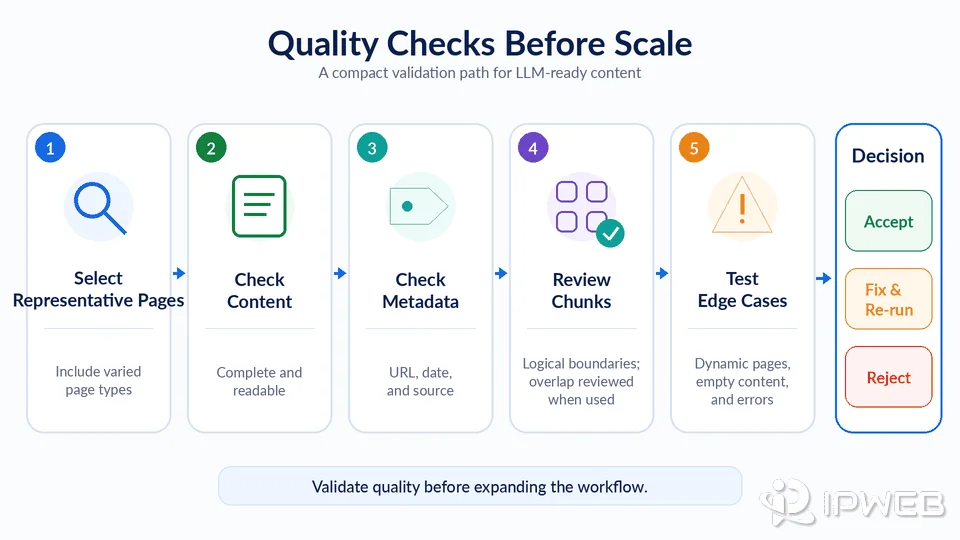
- Confirm that the returned page is the intended source rather than an error page, interstitial, or localized variant.
- Compare titles, dates, identifiers, prices, and other material fields with the visible source.
- Check that headings, lists, links, and tables remain in the correct order.
- Verify source URL, canonical URL, capture time, language, and parser version.
- Inspect chunk boundaries so definitions, headings, and supporting paragraphs are not separated unnecessarily.
- Detect duplicate pages, repeated templates, empty content, and near-identical records.
- Log whether each field came from deterministic parsing, page metadata, or LLM interpretation.
- Keep failed and low-confidence records out of the production index until reviewed.
Chunking should follow document structure rather than one universal number. A recursive splitter can prefer paragraph and sentence boundaries before smaller separators, helping related text remain together. The LangChain recursive text splitter documentation illustrates this structure-aware approach.
Measure quality against real downstream questions. A chunk is not useful merely because it fits a token limit; it should preserve enough context for retrieval, attribution, and a correct answer.
Frequently Asked Questions
Final Thoughts
An LLM scraper is valuable when it produces cleaner, more traceable, and more testable data than a basic page fetch. The strongest workflows do not treat the model as a substitute for retrieval, parsing, or validation. They assign each layer a clear job and preserve enough evidence to trace every result back to the source.
Start with the downstream task, define the output contract, and test the full path from page retrieval to final answer. AI-ready data is not simply shorter HTML; it is source-aware content with useful structure, reliable metadata, and documented quality checks.