
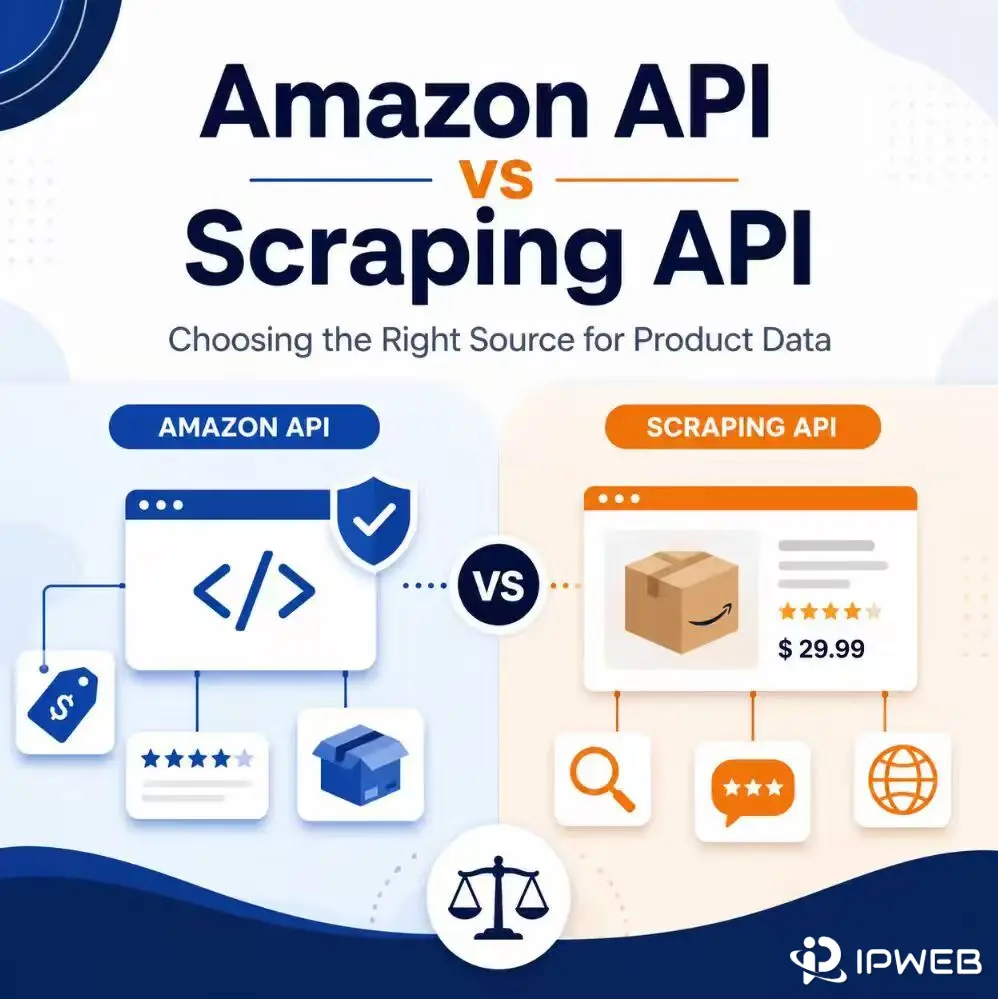
"Amazon Product API" is a broad search phrase rather than the name of one current Amazon interface. Amazon product data may come from the Creators API, Selling Partner API (SP-API), approved feeds, permitted public-page checks, or manual validation. The right source depends on who is requesting the data, which fields are needed, and what the data will support.
Use the Amazon Creators API for approved affiliate and publisher product-discovery workflows. Use SP-API for authorized seller or vendor catalog, pricing, and customer-feedback operations. Use a scraping API only for permitted public-page validation when the official interface does not provide the page-level state you need. A scraping API does not replace Amazon authorization, account access, or data-use rules.
- Amazon does not have one universal product API for every business model.
- Creators API, SP-API, customer-feedback insights, and public-page checks serve different users and data needs.
- Product Advertising API 5.0 is deprecated; current affiliate integrations should use Creators API.
- ASIN, variant, seller, marketplace, fulfillment, and timestamp context must be validated before records are compared.
- Scraping APIs and proxies may support permitted public-page QA, but they do not create authorization for restricted data.
Define the Amazon Product Data Job
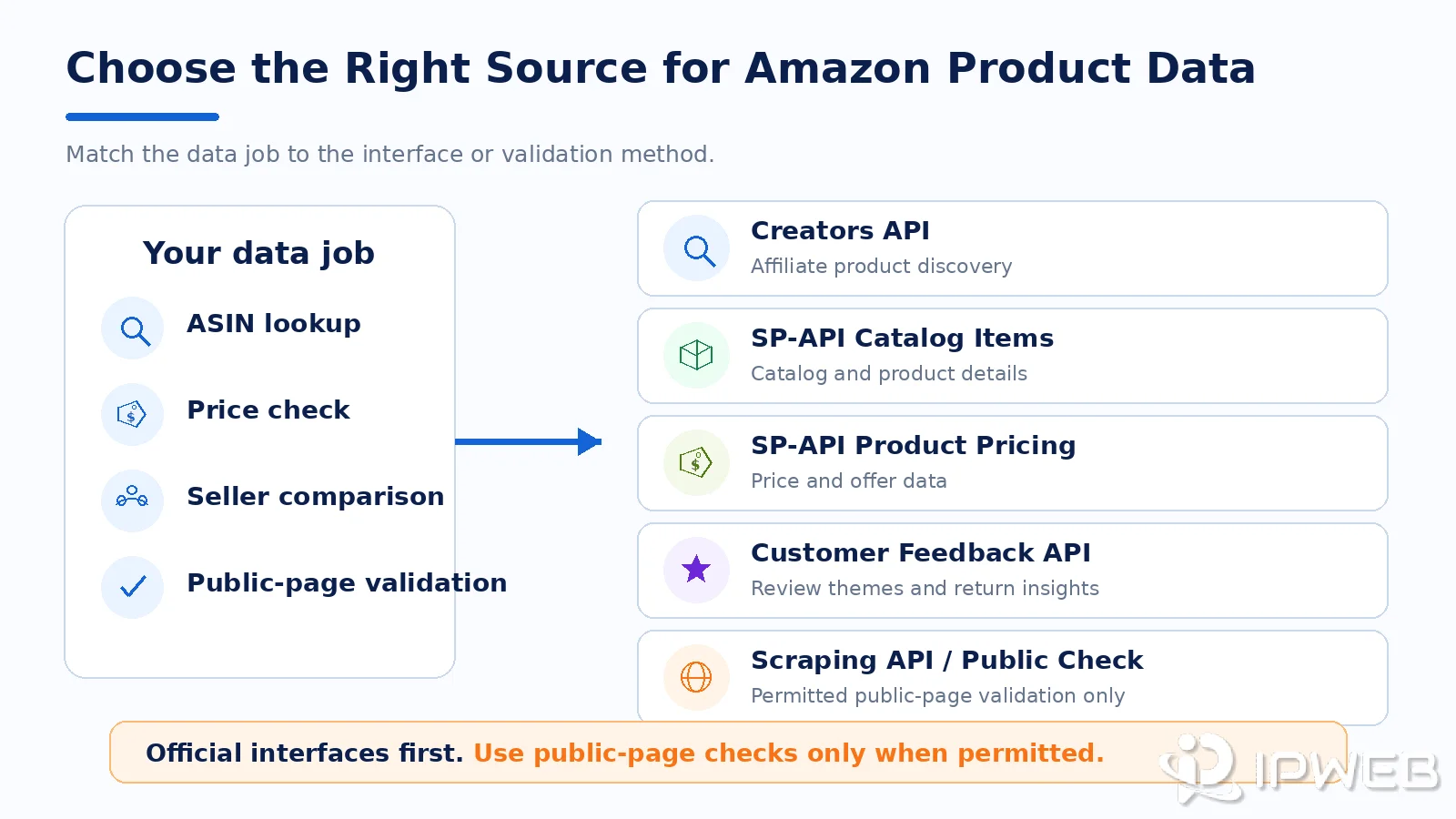
The first question is not "which Amazon API should I use?" It is "what decision will this data support?" A product-discovery page may need titles, images, offers, and affiliate links. A seller catalog workflow may need product identifiers, attributes, relationships, and marketplace context. A pricing tool may need offer-level pricing data. A review-analysis workflow may need approved topic or trend insights rather than complete review text.
Write down the required fields, target marketplace, update frequency, permitted use, and record-matching rules before choosing a source. This prevents a common mistake: selecting a tool first and then forcing incomplete data into the workflow.
Which Official Amazon API Fits?
Official Amazon interfaces are the best starting point when their intended user, permissions, and available fields match the job. The important distinction is that Amazon offers different interfaces for affiliate product discovery and seller or vendor operations.
Creators API for Affiliate Product Discovery
Amazon has deprecated Product Advertising API 5.0 and replaced it with Creators API. Creators API is designed for publishers, influencers, and affiliate partners that are building approved product-discovery experiences through the Amazon Associates program.
Its documented operations include SearchItems for keyword and category searches, GetItems for product details by ASIN or another supported identifier, GetVariations for parent-child product relationships, and GetBrowseNodes for category information. Access, display, caching, and reuse must follow the Creators API license and Amazon Associates policies.
SP-API for Seller and Vendor Operations
The Selling Partner API is intended for sellers, vendors, and applications acting with their authorization. The Catalog Items API supports catalog searches and detailed product records, including identifiers, attributes, images, relationships, and sales-ranking fields where available.
The Product Pricing API supports authorized pricing and offer workflows. It is a better fit for seller-side pricing operations than a general affiliate product API, but it still requires the correct account authorization and roles.
Customer Feedback API for Review and Return Insights
Amazon's Customer Feedback API provides approved insights derived from customer reviews and returns for supported seller and vendor workflows. It can expose review topics and trends at the ASIN or browse-node level, but it should not be described as a universal API for downloading every raw Amazon review.
This distinction matters for the supporting keyword "Amazon reviews API." A reader looking for review insights may have an official option, while a reader expecting unrestricted review text should not assume that the same access exists.
When a Scraping API or Public Check Adds Value
A scraping API or manual public-page check adds value primarily for page-level validation — it cannot act as a direct replacement for official business APIs. Examples include confirming whether a public product page is live, checking how a visible offer is presented, detecting a public layout change, validating a sampled search result, or comparing an internal record with the current public page.
These workflows should remain narrow and permission-aware. The collection method must respect the applicable terms, access controls, rate limits, privacy requirements, and data-use restrictions. For a broader explanation of extraction infrastructure, see the Web Scraping API guide. For compliance considerations, see Is Web Scraping Legal?
For repeated public-page checks, a consistent network location can make price, seller, availability, and regional comparisons easier to reproduce. In permitted workflows, static residential proxies can support stable regional QA, while rotating proxies are generally more suitable for broader sampling across many products or locations.
Amazon Product Data Sources Compared
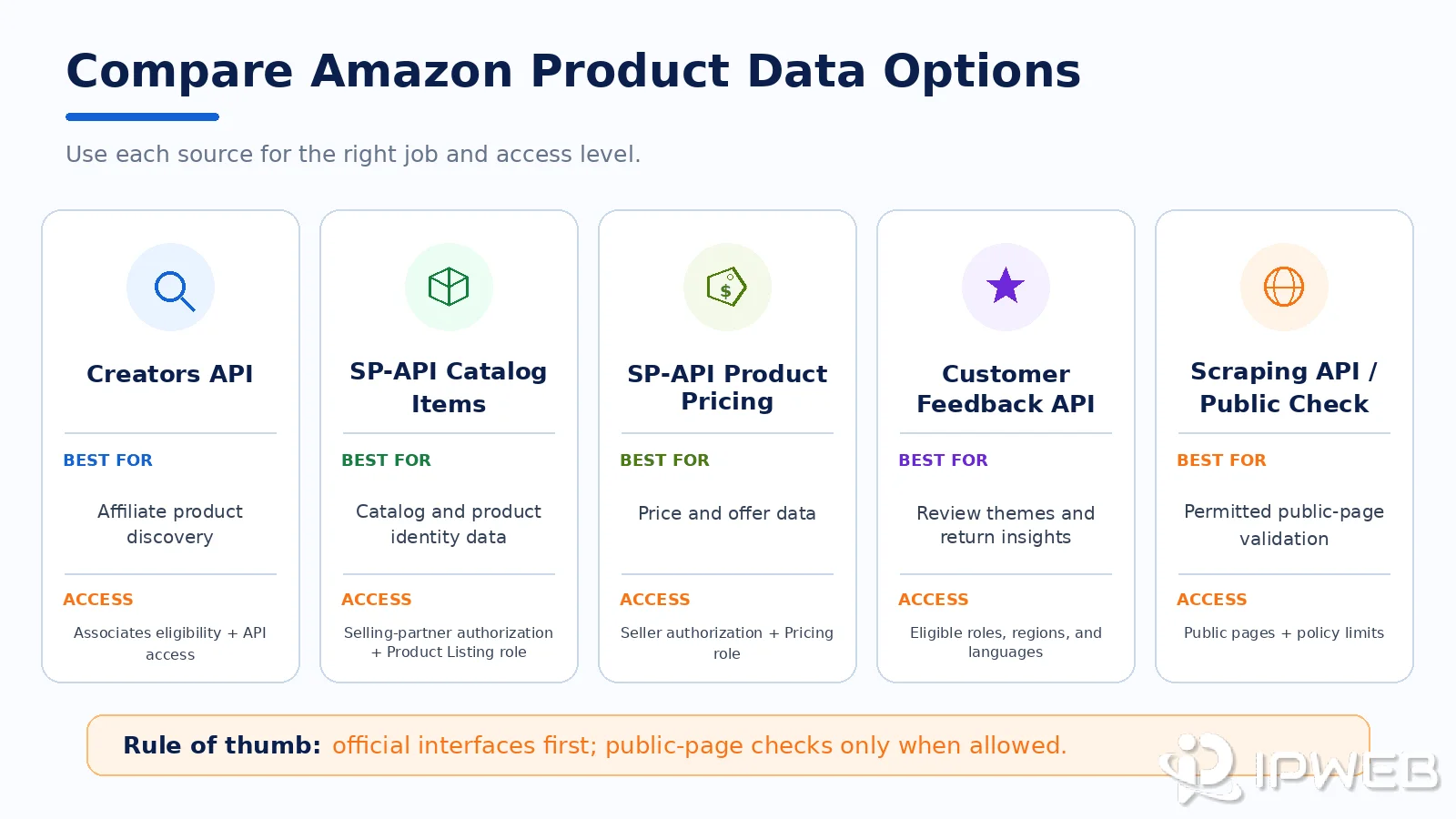
| Source option | Intended user | Best for | Main constraint | Good fit example |
|---|---|---|---|---|
| Amazon Creators API | Associates, publishers, influencers, and affiliate partners | Product search, ASIN lookup, item details, offers, variations, and categories | Program eligibility, license terms, supported resources, and display rules | Building an approved affiliate product-discovery experience |
| SP-API Catalog Items | Authorized sellers, vendors, and their applications | Catalog matching, product identifiers, attributes, images, and relationships | Selling-partner authorization and required application roles | Matching an internal SKU to an Amazon catalog item |
| SP-API Product Pricing | Authorized seller applications | Marketplace pricing and offer information | Seller authorization, API roles, quotas, and marketplace scope | Supporting an approved seller repricing workflow |
| Customer Feedback API | Supported sellers and vendors | Review topics, review trends, and return insights | It provides structured insights rather than unrestricted raw review exports | Finding recurring review themes for an ASIN |
| Scraping API or public-page check | Permitted public research and QA workflows | Visible page-state validation and sampled public comparisons | Layout changes, incomplete context, access rules, and data-use limits | Confirming whether a sampled public product page changed |
| Manual QA | Analysts and operations teams | High-impact exception review | Slow and difficult to scale | Confirming a surprising seller, variant, or price mismatch |
Validation Checks for Amazon Product Data
Amazon data workflows are especially sensitive to identity mistakes. Two records can display the same product name while referring to different variants, sellers, marketplaces, conditions, or fulfillment states.
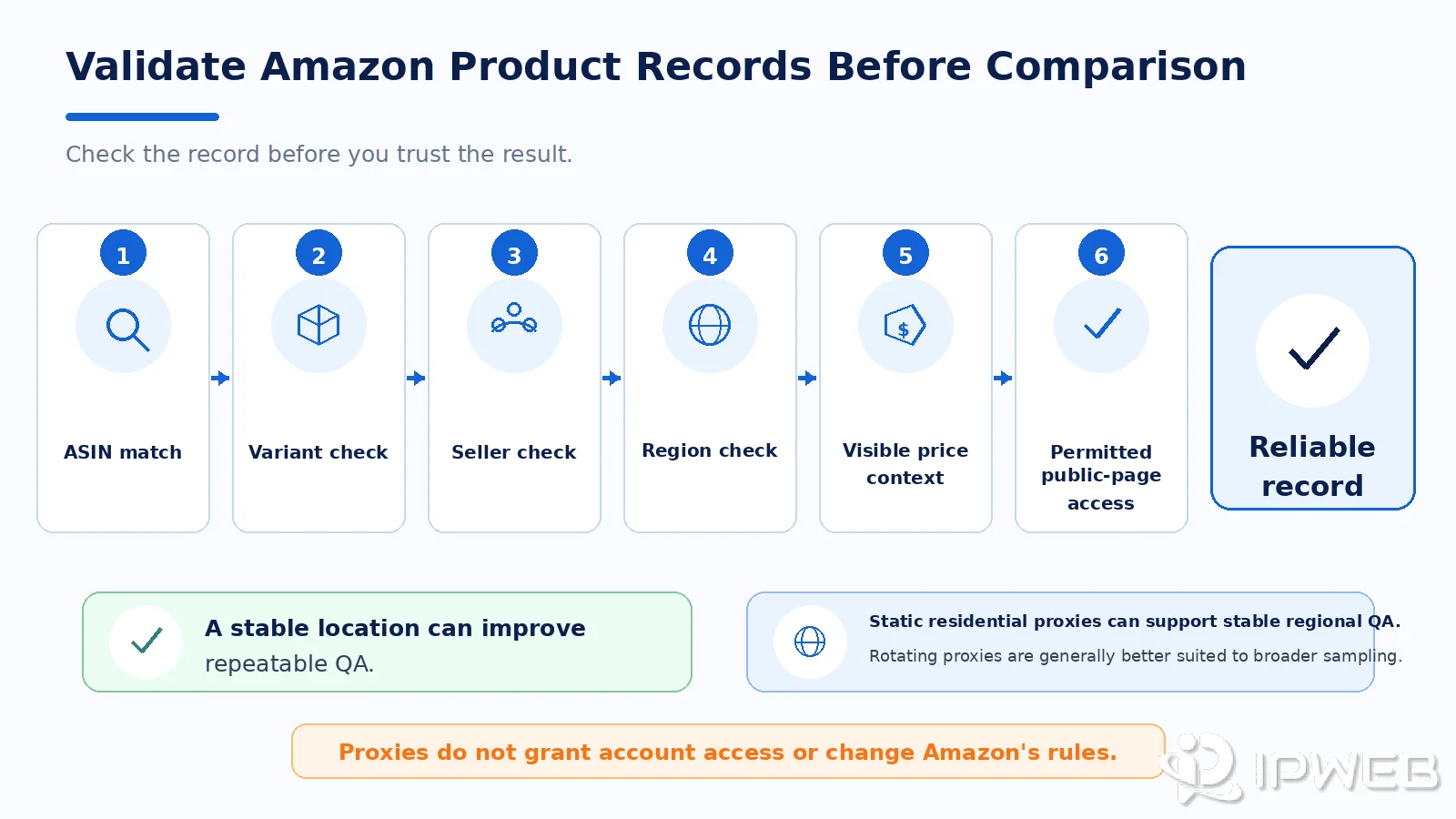
Before using or comparing a record, check:
- Does the ASIN or product identifier match the intended item?
- Is the record tied to the correct Amazon marketplace?
- Did the selected size, color, bundle, pack count, or child ASIN change?
- Is the seller, condition, or fulfillment method the same?
- Is the visible price affected by a coupon, membership state, shipping cost, or delivery location?
- Was the record collected recently enough for the decision it supports?
- Is the page public without restricted account context?
- Does the collection and reuse method comply with the relevant API, marketplace, and source terms?
For pricing or offer comparisons, store at least the ASIN, marketplace, child variant, seller or offer identifier, condition, fulfillment state, visible price components, currency, and timestamp. A price without this context may not describe the same purchasable offer.
Frequently Asked Questions
Final Thoughts
Amazon product data should follow a clear source hierarchy. Start with Creators API for approved affiliate product discovery or SP-API for authorized seller and vendor operations. Add permitted public-page validation only when an official interface does not answer the page-level question, and use manual review for high-impact exceptions.
The most reliable workflow is not the one that collects the most fields. It is the one that preserves product identity, marketplace context, source permissions, and timestamps well enough to support the intended decision.