
Imagine planning a June product release around a model that appeared to be only weeks away. The integration work is ready, the evaluation schedule is set, and customers are waiting—then the model enters a restricted preview, disappears after launch, or misses its expected release window.
That scenario became unusually relevant in June 2026. OpenAI was preparing GPT-5.6, Anthropic had released Claude Fable 5 and Claude Mythos 5, and Google had said Gemini 3.5 Pro would follow the launch of Gemini 3.5 Flash.
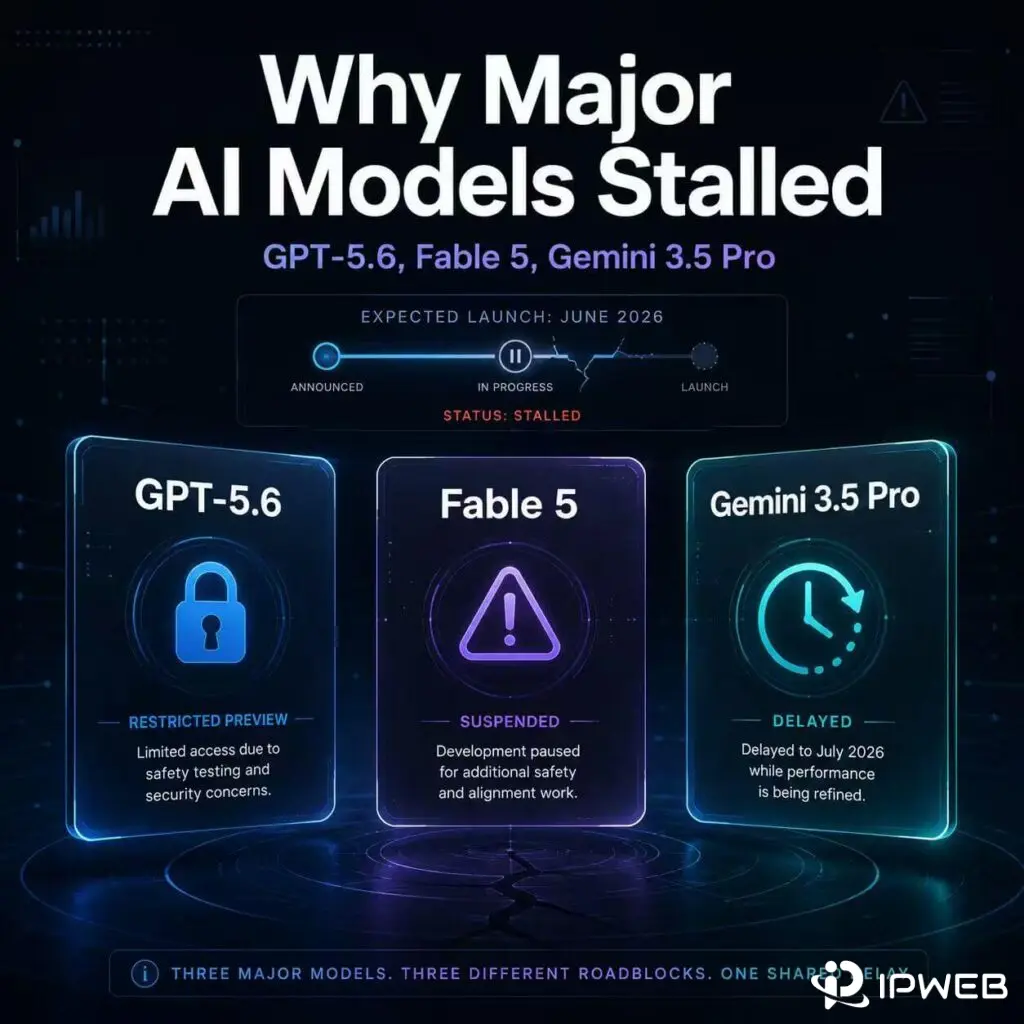
By June 26, none of those releases had unfolded as developers expected. GPT-5.6 was reportedly moving into a restricted preview rather than a broad launch. Anthropic's two new models had been taken offline only three days after release. Gemini 3.5 Pro had not arrived within Google's original June window.
The timing made the events look connected, but their causes were different. OpenAI faced reported government scrutiny before wider distribution. Anthropic responded to an export-control directive after its models had already launched. Google appears to have kept Gemini 3.5 Pro in development for further testing.
The three cases expose a growing gap between building a powerful model and making it available as a dependable product. A model can perform well in testing and still remain out of reach because the provider is not ready—or not permitted—to place it in users' hands.
- GPT-5.6 was not reported as cancelled. Its initial availability was reportedly narrowed to selected partners.
- Fable 5 and Mythos 5 were released before being suspended. Their disappearance was not a conventional product delay.
- Gemini 3.5 Pro remained in development. Google confirmed its original June window but had not announced a replacement date by June 26.
- AI startups may face higher launch and compliance costs. Uncertain access can force teams to repeat evaluations, maintain backup integrations, and revise customer timelines.
- Changing an IP address cannot restore model-level access. Availability depends on the provider, the account, and the relevant access rules.
- 1. Why June Became a Test for Frontier AI Releases
- 2. GPT-5.6 Moves Toward a Limited Preview
- 3. Fable 5 and Mythos 5 Launch, Then Disappear
- 4. Gemini 3.5 Pro Remains in Development
- 5. Three Models, Three Different Obstacles
- 6. What Developers Should Take From the Delays
- 7. What Network Infrastructure Can and Cannot Do
- 8. Frequently Asked Questions
1. Why June Became a Test for Frontier AI Releases
The expectation of a crowded June release window developed from several separate signals rather than one coordinated industry schedule.
Anthropic moved first, introducing Fable 5 and Mythos 5 on June 9. Google had already said that Gemini 3.5 Pro would follow Gemini 3.5 Flash the next month. OpenAI had not published a firm date for GPT-5.6, but reports about an approaching release intensified during June.
For users, the story seemed straightforward: three leading AI companies were preparing major upgrades at roughly the same time. What that narrative missed was the number of decisions between a successful internal model and a public service.
Before a frontier model reaches ordinary users, the provider must evaluate its behavior, prepare serving capacity, define API limits, establish access rules, and decide whether the product is ready for large-scale use. Legal or government review may change that process even after the technical work is largely complete.
This is why leaked names, benchmark appearances, and early-access screenshots can be misleading. They may show that a model exists, but they do not establish when ordinary customers will be able to use it reliably.
2. GPT-5.6 Moves Toward a Limited Preview
GPT-5.6 remains the least publicly documented of the three models. As of June 26, 2026, OpenAI had not published a formal product announcement, pricing structure, or date for general API access.
On June 25, Reuters reported that the U.S. administration had asked OpenAI to stagger the release of its newest model because of security concerns.
According to the report, OpenAI CEO Sam Altman told employees that GPT-5.6 would first be offered to selected partners through a limited preview. Early access would reportedly be reviewed customer by customer, with government offices involved in the process.
That arrangement would narrow the model's first stage of distribution without cancelling it.
Private access does not equal a public launch
A limited preview gives a small number of organizations early access under conditions that may change. General availability normally comes later, with public documentation, defined pricing, published limits, and a clearer commitment to production support.
| Release Stage | Who Typically Has Access | What It Means for Developers |
|---|---|---|
| Internal Testing | Employees and controlled evaluators | The model is not a public product. |
| Limited Preview | Selected partners or approved organizations | Access may be temporary and subject to review. |
| Public Preview | A broader developer audience | Pricing, behavior, and limits may still change. |
| General Availability | Eligible customers under published terms | The service is intended for wider production use. |
OpenAI had not announced GPT-5.6 pricing, regional availability, context limits, or a date for broad API access by June 26. Developers should therefore treat specific launch dates and configurations circulating online as unconfirmed until they appear in official documentation.
3. Fable 5 and Mythos 5 Launch, Then Disappear
Anthropic's situation followed a very different sequence because its models had already reached customers.
In its June 9 launch announcement, Anthropic introduced Claude Fable 5 as a general-use model with the company's safeguards in place. Claude Mythos 5 used the same underlying model but was available only to a smaller group of approved cybersecurity and critical-infrastructure partners.
Fable 5 became available through the Claude API and selected Claude subscription plans. Mythos 5 entered a controlled access program. Three days later, Anthropic suspended both models.
In a statement published on June 12, the company said it had received a U.S. government export-control directive concerning access by foreign nationals. Anthropic said the directive also applied to foreign-national employees working inside the United States.
Because of the way the restriction was written, Anthropic said it had to disable the models for all customers while working to comply. Its other Claude models remained available.
This was not a launch that slipped by a few weeks. The models were announced, deployed, and then withdrawn after an external decision changed the conditions under which they could be used.
The episode also shows why a provider-level suspension cannot be reduced to an IP-location problem. Our earlier explanation of why proxies cannot restore Fable 5 or Mythos 5 access examines the difference between network routing, account authorization, and model availability.
The security dispute remains unresolved
Anthropic said it understood the government's concern to involve a method for bypassing some Fable 5 safeguards. The company argued that the demonstrated technique exposed only a small number of previously known and relatively minor vulnerabilities.
It also said that its own pre-release testing had not identified a universal jailbreak capable of removing the model's protections across a broad range of tasks.
The disagreement remains unresolved. What the public record does show is that bypassing a safeguard in a narrow test is not necessarily the same as defeating the model's entire safety system.
4. Gemini 3.5 Pro Remains in Development
Google's schedule change appears closer to a conventional software delay.
When Google introduced the Gemini 3.5 family on May 19, it made Gemini 3.5 Flash available across several products. In its official announcement, the company said Gemini 3.5 Pro was already being used internally and was expected to roll out the following month.
That created an official June window, although Google did not provide a specific launch date.
On June 24, Business Insider reported that the target had moved to July. The report said Google wanted more time to collect feedback from early testers and make further adjustments.
Feedback from Gemini 3.5 Flash, including concerns about token consumption, was also reportedly informing the Pro version. Google declined to comment on the revised schedule.
As of June 26, Google had confirmed the original June expectation but not the reported July date. There was no indication that Gemini 3.5 Pro had been cancelled or restricted by a government order. The available evidence pointed to a product that remained under active development.
5. Three Models, Three Different Obstacles
Their release paths diverged at different stages.
| Model | Status | Stage Affected | Main Reported Reason |
|---|---|---|---|
| GPT-5.6 | Limited preview reportedly planned before wider access | Pre-release distribution | Government review and customer vetting |
| Claude Fable 5 | Suspended after public launch | Post-release availability | U.S. export-control directive |
| Claude Mythos 5 | Controlled partner access suspended | Post-release partner program | The same export-control directive |
| Gemini 3.5 Pro | Reportedly moved beyond its original June window | Pre-release development | Additional testing and product refinement |
GPT-5.6 shows how external review can narrow a model's first release even when development is approaching completion.
Fable 5 and Mythos 5 show that a model can reach customers and still become unavailable after the rules governing access change.
Gemini 3.5 Pro represents a more familiar product decision: keeping a model in development while the company evaluates performance and feedback from early users.
Release uncertainty raises the cost of building on frontier models
For AI startups, an uncertain release calendar affects more than engineering schedules. A delayed or restricted model can force teams to repeat evaluations, maintain integrations with several providers, revise customer commitments, and spend more time reviewing account, regional, and compliance requirements.
Larger companies may be able to distribute that work across legal, security, and infrastructure teams. Smaller startups often have fewer resources to absorb it. They may respond by delaying a launch, limiting a new feature to a smaller preview group, or keeping an older model in production longer than planned.
The uncertainty may also change how AI products are marketed. Instead of promising support for a model that has not been released, teams may increasingly describe features in provider-neutral terms and add new models only after access, pricing, and production behavior are documented.
None of these cases suggests that frontier AI research has stopped. They show that a completed model and a reliable public service are no longer the same thing.
6. What Developers Should Take From the Delays
An anticipated model should not become a production dependency before its access conditions are clear. A leaked endpoint, benchmark listing, or executive comment may justify experimentation, but it is not enough to support a customer launch or contractual deadline.
Wait for usable product details
Before planning around a new model, developers need to know whether an API exists, which accounts can use it, where it is available, what it costs, and whether the provider considers it suitable for production.
A model can be highly capable while remaining unavailable to a particular company because of a private preview, regional rule, approval process, capacity limit, or provider suspension.
Keep a tested alternative
Using more than one model provider does not require treating every model as interchangeable. It means deciding in advance which parts of an application can move to a fallback and which require manual review.
A second model that scores slightly lower on a public benchmark may still be the better operational choice if its access, pricing, and performance are predictable.
Evaluate models on your own work
Public benchmarks cannot represent every production environment. Teams should maintain a compact evaluation set based on their own documents, prompts, edge cases, and expected outputs.
That makes it possible to compare a delayed model with an available alternative without rebuilding the evaluation process from the beginning.
Keep the data layer portable
Applications become especially fragile when one provider controls both the reasoning model and the information entering the system.
Keeping documents, retrieval data, and evaluation records in a provider-independent format makes model changes less disruptive. The same source material can be tested with several models without reconstructing the entire data pipeline.
7. What Network Infrastructure Can and Cannot Do
The disruptions also produced a familiar misunderstanding: if a service is unavailable, changing the IP address should restore it.
That can help only when the problem is an ordinary network route. It does not work when the model has not been publicly released, an account is outside a private preview, the provider has disabled the service, or access depends on account-level or legal authorization.
| Situation | Can a Proxy Change the Outcome? | Why |
|---|---|---|
| The model has no public endpoint | No | There is no publicly available service to connect to. |
| The account is not included in a private preview | No | Access is controlled by account approval and credentials. |
| The provider has suspended the model | No | The service has been disabled at the provider level. |
| Access depends on legal eligibility | No | An IP address does not replace authorization. |
| An authorized service has a local routing problem | Possibly | A different network route may restore connectivity. |
| A team is testing public regional website content | Yes | Geo-targeted IPs can support localization and website testing. |
Proxy infrastructure has a separate role in AI projects. Teams building research tools, retrieval systems, or AI applications may need to work with public webpages from different regions and keep that information independent of one model provider.
Teams that maintain independent public-data workflows may use unlimited residential proxy infrastructure to work with geographically distributed public webpages at scale. Practical examples include comparing public AI product pages and pricing across regions, checking localized search results, tracking changes to model documentation, and building regionally diverse public data sources for retrieval-augmented generation.
These workflows do not provide access to private previews or suspended models. Their value is that research and retrieval data can remain independent of the AI provider later used to classify, summarize, or analyze it.
GPT-5.6, Fable 5, Mythos 5, and Gemini 3.5 Pro reached June 26 in very different positions. One was reportedly entering a narrower preview, two had been suspended after launch, and one remained in development beyond its original window.
For developers, the practical response is to wait for documented access, maintain a tested alternative, evaluate models on real tasks, and keep important data portable. A rumored model may be exciting, but only an available and supported service can become a reliable part of a product.