
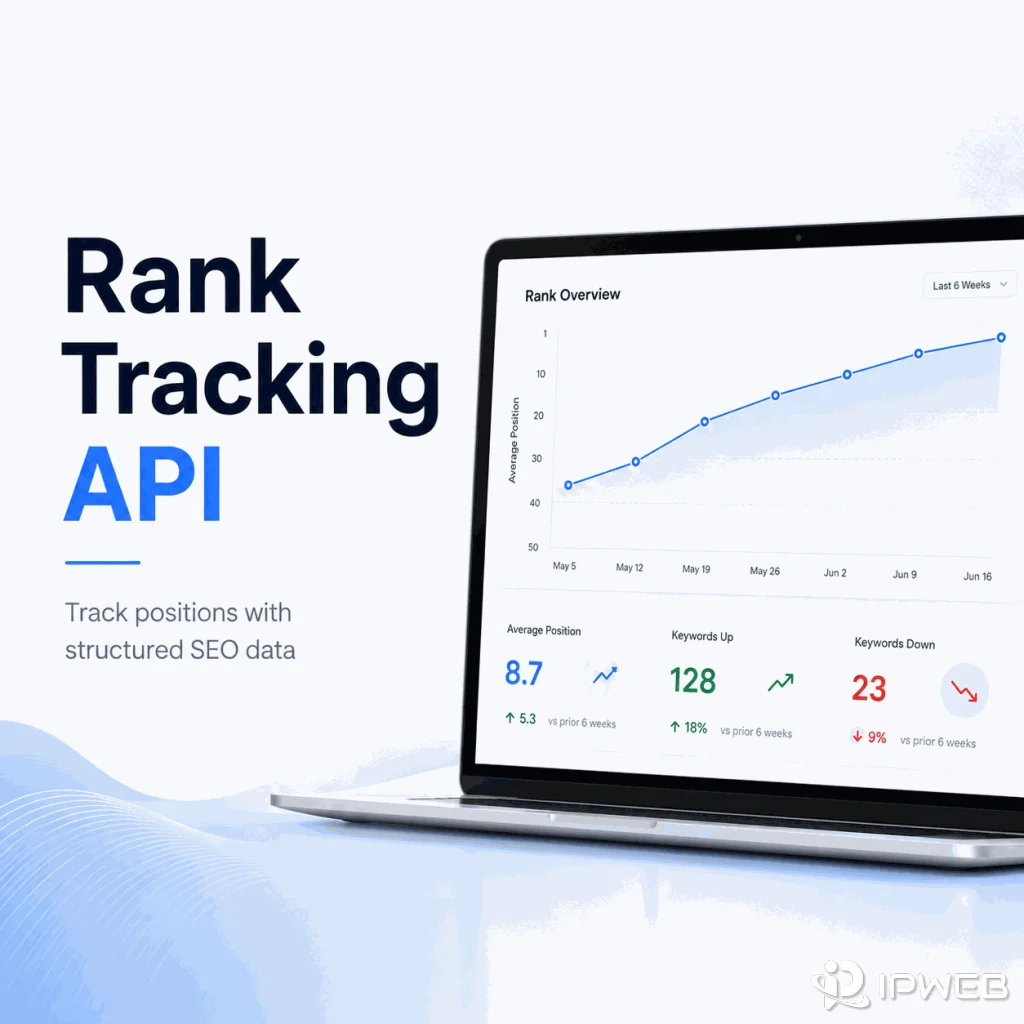
Rank tracking becomes messy when teams move beyond a few manual keyword checks. One person may search from a desktop in one city, another from a phone in another country, and a reporting system may need the same queries every day. A rank tracking API gives teams a repeatable way to collect and compare ranking snapshots.
A rank tracking API is an interface for collecting keyword position data on a schedule. It sends configured search queries, locations, languages, devices, and search engines to a ranking data provider, then returns structured results that can be stored, compared, and reported over time.
- A rank tracking API is built for recurring SEO monitoring, not one-off search-result collection.
- It may use SERP API data underneath, but it adds scheduling, storage, comparison, and reporting logic.
- Ranking data is always context-dependent because search results vary by location, device, language, and time.
- Good workflows store the input parameters, not only the reported position.
- Common use cases include SEO reporting, market research, and analysis of publicly available search results.
What Is a Rank Tracking API?
A rank tracking API lets software request keyword position data programmatically. Instead of opening a search engine manually, the system sends keywords and search context to an API and receives structured ranking data.
The output may include the ranking URL, position, title, snippet, search engine, country, device, timestamp, SERP features, and competing domains. A more complete workflow then stores those snapshots and calculates movement over time.
The core value is consistency. Manual ranking checks are hard to reproduce. A rank tracking API makes the method visible: same query, same location setting, same device type, same schedule, and the same parsing rules.
How Rank Tracking APIs Work
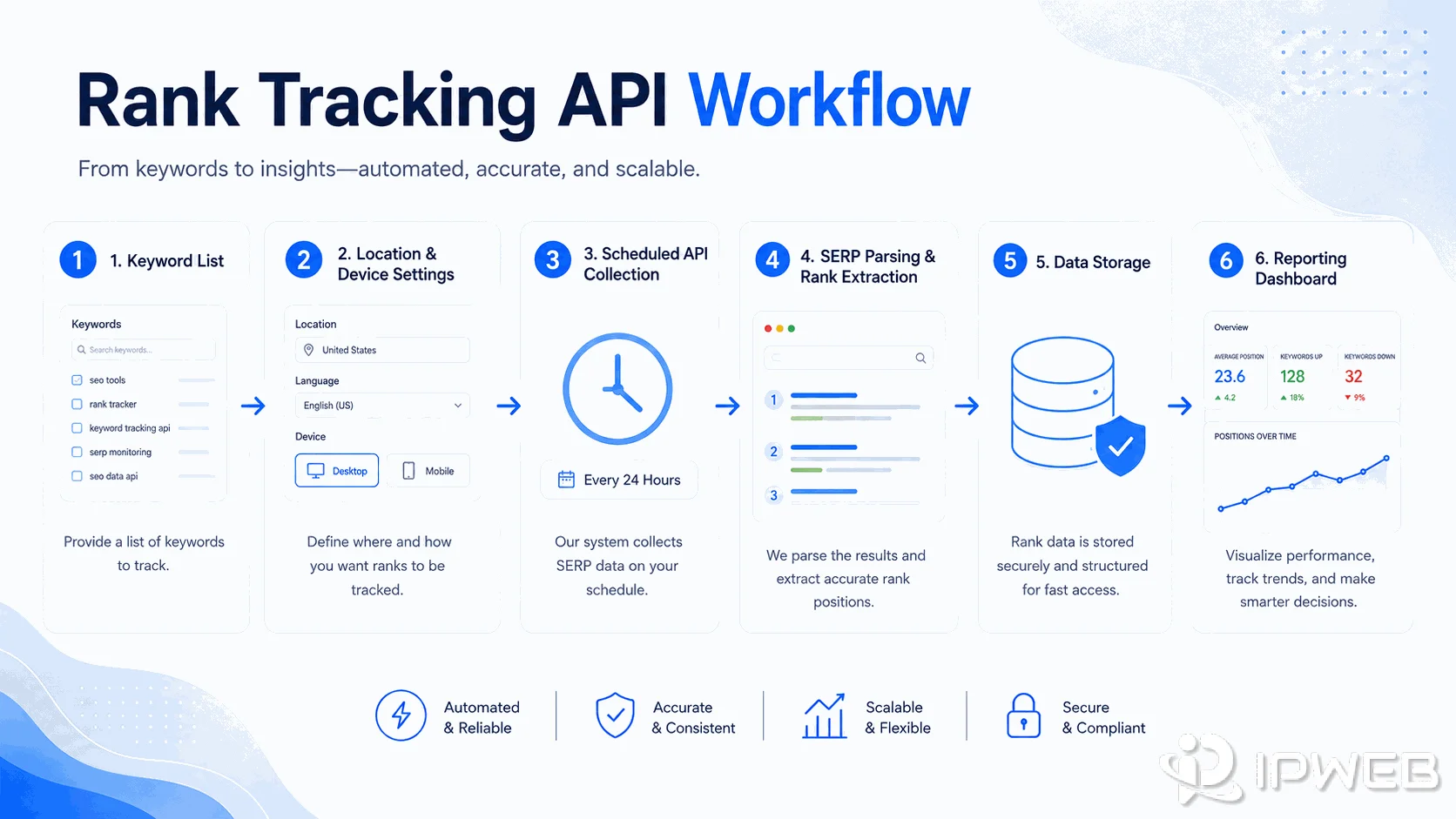
A typical workflow has six steps.
- Define the keyword list and target URLs or domains.
- Choose search engine, country, language, device, and location settings.
- Schedule collection: daily, weekly, hourly, or event-based.
- Collect SERP data through a provider or search-result data layer.
- Parse positions, result features, target URLs, and competitors.
- Store snapshots and calculate changes over time.
The API call is only one part of the system. Useful rank tracking also needs storage, alert rules, anomaly checks, dashboards, and a clear methodology that explains why the numbers may differ from a person's browser.
Rank Tracking API Request Example
Providers use different endpoints and field names, so the following is provider-neutral JSON pseudocode rather than a documented IPWeb endpoint. It shows the context a rank-tracking service or scheduling layer should send with each job.
Example request
{
  "keywords": [
    "rank tracking api",
    "serp tracking api"
  ],
  "target_domain": "example.com",
  "search_engine": "google",
  "location": {
    "country": "US",
    "city": "New York"
  },
  "language": "en",
  "device": "desktop",
  "frequency": "daily",
  "store_serp_features": true
}
Example normalized result
{
  "keyword": "rank tracking api",
  "checked_at": "2026-07-28T14:00:00Z",
  "organic_position": 7,
  "absolute_position": 11,
  "ranking_url": "https://example.com/rank-tracking-api/",
  "serp_features": [
    "featured_snippet",
    "people_also_ask"
  ],
  "status": "complete"
}
The request preserves the search context, while the normalized result separates organic position from absolute position and records the SERP features present during collection. In production, also store the raw provider response, request cost, retry count, and methodology version.
Rank Tracking API vs SERP API
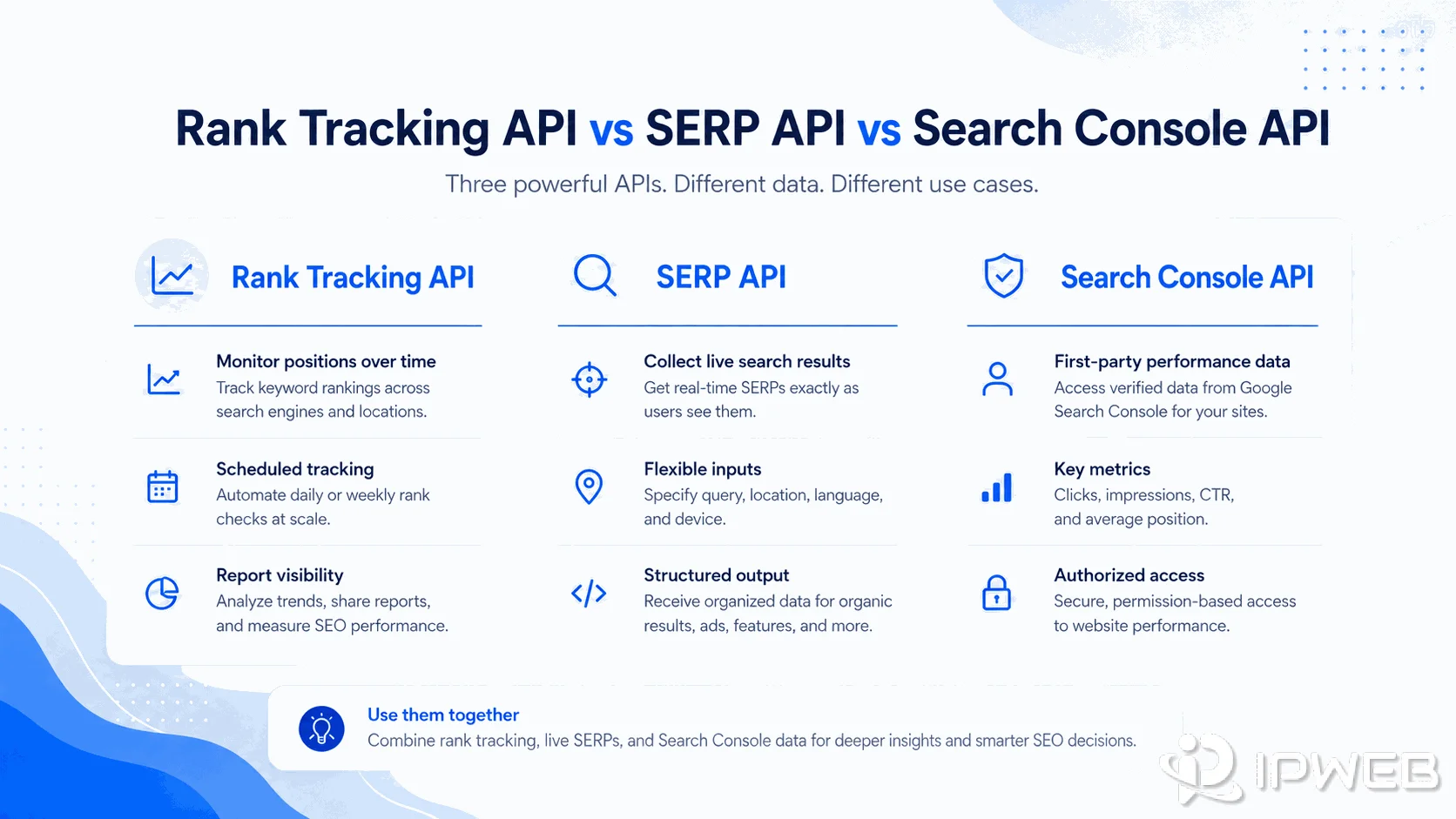
A rank tracking API is the monitoring layer; a SERP API is often the collection layer. The difference matters because "get today's result page" and "report ranking movement over six months" are not the same job.
| Tool | Primary Purpose | Typical Output | Best Fit |
|---|---|---|---|
| SERP API | Collect structured search results for a query | Organic results, snippets, SERP features, local or shopping blocks where supported | One-off or application-level search-result collection |
| Rank tracking API | Monitor ranking positions over time | Position, target URL, history, competitors, changes, alerts | SEO reporting and recurring visibility monitoring |
| Search Console API | Report verified-site performance | Queries, pages, clicks, impressions, CTR, average position | First-party reporting for properties you control |
If your product needs fresh public search-result context for an AI or research workflow, a SERP API may be enough. If your team needs trend reports, alerts, and historical keyword movement, a rank tracking API or a rank-tracking layer is more appropriate. For first-party reporting, the Google Search Console API provides performance data for verified properties rather than public SERP snapshots.
What Data to Store
Store more than the keyword and rank. Without the collection context, ranking numbers are easy to misread.
Recommended fields include:
- Keyword
- Target domain or URL
- Search engine
- Country, city, language, and device
- Timestamp and collection frequency
- Organic position and absolute position when available
- Result URL, title, snippet, and displayed domain
- SERP features present on the page
- Competing domains and URLs
- API status, error reason, and request cost
- Methodology version or parser version
This context helps explain changes. A position shift may come from a real ranking change, a location difference, a SERP-feature change, a parser update, or a temporary search-result fluctuation.
2026 Google Search Console Change
Google stopped showing FAQ rich results in Search on May 7, 2026, and plans to deprecate support for the FAQ search appearance in the Search Console API in August 2026. Teams that store Search Console appearance data should allow the FAQ value to disappear or return no new data, while preserving historical rows for comparison.
This change applies to the Search Console API's FAQ search appearance reporting. It does not mean that every question-style SERP module, such as People Also Ask, should be removed from a rank-tracking schema. Keep observed public SERP features separate from Search Console search-appearance fields, and update filters or dashboards that assume the FAQ appearance will always exist. See Google's Search Analytics API documentation for the current deprecation notice.
How to Validate Ranking Data
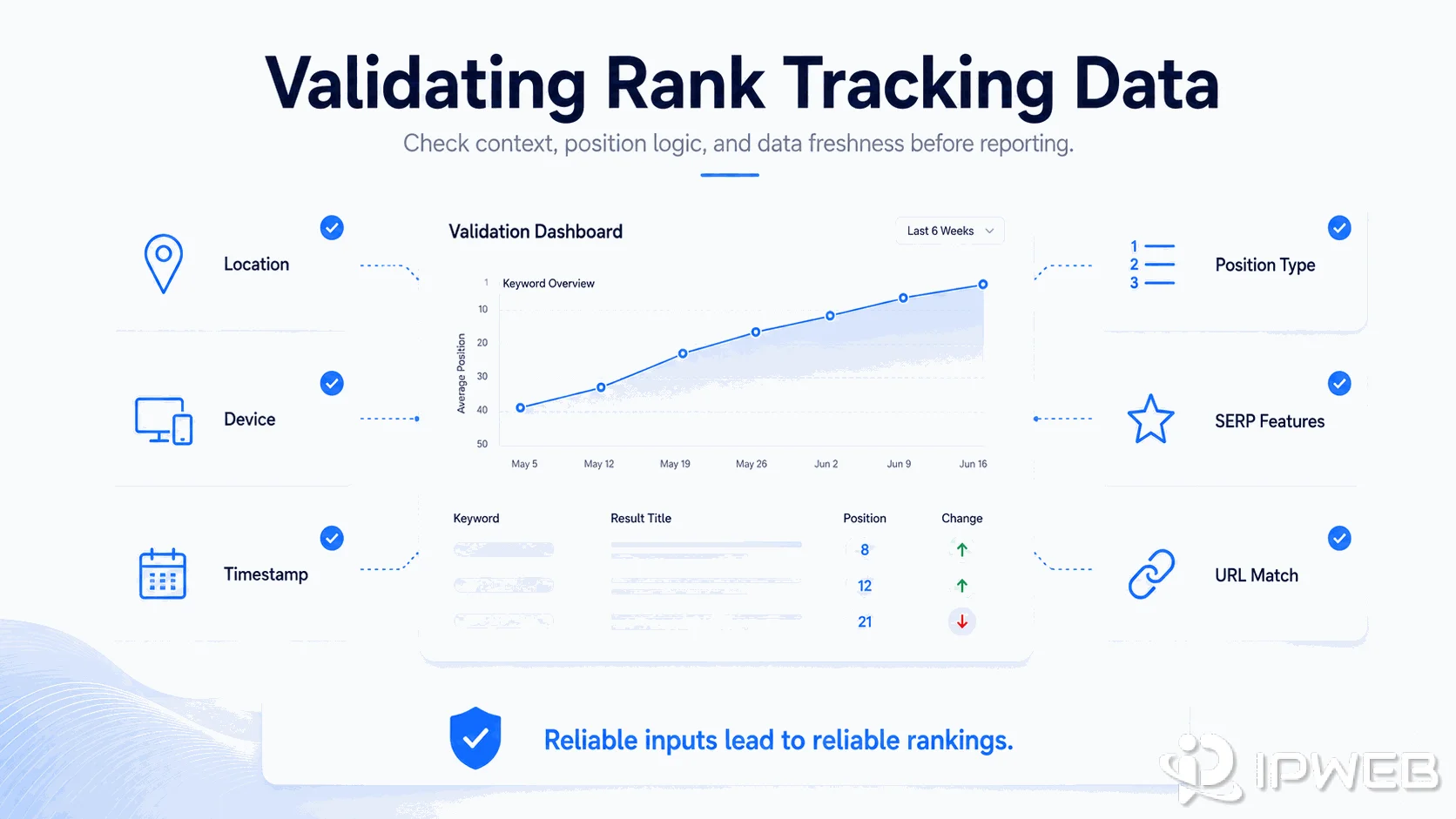
Validation is the part many workflows skip. Before trusting a report, test whether the API result matches the method you care about.
Use this checklist:
- Compare a small sample with a manual browser check using the same country, language, and device assumption.
- Confirm whether the API reports organic position, absolute position, or both.
- Record how ads, local packs, image blocks, and People Also Ask affect position counting.
- Check whether redirects, canonical URLs, or mobile URLs are normalized.
- Test branded, non-branded, local, and long-tail queries separately.
- Watch for empty results that are returned as successful responses.
- Keep timestamps because search results can change during the day.
Do not expect every tool to match every browser exactly. The goal is a consistent reporting methodology, not a universal truth about a ranking that never changes.
Workflow Requirements for SEO and Data Teams
For SEO teams, a rank tracking API should support the way reports are actually used. That usually means grouping keywords by market, page, topic, intent, and device. It also means storing enough history to distinguish a sustained trend from a one-day fluctuation.
- Group keywords by market, page, topic, intent, and device.
- Store every ranking snapshot with the exact query context and collection time.
- Keep result URLs, snippets, SERP features, and error details for later review.
- Separate the collection layer from scheduling, storage, validation, and reporting.
- Document changes to parsers, position-counting rules, and methodology.
For data teams, ranking snapshots may become inputs to retrieval, market analysis, or brand-intelligence workflows. Source validation matters more than decorative dashboards. Store the result URL, snippet, query context, and timestamp so later analysis can explain where the data came from. For a broader explanation of collection, validation, and storage as separate stages, see IPWeb's web scraping workflow guide.
If a workflow needs search-result collection before rank calculations, IPWeb SERP API can provide structured public search-result data. Keep the implementation boundary clear: the SERP API supplies the collection layer, while your rank-tracking system still needs scheduling, historical storage, validation, change calculations, and reporting.
Teams that build the collection layer themselves may use dynamic residential proxies when legitimate rank checks require localized public search results across countries or cities. A proxy changes the network route; it does not provide scheduling, result parsing, historical storage, or ranking calculations. IPWeb's web scraping proxy guide explains this infrastructure boundary in more detail.
Practical Use Cases
Rank tracking becomes more useful when teams define the market, query set, and reporting goal before collecting data.
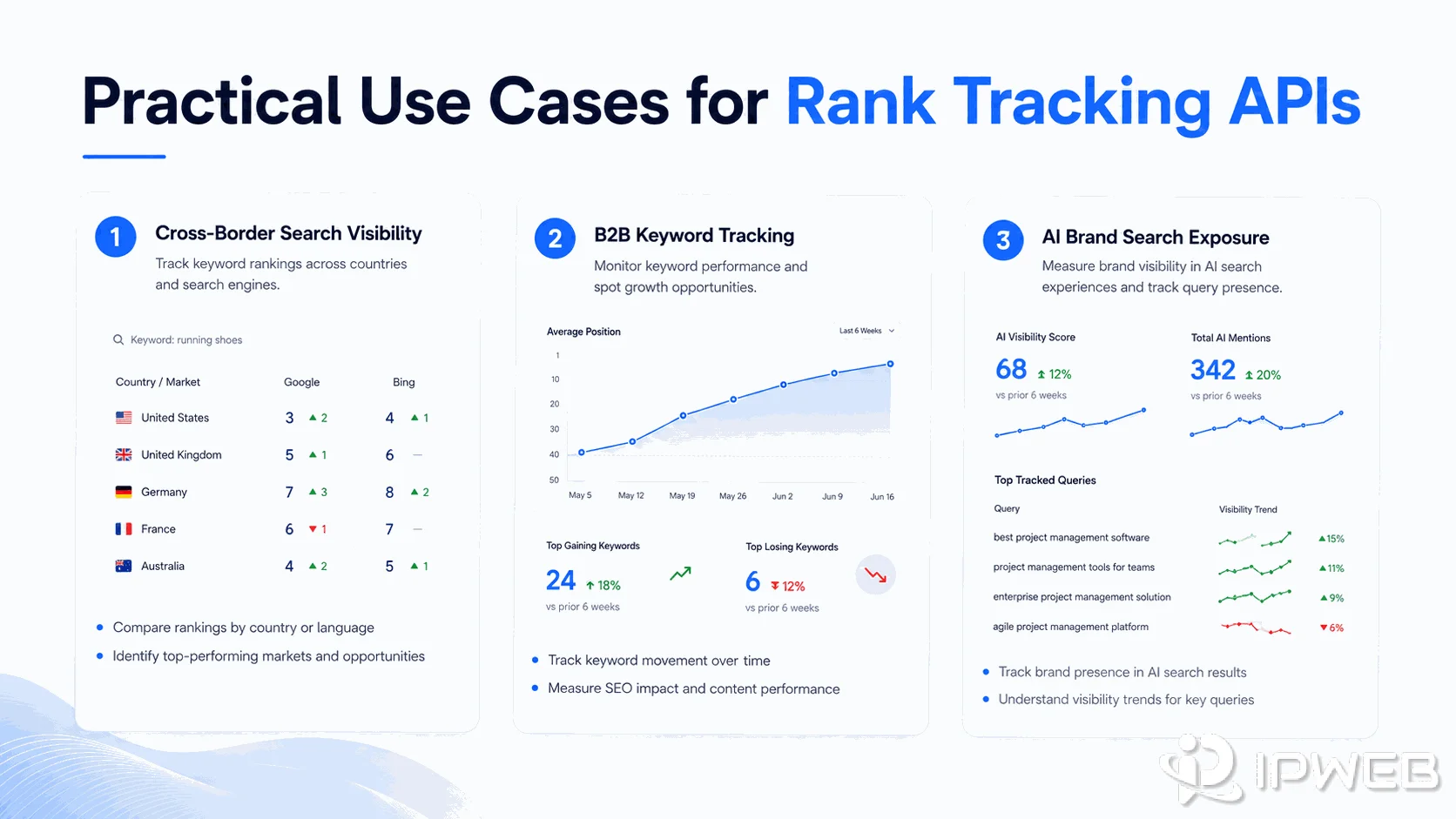
Cross-border e-commerce visibility
An e-commerce team can track whether category pages, product pages, or marketplace listings appear for commercial queries in different countries. The workflow should separate desktop and mobile results, record shopping or merchant modules, and avoid treating a layout change as a true organic-position loss.
International B2B search monitoring
A B2B service provider can group keywords by country, language, solution page, and buying stage. Weekly snapshots help the team distinguish a sustained visibility trend from a short-lived fluctuation and identify which landing page is ranking in each market.
AI tool brand visibility
An AI software company can monitor branded queries, category terms, comparison searches, and problem-based prompts that surface traditional web results. Storing result URLs, snippets, competing domains, and SERP features creates an auditable dataset for reviewing how the brand is represented across search markets.
Common Limits
Ranking data is useful, but it is not absolute. Search engines can personalize results, rotate layouts, test features, and change result pages quickly. Location and device settings can also shift the result set.
Rank tracking APIs also differ in how they count positions. Some tools count only organic results. Others account for ads, local packs, or rich features differently. If reports from two tools disagree, compare methodology before assuming one is wrong.
Finally, avoid treating rank tracking as the whole SEO picture. Position movement matters, but traffic, click-through rate, conversion, content quality, crawlability, and business value decide whether a ranking is useful.
Frequently Asked Questions
Final Thoughts
A rank tracking API helps teams turn search-result snapshots into repeatable monitoring. It is strongest when the workflow stores inputs, result fields, timestamps, and methodology along with the reported position.
The main limitation is that rankings are contextual. Build validation into the workflow, compare like with like, and treat ranking data as one visibility signal rather than the entire SEO answer.
If you are building the collection layer first, a SERP API can return structured search-result data while your own system handles scheduling, history, validation, position calculations, and reporting.