
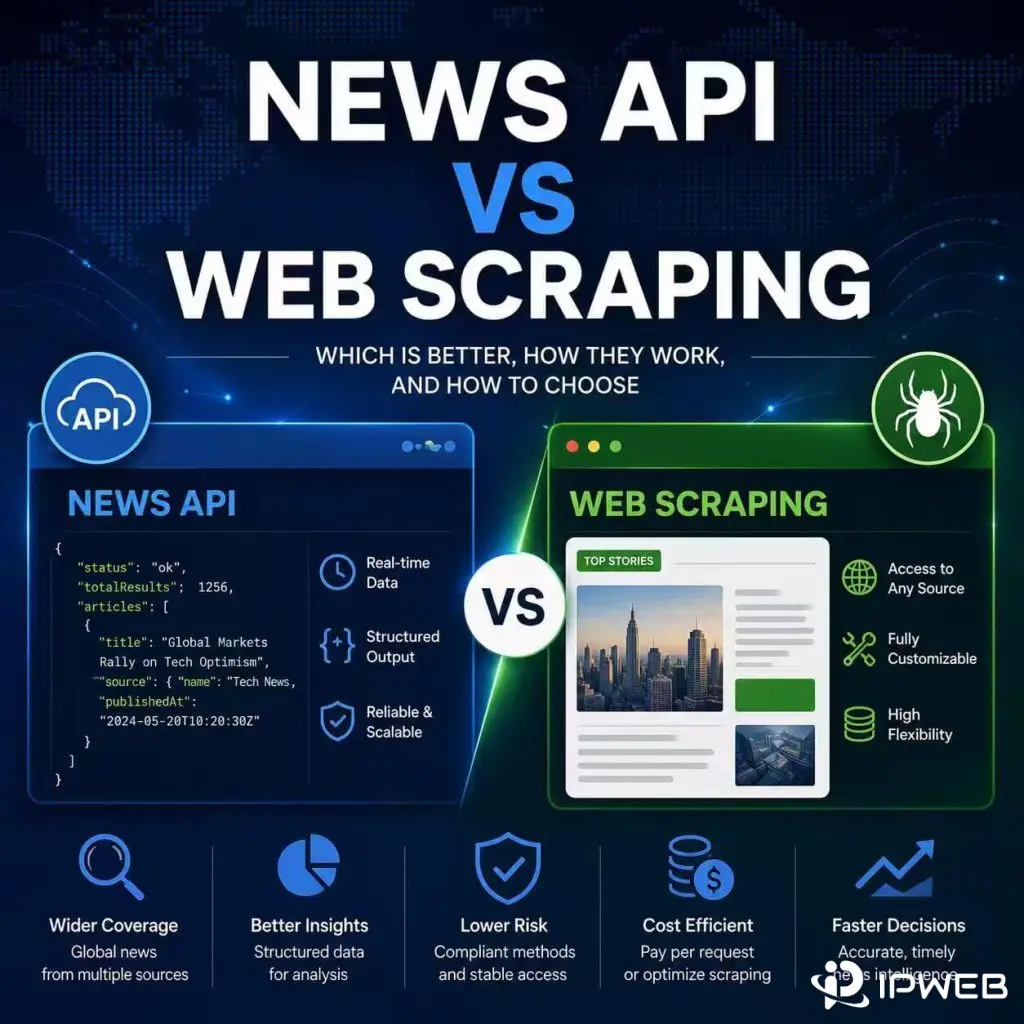
News data can support brand monitoring, market research, event alerts, competitive analysis, and AI summaries. The difficult part is not collecting more records. It is choosing a source that provides the coverage, context, freshness, and usage rights your workflow actually needs.
Choose a news API when you need structured records, predictable request handling, and broad source coverage with less maintenance. Choose web scraping when permitted public pages contain niche sources, page-level context, or fields the API does not provide. RSS feeds and licensed datasets may be better when the publisher already offers an official feed or when licensing and redistribution rights are the main requirement.
- A news API reduces parsing work, but coverage, history, quotas, and licensing still vary by provider.
- Web scraping gives more page-level control, but layouts change and each source needs its own validation rules.
- RSS is useful for official publisher updates when a small, consistent field set is enough.
- Licensed datasets are often the strongest option when full-text analysis or redistribution rights are essential.
- Good workflows preserve canonical URLs, publisher attribution, original timestamps, language, region, and collection method.
What a News API Provides
A news API returns structured records instead of raw article pages. Typical fields include the headline, publisher, author, publication time, canonical or source URL, language, region, category, image URL, and a short description. Some providers also offer topic labels, sentiment, entity extraction, historical archives, or full text under specific licensing terms.
The main advantage is consistency. Your application can process one response format across many publishers rather than maintaining a separate parser for every site. This makes APIs a practical starting point for dashboards, alerts, scheduled reports, and applications that need predictable JSON.
The limitation is that an API defines the available universe. It may exclude small publishers, provide delayed updates, limit historical access, normalize away useful page details, or restrict how returned content can be stored and redistributed. Check source lists, regions, languages, quotas, retention rules, and licensing before building around a provider.
Popular News API Options
Provider names are useful for narrowing a shortlist, but there is no universal best news API. Compare the actual source list, language and country coverage, archive depth, full-text rights, update latency, quotas, and permitted downstream use before choosing one.
| Provider | Best fit | Notable strengths | What to verify |
|---|---|---|---|
| NewsAPI.org | General article search and headline applications | Separate search and top-headline endpoints, source and domain filters, date ranges, and a straightforward REST format | Archive depth, full-content availability, commercial-use terms, storage rules, and plan-specific request limits |
| GNews API | Keyword discovery and country- or language-targeted headline monitoring | Search and top-headline endpoints, Boolean query support, date filtering, and headline selection based on Google News rankings | Coverage for required publishers, historical depth, returned content fields, and plan-specific limits |
| Mediastack | Standardized live and historical records across multiple markets | Country, language, source, category, and date filters in a normalized REST response | Source inventory, update latency, archive access, HTTPS availability, and usage rights for the selected plan |
| Event Registry | Media intelligence, event clustering, entity analysis, and trend monitoring | Groups related reporting into events and adds concepts, entities, categories, and monitoring features | Whether the workflow needs an intelligence layer rather than a simple article feed, plus export and licensing terms |
This comparison is a starting point, not a fixed ranking. Provider coverage and plan features can change, so test the same representative query set against each shortlisted service before committing to an integration.
When Web Scraping Adds Value
Web scraping is useful when the public page itself contains information that the API does not expose. Examples include checking whether an article is still live, identifying the canonical URL, comparing headline revisions, reading visible correction notices, extracting structured data, or monitoring a niche publication that is absent from a general news API.
It also gives you control over the extraction schema. You can decide which page elements matter and preserve source-specific context instead of accepting a provider's normalized fields. For a broader explanation of the collection process, see how web scraping works.
That control comes with more maintenance. Page layouts change, JavaScript rendering can affect extraction, duplicate and syndicated articles need special handling, and collection rules differ by publisher. For permitted regional comparisons, rotating residential proxies can provide location-specific network routes for checking how public news pages appear across markets. Review publisher terms, access controls, robots directives, licensing requirements, and applicable laws before collecting content. A proxy does not authorize access to restricted content, and public availability alone does not grant unrestricted reuse.
News API vs Web Scraping
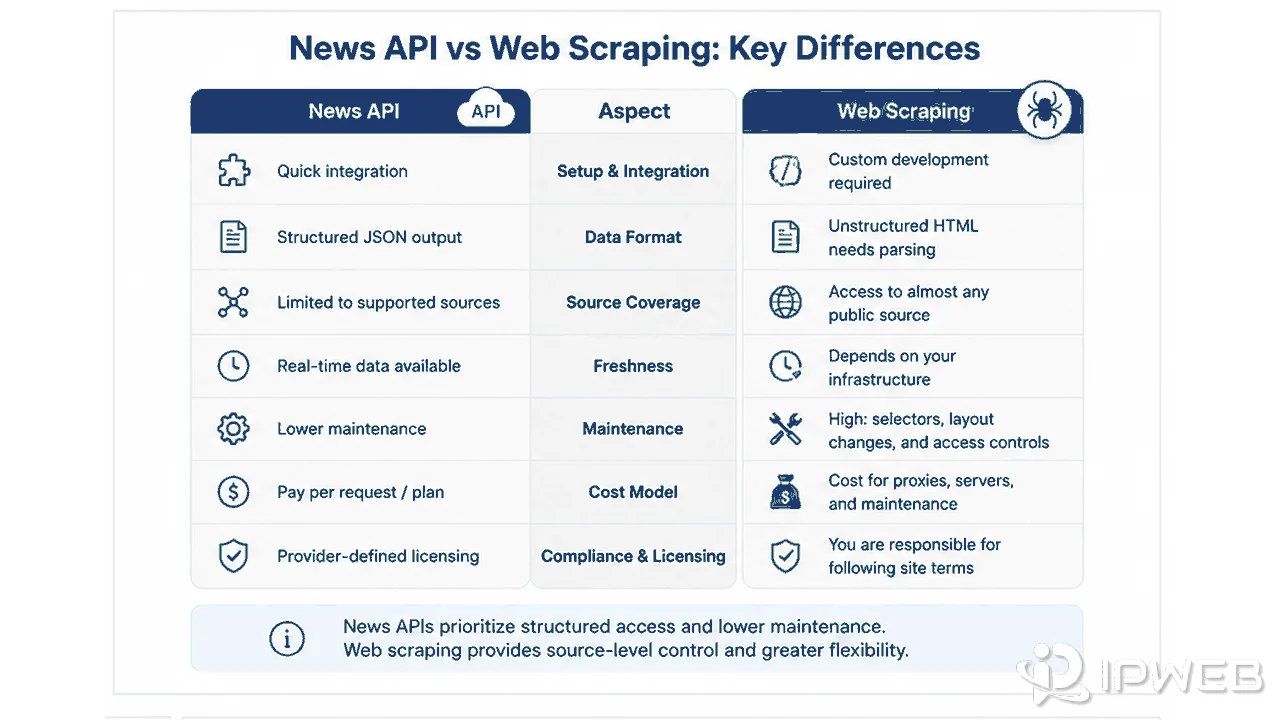
The decision usually depends on whether your priority is structured scale or page-level control. Neither method is universally better.
| Decision factor | News API | Web scraping |
|---|---|---|
| Setup speed | Usually faster because the response schema is already defined | Slower because selectors, rendering, and source rules must be configured |
| Source coverage | Limited to the provider's publisher and regional coverage | Can include permitted niche sources not covered by an API |
| Data structure | Consistent JSON fields across sources | Custom fields, but each layout may need separate parsing |
| Page-level context | Often limited to normalized metadata and excerpts | Can preserve visible corrections, page structure, canonical tags, and source-specific details |
| Maintenance | Provider manages collection and parser changes | Your team handles layout changes, retries, rendering, and validation |
| Historical access | Depends on plan, archive depth, and license | Requires your own collection history or permitted archive source |
| Usage rights | Defined by the provider's contract and publisher agreements | Must be evaluated for every source and intended downstream use |
| Best fit | Broad monitoring, alerts, dashboards, and normalized analysis | Niche coverage, page validation, and source-specific context |
Where RSS, Datasets, and SERP APIs Fit
A news API and web scraping are not the only options. In many workflows, a smaller or more specialized source is a better fit.
| Source option | Use it when | Check before implementation |
|---|---|---|
| RSS feed | The publisher offers an official feed and basic update tracking is enough | Field completeness, feed freshness, canonical links, and duplicate entries |
| Licensed dataset | You need defined rights, large historical archives, or full-text analysis | License scope, storage period, redistribution, attribution, and refresh frequency |
| SERP API | You need to know which news results appear for a search query rather than monitor a publisher directly | Search engine, location, language, device, result type, and timestamp |
| Publisher page | You need visible page evidence, corrections, canonical metadata, or niche coverage | Access rules, terms, robots directives, page stability, and required fields |
A SERP API answers a different question from a news API. It shows which results appear for a query, location, language, and device. It does not automatically provide complete publisher-level monitoring or licensed article content. For structured search-result collection, see the IPWeb SERP API.
A Practical Public News Data Workflow
Start by defining the decision the data must support. A system built for urgent alerts needs different freshness and validation rules from a monthly market-research report.
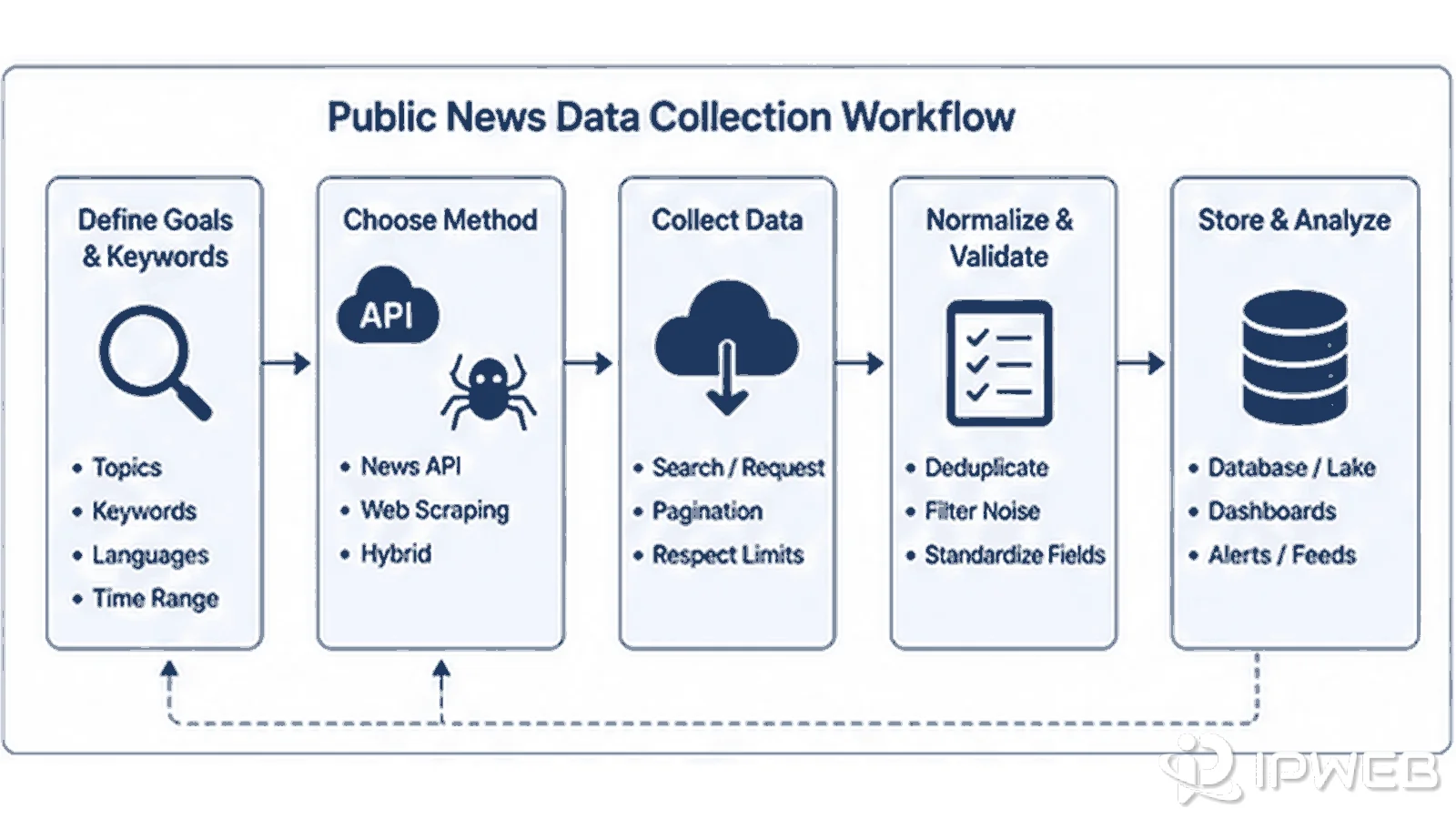
- Define the required fields. List the headline, URL, publisher, author, publication time, topic, language, region, excerpt, and any page-level evidence you need.
- Choose the least fragile source. Test an API, official RSS feed, or licensed dataset before building custom page parsers.
- Document the collection context. Store the source type, query or feed URL, collection timestamp, language, region, and parser or API version.
- Normalize records. Map different providers and pages into a shared schema without discarding the original values.
- Deduplicate carefully. Use canonical URLs, normalized headlines, publishers, timestamps, and similarity checks to group syndicated copies.
- Recheck important records. Headlines, timestamps, corrections, and URLs can change after publication.
- Keep attribution visible. Downstream dashboards and AI summaries should preserve the publisher, author, date, and source URL.
A Simple Python News API Example
The following example uses the NewsAPI.org /v2/everything endpoint because it provides a compact REST request for demonstration. Store the API key in an environment variable, add a timeout, check the HTTP status, and keep only the fields your workflow needs. Provider fields, limits, and usage terms may differ.
import os
import requests

api_key = os.environ["NEWS_API_KEY"]

response = requests.get(
    "https://newsapi.org/v2/everything",
    headers={"X-Api-Key": api_key},
    params={
        "q": '"artificial intelligence"',
        "language": "en",
        "sortBy": "publishedAt",
        "pageSize": 5,
    },
    timeout=20,
)
response.raise_for_status()

for article in response.json().get("articles", []):
    print({
        "headline": article.get("title"),
        "publisher": article.get("source", {}).get("name"),
        "published_at": article.get("publishedAt"),
        "source_url": article.get("url"),
    })
In production, add pagination, rate-limit handling, retries with capped backoff, request logging, and deduplication. Do not assume the returned description or content field contains a licensed full article.
How to Normalize News Records
Different APIs, feeds, and publisher pages use different field names. A shared internal schema makes later deduplication and reporting more reliable. The example below is provider-neutral and shows a normalized record rather than a real vendor request.
{
  "headline": "Example headline",
  "publisher": "Example Publisher",
  "author": "Reporter Name",
  "published_at": "2026-07-28T09:30:00Z",
  "canonical_url": "https://example.com/news/example-story",
  "language": "en",
  "region": "US",
  "summary": "Short provider or publisher excerpt",
  "source_type": "news_api",
  "collected_at": "2026-07-28T09:35:12Z"
}
Keep the original response or extracted fields separately when possible. Normalization is useful for analysis, but the source record helps explain why two systems reported different authors, timestamps, summaries, or URLs.
- Original source URL or API record identifier
- Publisher and author as originally reported
- Original and normalized publication timestamps
- Collection time and collection method
- API version, feed URL, or parser version
How to Control Collection Costs
Cost control starts with collection design, not with deleting useful records after they arrive. Track API requests, proxy traffic, empty-result rates, duplicate rates, and downstream enrichment costs separately so you can see where the budget is being consumed.
- Tier sources by importance. Poll high-priority publishers or topics more frequently, use a slower schedule for standard sources, and check long-tail sources only when a trigger or research task requires them.
- Combine filters where supported. Use provider-supported multi-source, keyword, date, and language filters instead of sending one request for every source-keyword pair.
- Separate discovery from verification. Use an API or feed to discover candidate stories, then recheck only high-value pages rather than requesting every article page.
- Cache stable history. Do not repeatedly request date ranges or article records that are no longer expected to change.
- Deduplicate before enrichment. Group syndicated copies before running sentiment, entity extraction, translation, embeddings, or AI summaries.
- Handle limits deliberately. Respect
429responses andRetry-Afterheaders, use capped exponential backoff for temporary failures, and avoid unlimited retries. - Measure cost per useful record. A cheap request is still wasteful when it returns no relevant or unique articles.
- Define a maximum detection delay for priority topics, such as 10 minutes, only when the provider's freshness and quota support it.
- Set a duplicate-rate target after normalization and event grouping.
- Use an internal target such as reducing manual normalization time by 30%, then compare actual staff hours before and after implementation. Treat this as a benchmark to test, not a universal result.
Practical Use Cases
Brand and Reputation Monitoring
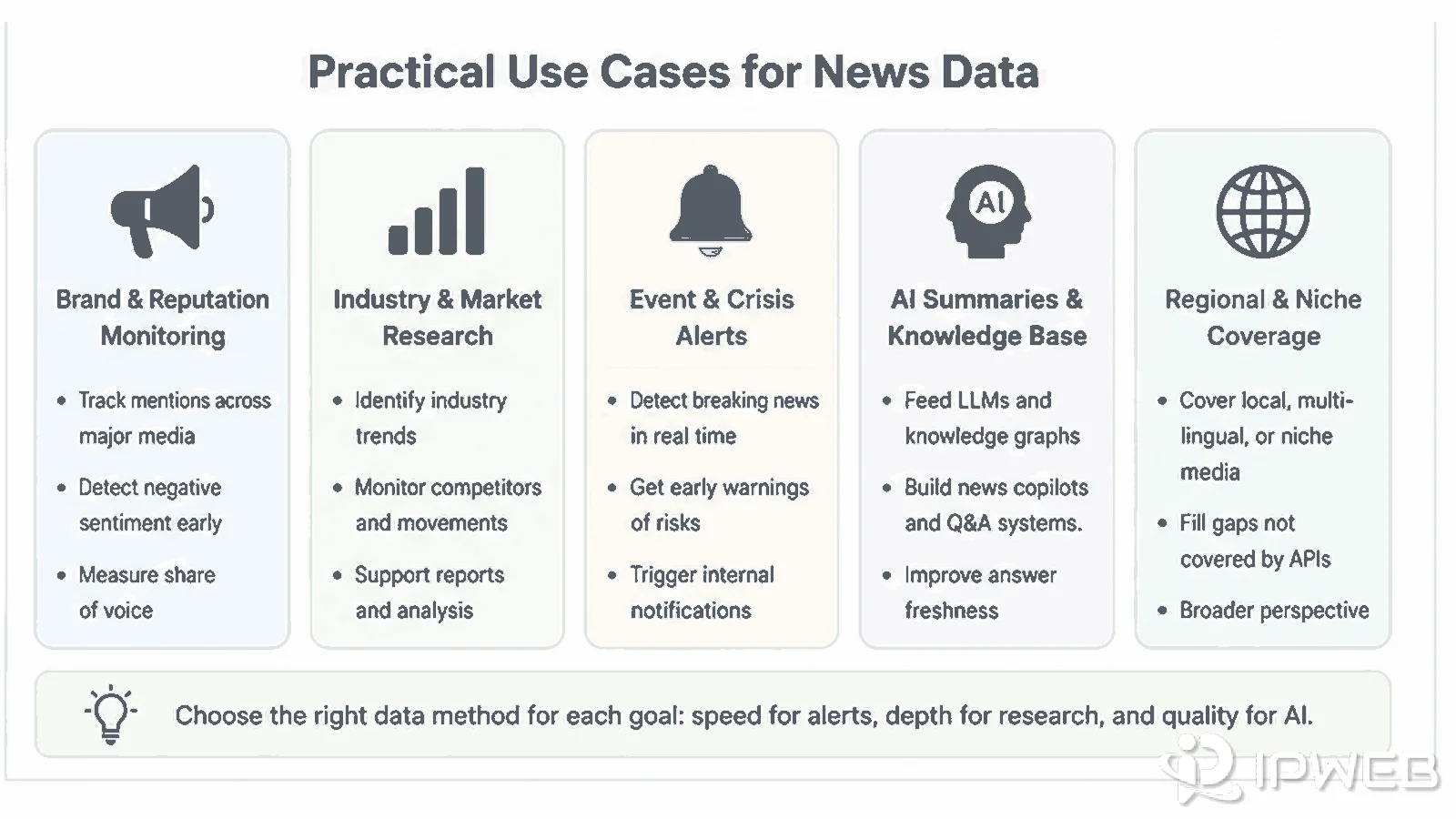
A news API can support frequent discovery across the sources covered by the provider, while official feeds or permitted page checks fill gaps in trade publications and local media. For priority terms, measure median detection time and the delay between the first source publication and the internal alert instead of claiming complete web coverage.
Niche Industry Research
General APIs may miss trade publications, local outlets, and specialist blogs. A mixed workflow can combine an API for broad discovery with official feeds or permitted page collection for high-value niche sources. Track how many unique, relevant records each source type contributes so niche coverage does not become an unmeasured maintenance cost.
Event and Market Alerts
For fast alerts, prioritize publication time, source reliability, duplicate grouping, and update latency. Treat a cluster of syndicated copies as one underlying event rather than multiple independent confirmations, then report both the event and the supporting publisher list.
AI Summaries and Retrieval Workflows
AI systems need more than article text. Store publisher attribution, canonical URLs, timestamps, language, region, and the exact source record used for each summary. A shared schema can reduce manual cleaning and mapping work, but the effect should be measured against the team's previous process. A 30% reduction is a reasonable internal test target, not a guaranteed industry result.
Common Data Quality Checks
News records can look consistent while still producing misleading analysis. Time-zone mistakes, syndicated copies, rewritten headlines, tracking URLs, missing corrections, and source attribution gaps are common causes.
- Normalize timestamps to UTC while keeping the publisher's original time and time zone.
- Remove tracking parameters, but preserve the canonical and originally collected URLs.
- Group wire-service and syndication copies instead of counting every republished page as a new event.
- Store both the original headline and later observed revisions when headline changes matter.
- Check visible structured data against the page. The Schema.org NewsArticle type describes common article properties, but publisher markup can still be incomplete or incorrect.
- For publisher-side discovery and validation, Google documents how a news sitemap can provide additional information about news articles.
- Flag paywalled, account-restricted, or otherwise protected pages rather than treating access failure as missing news.
- Keep publisher, author, publication date, collection method, and source URL visible in downstream reports.
Frequently Asked Questions
Final Thoughts
Use a news API when a provider already offers the coverage, structure, freshness, and usage rights your workflow needs. Add RSS feeds, licensed datasets, or permitted page-level collection only where they solve a clear source or context gap.
The strongest systems do not hide where a record came from. They preserve canonical URLs, publisher attribution, timestamps, source type, and the original evidence so alerts, reports, and AI summaries remain explainable.