

Ryan
IP Proxy Research Team
Ryan is a web data and proxy infrastructure specialist focused on IP networks, scraping systems, SERP APIs, and global data access solutions. He shares practical insights on proxy usage, data collection architecture, and scalable web intelligence systems.
Ryan's Articles
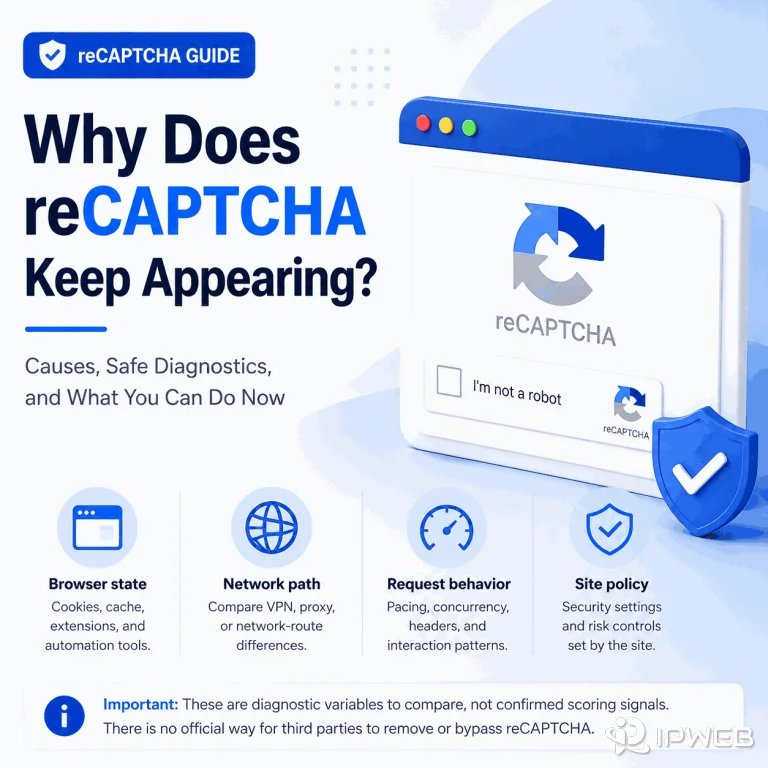
Why Does reCAPTCHA Keep Appearing?
Repeated reCAPTCHA prompts can interrupt QA, login, form, and public-data workflows, but they do not automatically mean that one specific browser setting, IP address, or proxy is at fault. The useful goal is to identify what changed in the session and reduce avoidable verification without trying to disable or bypass the site's controls. Direct Answer You cannot reliably disable or “stop” reCAPTCHA on a website you do not control. If it keeps appearing, compare browser state, request timing, application routing, and the site's own access requirements. These are useful diagnostic variables, not confirmed reCAPTCHA scoring signals unless Google documents them....

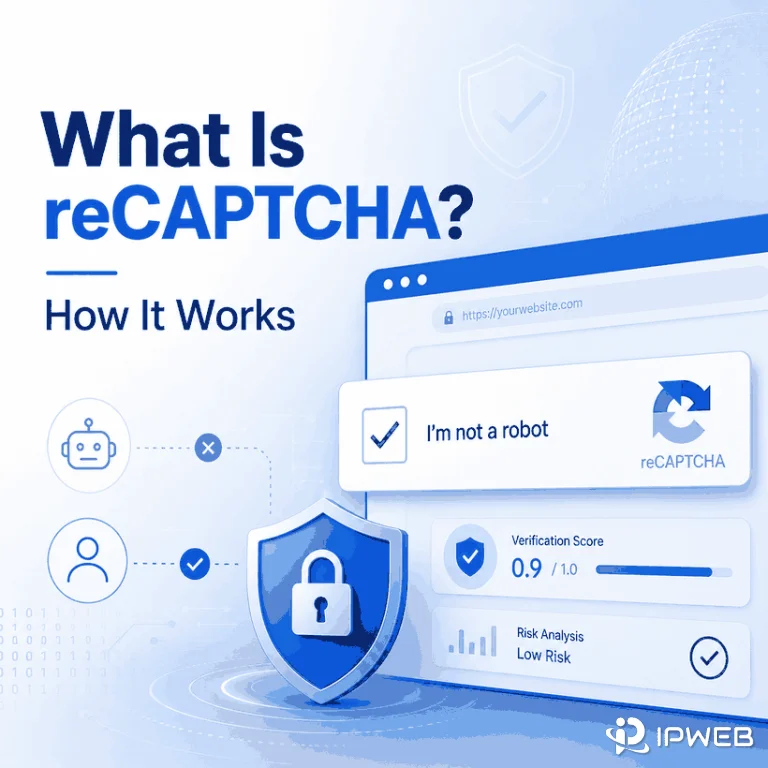
What Is reCAPTCHA? How It Works
Understanding reCAPTCHA matters for developers, QA teams, and data workflow owners because verification can change how a normal browser test, form submission, or public-data workflow behaves. The useful first step is to understand what reCAPTCHA checks, how its main versions differ, and what a challenge does—and does not—tell you. Direct Answer reCAPTCHA is Google's anti-abuse service for helping websites distinguish legitimate human interactions from automated or suspicious activity. Depending on the version and site configuration, it may show a checkbox or challenge, run without a visible prompt, or return a risk score that the website uses in its own decision...
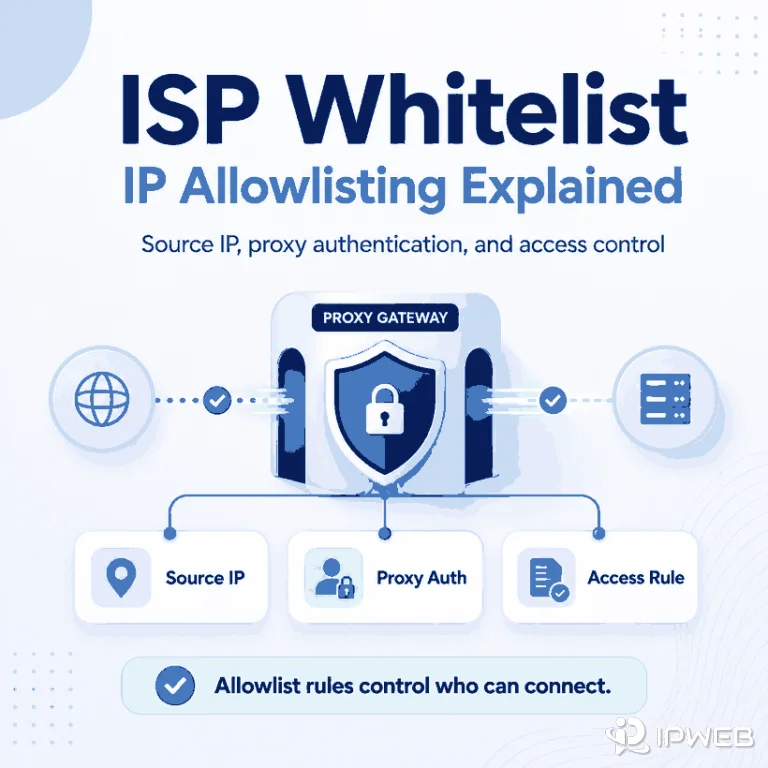
ISP Whitelist: IP Allowlisting for Proxies
The phrase ISP whitelist is used for several different access-control setups. It may mean allowing a trusted ISP network through a firewall, authorizing a fixed public IP to connect to a proxy gateway, or allowing a proxy exit IP to reach an API or private system. These scenarios look similar, but they authorize different points in the network path. Direct Answer An ISP whitelist is an allowlist rule that permits traffic from an approved IP address, network range, ASN, or provider network. In a proxy service, IP allowlisting usually authorizes the public source IP that may connect to the proxy...
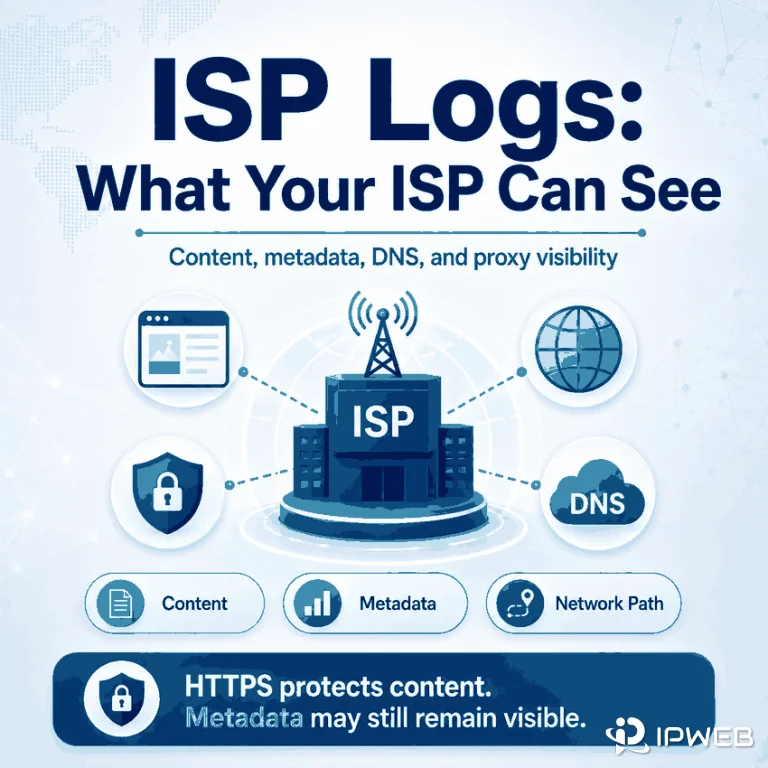
ISP Logs: What Can Your ISP See?
Questions about ISP logs usually start with a simple concern: how much of your internet activity can an internet service provider actually observe or retain? The answer depends on the connection type, encryption, DNS configuration, application routing, and the provider's own policies. It is more accurate to separate visible content from connection metadata than to assume an ISP either sees everything or nothing. Direct Answer ISP logs are operational, security, billing, and compliance records that an internet service provider may keep about a subscriber's network connection. Depending on the network and policy, these records may include assigned IP addresses, connection...
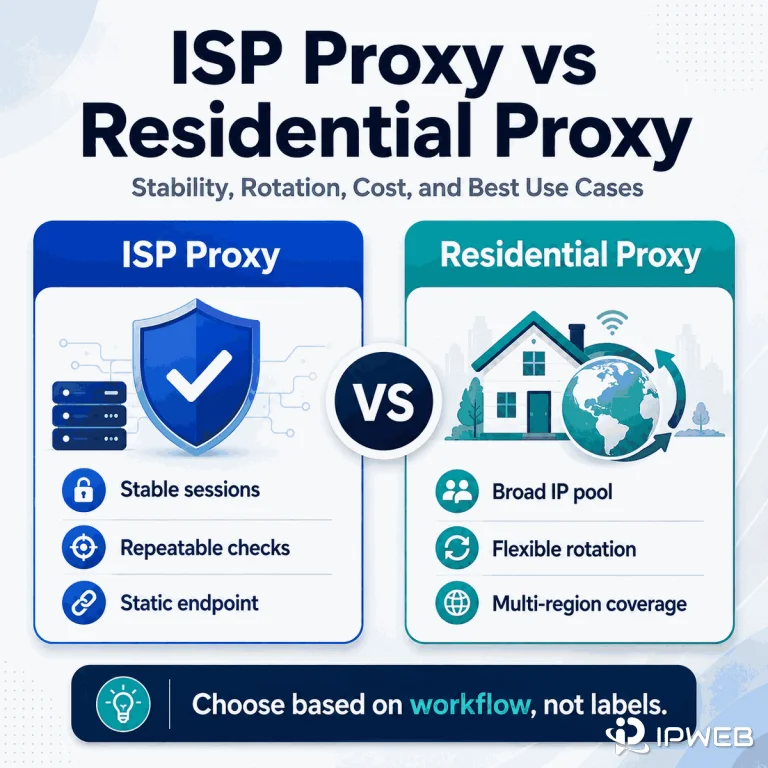
ISP Proxy vs Residential Proxy: How to Choose
The phrase ISP proxy vs residential proxy looks like a simple product comparison, but it often mixes two different questions: where the outgoing IP comes from and how long that IP stays assigned to a session. Separating those two questions makes the choice much easier. An ISP proxy is usually built around an ISP-associated IP that remains stable for an extended period. A residential proxy service usually emphasizes access to a larger pool of residential IPs, with rotation or sticky-session controls. However, provider terminology is not standardized, so the product name alone does not tell you whether an endpoint is...
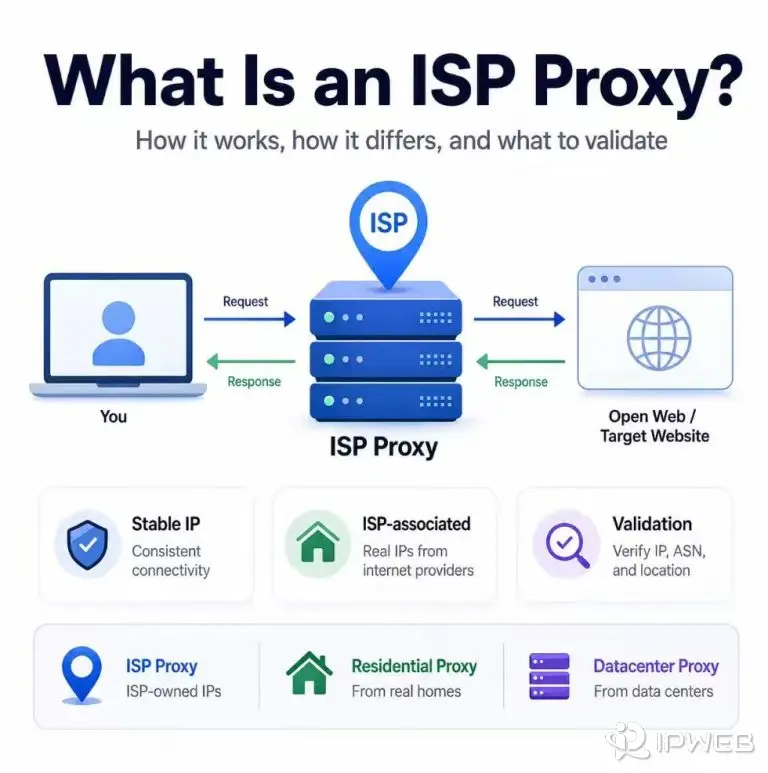
What Is an ISP Proxy? Meaning and Use Cases
The term ISP proxy is not used in exactly the same way by every provider. It commonly refers to a stable proxy IP registered to, allocated through, or leased from an internet service provider, while the proxy infrastructure itself is often hosted on servers rather than ordinary household devices. Direct Answer An ISP proxy, often called a static residential proxy, is a proxy endpoint that commonly uses a stable IP address associated with an internet service provider. It combines persistent IP sessions with ISP-related network registration, but it does not prove that traffic comes from a household device or guarantee...
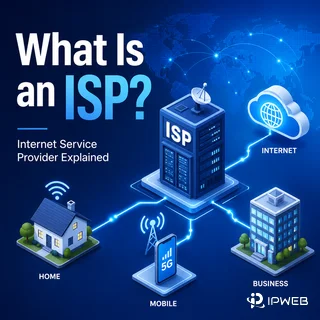
What Is an ISP? Meaning for IPs and Proxies
An internet connection does not reach the public internet on its own. It normally passes through a company or network organization that provides access, carries traffic, and assigns or routes the public IP address used by the connection. That organization is commonly called an ISP. Direct Answer An ISP, or internet service provider, is a company or network organization that connects individuals, businesses, devices, or other networks to the internet. An ISP may provide broadband or mobile access, assign public IP addresses, operate DNS resolvers, and carry traffic between its customers and other networks. In an IP lookup, the ISP...
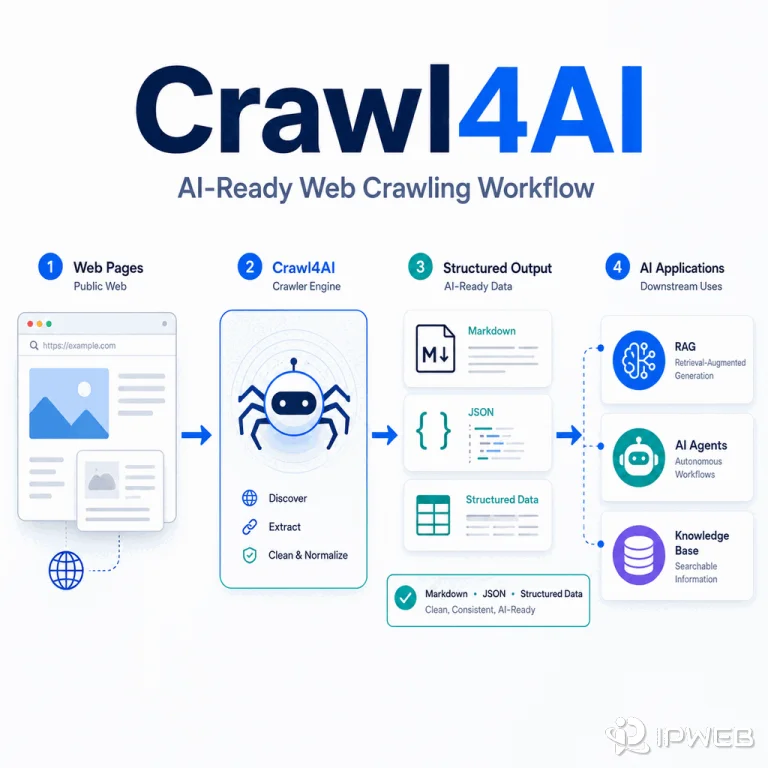
What Is Crawl4AI? How It Works and When to Use It
Crawl4AI is an open-source Python crawler and scraper built for AI-oriented web data workflows. It uses browser automation to load pages and can return clean Markdown, HTML, or structured content for LLM, RAG, agent, and knowledge-base pipelines. The practical question is not whether Crawl4AI replaces every crawler. It is whether your workflow benefits from an AI web scraper that combines page rendering, content cleanup, and extraction in one Python tool. Direct AnswerCrawl4AI is an open-source Python tool for crawling pages and preparing web content for AI systems. It can render JavaScript, generate clean Markdown, and extract structured fields with CSS,...
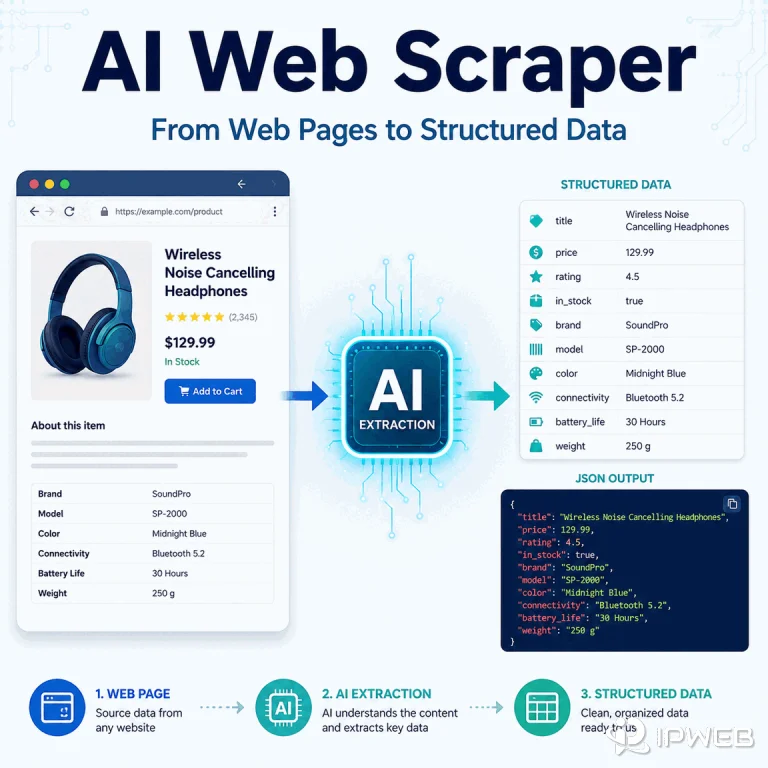
What Is an AI Web Scraper?
An AI web scraper is a web extraction tool that uses AI to understand page content, identify fields, handle layout variation, or convert pages into structured data with less hand-written parsing logic. It still needs normal web scraping fundamentals: permitted sources, stable requests, rendering checks, schema validation, and error handling. The term can be confusing because people use it for several related workflows: a scraper with an LLM extraction step, a browser automation tool controlled by an AI agent, a no-code extraction product with AI field detection, or a pipeline that turns HTML into Markdown or JSON for AI systems....
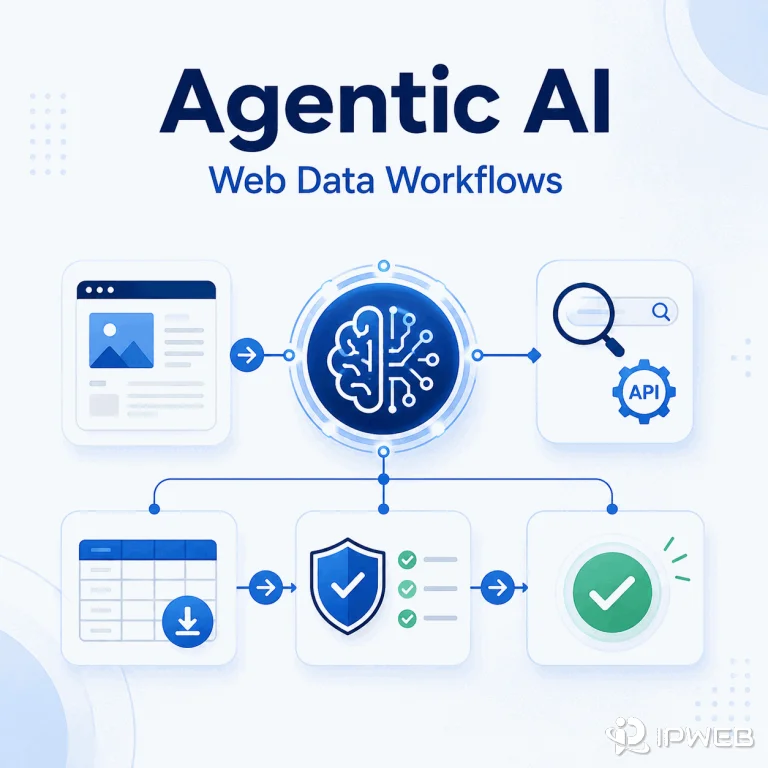
What Is Agentic AI? Web Data Workflow Guide
Agentic AI is an AI system that can plan a task, choose tools, take intermediate actions, evaluate results, and continue until it reaches a defined goal. In web data workflows, an AI agent may call a search API, open a browser, extract visible page content, compare sources, validate structured records, or route a request through an approved network path. The useful question is not only "What is agentic AI?" It is also "What does an agent need before it can act safely on live web information?" The answer is a controlled workflow with clear goals, tool boundaries, fresh data, validation...
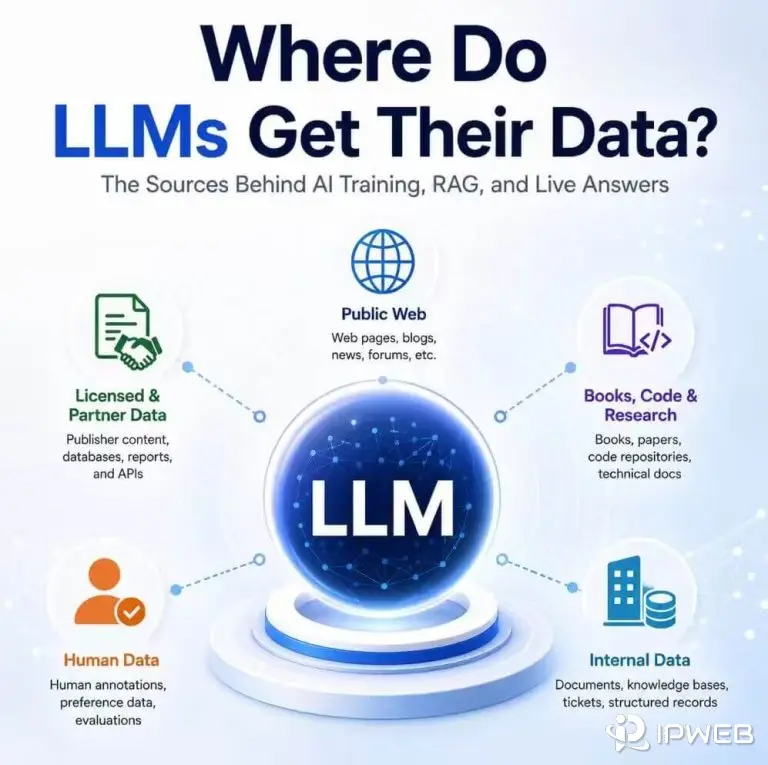
Where Do LLMs Get Their Data? Training Sources Explained
When people ask where large language models get their data, they may be referring to several different processes. A foundation model learns broad language patterns during pretraining, an assistant is refined during post-training, a RAG application retrieves documents at request time, and some products can use search or browsing tools to access current information. These mechanisms are related, but they are not interchangeable. A document retrieved by a RAG system is not automatically added to the model's training data, and a model that can browse the web is not continuously retraining itself on every page it opens. Quick Answer LLM...
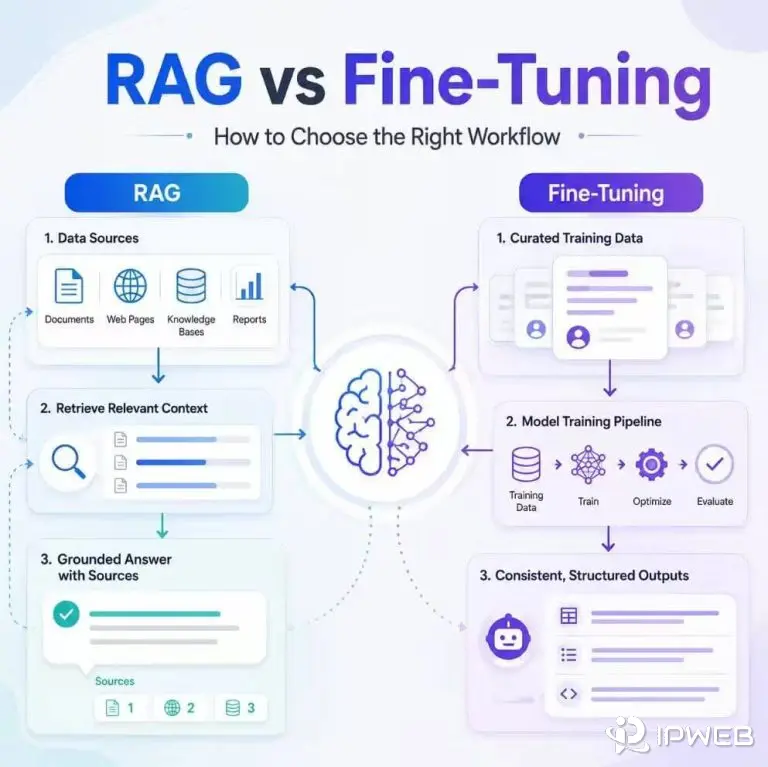
RAG vs Fine-Tuning: Choosing a Web Data Workflow
Choosing between retrieval-augmented generation and fine-tuning is not simply a choice between two model techniques. It is a decision about where knowledge should live, how quickly it must change, whether answers need traceable sources, and what type of data your team can maintain. For web data projects, this distinction matters even more. Product pages, news, search results, policies, and market data can change frequently. A model may also need to classify records, follow a fixed schema, or produce consistent outputs. Those requirements point to different workflows. Direct Answer Choose RAG when the system needs current or source-grounded information. Choose fine-tuning...