

Google AI Overviews can appear, disappear, or cite different sources even when the search query stays the same. A single SERP capture shows one moment, but it does not show whether the result is stable or how citation visibility changes over time.
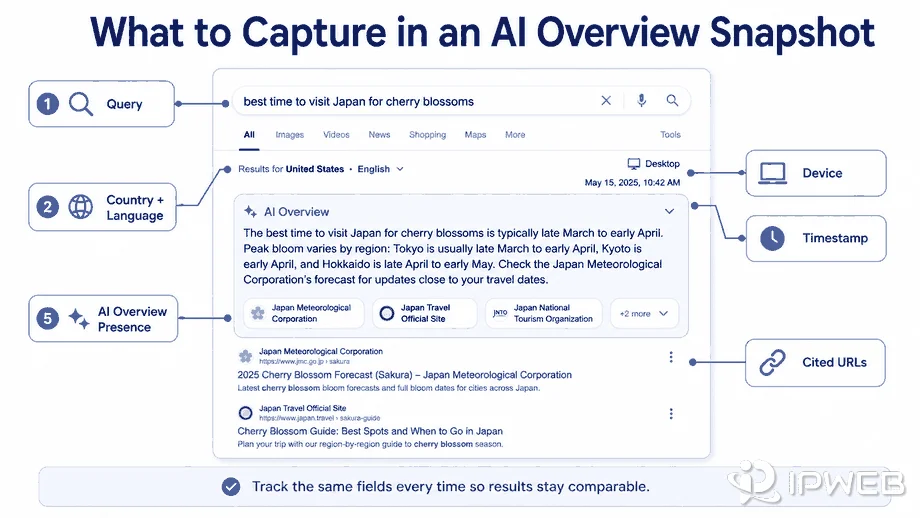
Useful AI Overview tracking focuses on observable search data: the exact query, country, language, device, timestamp, AI Overview presence, cited URLs, and surrounding organic results. Keeping those conditions consistent makes repeated captures easier to compare without treating a visible citation as proof of Google's selection logic.
AI Overview tracking means checking whether Google shows an AI Overview for a defined query, which sources are visibly cited, and how that result changes across repeated searches. Keep the query, country, language, device, and capture conditions consistent. SERP observations can show visible changes, but they cannot prove why Google selected a source or guarantee that the same citation will appear again.
- Track AI Overviews as changing search features rather than fixed rankings.
- Record the query, country, language, device, timestamp, AI Overview presence, and cited URLs.
- Use the same query set and search conditions when comparing results over time.
- Separate visible citation changes from assumptions about why Google selected a source.
- Use Search Console and direct SERP observation for different parts of the measurement process.
- For regional comparisons, keep the network location consistent; a static proxy endpoint can reduce location variation without influencing whether an AI Overview appears.
What AI Overview Tracking Measures
Google AI Overviews are generated search summaries that can appear above or among traditional results. Tracking focuses on what is visible at a specific moment: whether an AI Overview appears, which URLs or domains are shown as sources, and what other results appear nearby.
Because AI-generated search results can change, one screenshot or one search is not enough to establish a trend. Repeated observations are more useful when the same conditions are preserved. A basic record should include the exact query, country, language, device type, timestamp, AI Overview status, visible source URLs, and surrounding organic results.
Location, language, device, and result structure also matter when search pages are collected repeatedly. For a closer look at how those fields shape structured search snapshots, see how SERP data collection works.
What SERP Data Can and Cannot Show
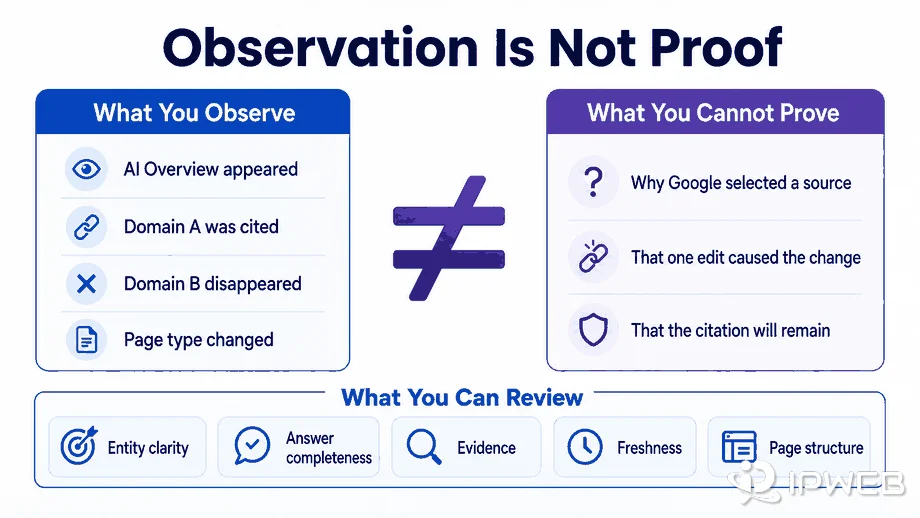
SERP data is useful for recording observable search results, but it does not reveal Google's internal ranking systems. A citation that appears today can disappear, move, or be replaced later, even when the underlying page has not changed.
| SERP data can show | SERP data cannot prove |
|---|---|
| Whether an AI Overview appeared at capture time | Why Google generated the AI Overview |
| Which source URLs were visibly cited | Why a specific source was selected |
| Query, market, language, device, and timestamp context | Every personalized search experience |
| Changes across repeated observations | That one page edit caused a citation change |
| Nearby organic results and other SERP features | Future citation stability |
Build a Repeatable Tracking Workflow
A useful AI Overview tracking process depends on consistent comparisons. Start with a fixed list of queries and define the market, language, device, and capture conditions before collecting results.
- Select a stable query set.
- Define the target country or market, language, and device type.
- Record whether an AI Overview appears.
- Save the visible cited URLs and domains.
- Record nearby organic results and notable SERP features.
- Repeat the same checks on a consistent schedule.
- Compare citation gains, losses, and source changes over time.
For larger query sets, a spreadsheet or database can keep the observations structured. Keep measured fields such as “citation present” separate from conclusions about why a source appeared or disappeared.
The same consistency principles apply to conventional ranking checks. Our rank tracking workflow shows how recurring SERP snapshots can be organized by query, location, device, timestamp, and historical change.
Build a Useful Query Set
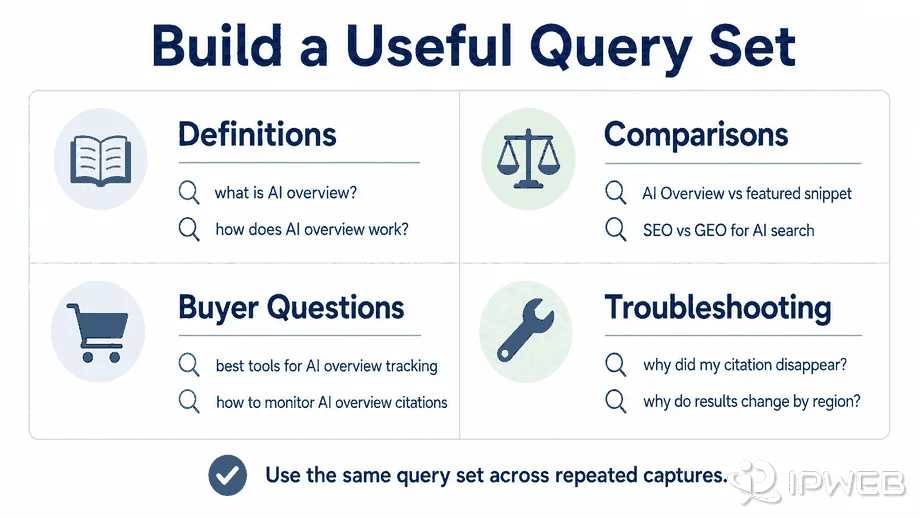
A query set should reflect the questions that matter to the site rather than a random collection of high-volume terms. Useful groups often include definitions, comparisons, buyer questions, troubleshooting searches, and product or category alternatives.
| Query group | Example intent | What to observe |
|---|---|---|
| Definitions | “what is residential proxy” | Whether an AI Overview appears and which educational sources are cited |
| Comparisons | “residential proxy vs datacenter proxy” | Which comparison pages and brands appear |
| Buyer questions | “best proxy type for market research” | Whether product pages, publishers, documentation, or forums are cited |
| Troubleshooting | “why does my proxy connection fail” | Whether support pages, forums, or technical documentation are cited |
Track Citations and Changes Over Time
A visible AI Overview citation is a point-in-time observation, not a permanent ranking. One useful comparison is citation continuity: does the same domain remain visible, does a new source replace it, or does the AI Overview disappear entirely?
For example, a query may cite Domain A, Domain B, and Domain C during one observation, then cite Domain A and Domain D several days later. That does not explain why the sources changed. It does show that citation visibility is variable and that a single captured result can be misleading.
When a page is repeatedly cited, review factual completeness, clear entity naming, direct answers, supporting evidence, useful tables or examples, and current information. These checks can improve content quality, but none of them guarantees future citation.
Search Console vs SERP Tracking
Google introduced dedicated Generative AI performance reports in Search Console in June 2026. The reports show impressions for a site's URLs in generative AI features and can be broken down by pages, countries, devices, and dates. Google states that the reports are still being rolled out to a subset of sites.
Google's Search Central announcement describes the report and its available dimensions. Google's broader guidance also recommends using Search Console to measure visibility in generative AI features rather than relying on assumptions about internal ranking signals.
| Search Console | Direct SERP tracking |
|---|---|
| Shows your site's generative AI impressions where the report is available | Shows what was visibly present for a defined query at capture time |
| Breaks visibility down by page, country, device, and date | Can preserve exact query, market, language, and visible citation context |
| Focuses on your own verified property | Can compare the broader SERP environment and visible competing sources |
| Uses Google's first-party reporting | Depends on the consistency of the observation method |
If you are deciding when to use first-party Search Console reporting and when to inspect public search-result snapshots, see Google Search API vs SERP API for a side-by-side comparison.
Why Location Consistency Matters
AI Overviews and other search features can vary by market, language, device, and other context. If regional comparison matters, avoid mixing observations collected under different location conditions and treating them as a single trend.
A stable network location can make regional checks easier to compare. A consistent static residential proxy can provide a repeatable network endpoint when a permitted workflow needs the same regional routing across multiple checks.
The proxy does not determine whether Google shows an AI Overview, and it does not make citation results predictable. It only helps control one part of the search environment.
Minimal Python SERP Capture Example
The example below keeps the Google market and language parameters fixed and sends the request through the same static proxy endpoint. It saves the returned SERP HTML for later comparison. Google can change its response format, and an AI Overview is not guaranteed to appear for every query or request.
import requests

proxy = "http://USERNAME:PASSWORD@STATIC_PROXY_HOST:PORT"
proxies = {"http": proxy, "https": proxy}

params = {
    "q": "what is residential proxy",
    "gl": "us",
    "hl": "en",
}

headers = {
    "User-Agent": "Mozilla/5.0"
}

response = requests.get(
    "https://www.google.com/search",
    params=params,
    headers=headers,
    proxies=proxies,
    timeout=30,
)
response.raise_for_status()

with open("ai-overview-serp.html", "w", encoding="utf-8") as file:
    file.write(response.text)

print(response.url)
For repeated monitoring, keep the query, gl, hl, device profile, and proxy location consistent, then compare the saved observations over time. Do not assume that one HTML selector will remain stable indefinitely; record only the AI Overview and citation fields that are actually visible in each captured result.
Google also notes that AI features are part of Search and that normal Search eligibility and content-quality guidance still apply. The Google Search Central AI features documentation provides current eligibility guidance.
Frequently Asked Questions
Final Thoughts
AI Overview tracking works best as a controlled measurement process. Keep the query set and search conditions stable, record only what is visibly observed, compare changes over time, and use Search Console alongside SERP observations when the generative AI report is available. This produces a clearer view of AI search visibility without turning a changing search result into a claim about Google's internal selection logic.