
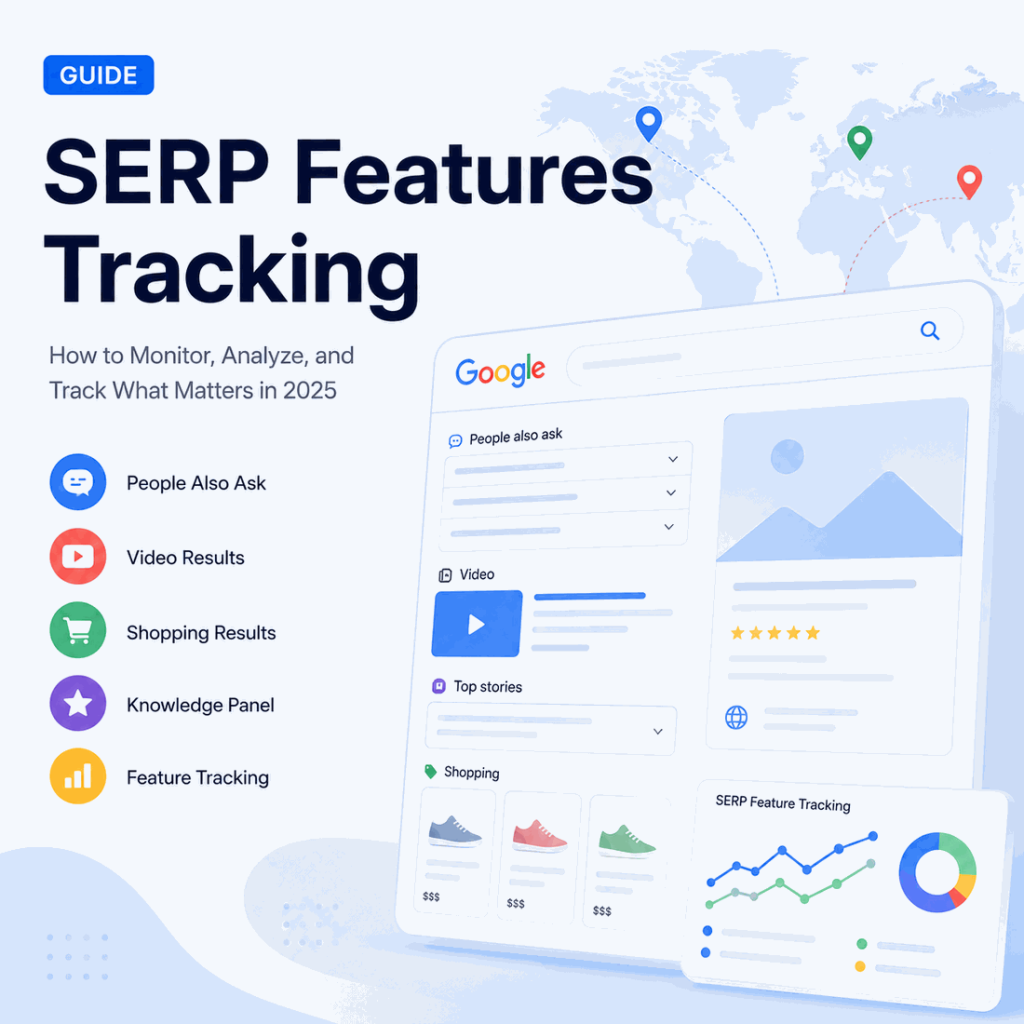
SERP features can change what users see before they ever reach a traditional organic listing. For teams comparing search visibility across countries or cities, the important question is not only which features appear, but whether those observations were collected under consistent location, language, device, and timing conditions.
SERP features are search-result elements beyond a standard organic listing, such as featured snippets, People Also Ask, local packs, shopping results, videos, knowledge panels, Top Stories, and AI Overviews. For regional SEO checks, track both feature presence and feature ownership while keeping the search environment consistent. A region-targeted proxy can help control the IP-based network-location signal, but it does not control every factor that can change a search result.
- SERP feature tracking should record both presence and ownership: what appeared and which domain, business, product, or source occupied it.
- Featured snippets, local packs, shopping units, videos, Top Stories, and AI Overviews serve different search intents and should not be measured as one generic visibility metric.
- Regional comparisons are only useful when query, language, device, timestamp, and location conditions are documented consistently.
- A proxy can help reproduce a selected IP-based network region for permitted search QA, but it does not control GPS, account history, cookies, personalization, or search-engine experiments.
- For multi-market checks, verify the exit IP and expected region before interpreting changes in SERP features.
What SERP Features Are
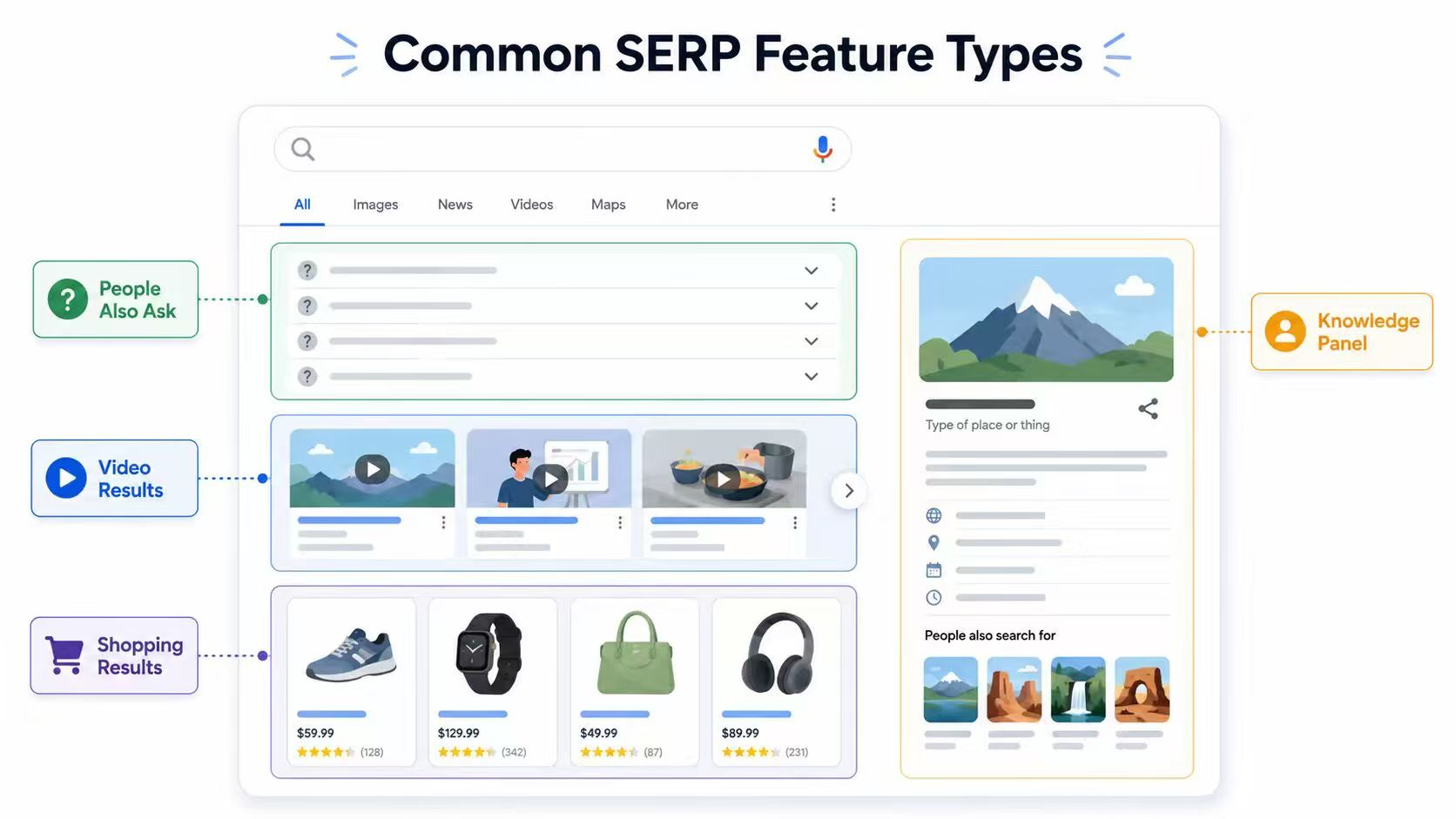
A standard organic result usually contains a title link, visible URL or site name, and a description. On a search engine results page (SERP), SERP features add other result formats around or between those listings. They may answer a question directly, group nearby businesses, surface products, show videos or images, highlight recent news, or generate an AI-assisted summary.
Google's visual elements gallery for Google Search documents many of the result formats that can appear in Search. The exact mix is not fixed, so feature analysis should focus on what was actually visible for the tested query and environment.
Common SERP Feature Types
Different features serve different user needs. A local query may emphasize nearby businesses, while a product query may surface shopping units. Informational searches may trigger featured snippets, People Also Ask, videos, or AI-generated answers.
| SERP feature | What it shows | Typical search intent | Useful tracking field |
|---|---|---|---|
| Featured Snippet | A prominently extracted answer from a web page | Informational | Presence, source URL, snippet format |
| People Also Ask | Expandable related questions and answers | Informational / exploratory | Questions shown, cited domains |
| Local Pack | Nearby businesses and map-based results | Local | Businesses shown, order, tested city |
| Shopping Results | Products, prices, merchants, and product imagery | Commercial / transactional | Products, merchants, price visibility |
| Video Results | Video cards or carousels | How-to / visual | Video source, position, format |
| Top Stories | Fresh news coverage | News / freshness-sensitive | Publishers shown, timestamp |
| AI Overview | An AI-generated summary with visible source links when provided | Informational / exploratory | Presence, cited URLs, surrounding results |
| Sitelinks | Additional pages from the same site beneath a primary result | Navigational / branded | Pages shown, branded query context |
Some rich search appearances can depend on supported structured data and other eligibility requirements. Google's structured data feature gallery shows which search experiences have documented markup requirements. Valid markup can make a page eligible, but it does not guarantee that Google will display a specific feature.
How Stable Are Different SERP Features?
Not every SERP feature changes at the same rate. A useful tracking plan should consider how sensitive each feature is to regional context, freshness, and ownership changes instead of assuming that all features behave like standard organic listings.
| SERP feature | Regional sensitivity | Time sensitivity | Ownership volatility |
|---|---|---|---|
| Local Pack | High | Medium | High |
| Shopping Results | High | Medium | High |
| Featured Snippet | Medium | Medium | Medium |
| People Also Ask | Medium | Medium | High |
| Top Stories | Medium | Very high | Very high |
| AI Overview | Medium to high | High | High |
| Sitelinks | Low | Low to medium | Low |
For example, Local Packs and shopping modules are often more sensitive to market context, while Top Stories can change quickly as new coverage appears. AI-assisted results can also change in both presence and cited sources. A tracking schedule should reflect those differences rather than treating one snapshot as representative for every feature type.
Why Regional SERP Feature Testing Needs Consistent Network Location
SERP feature analysis becomes more difficult when teams compare results across markets. A Local Pack may appear in one city and disappear in another. Shopping units, news modules, videos, and AI-assisted results can also differ between markets or languages.
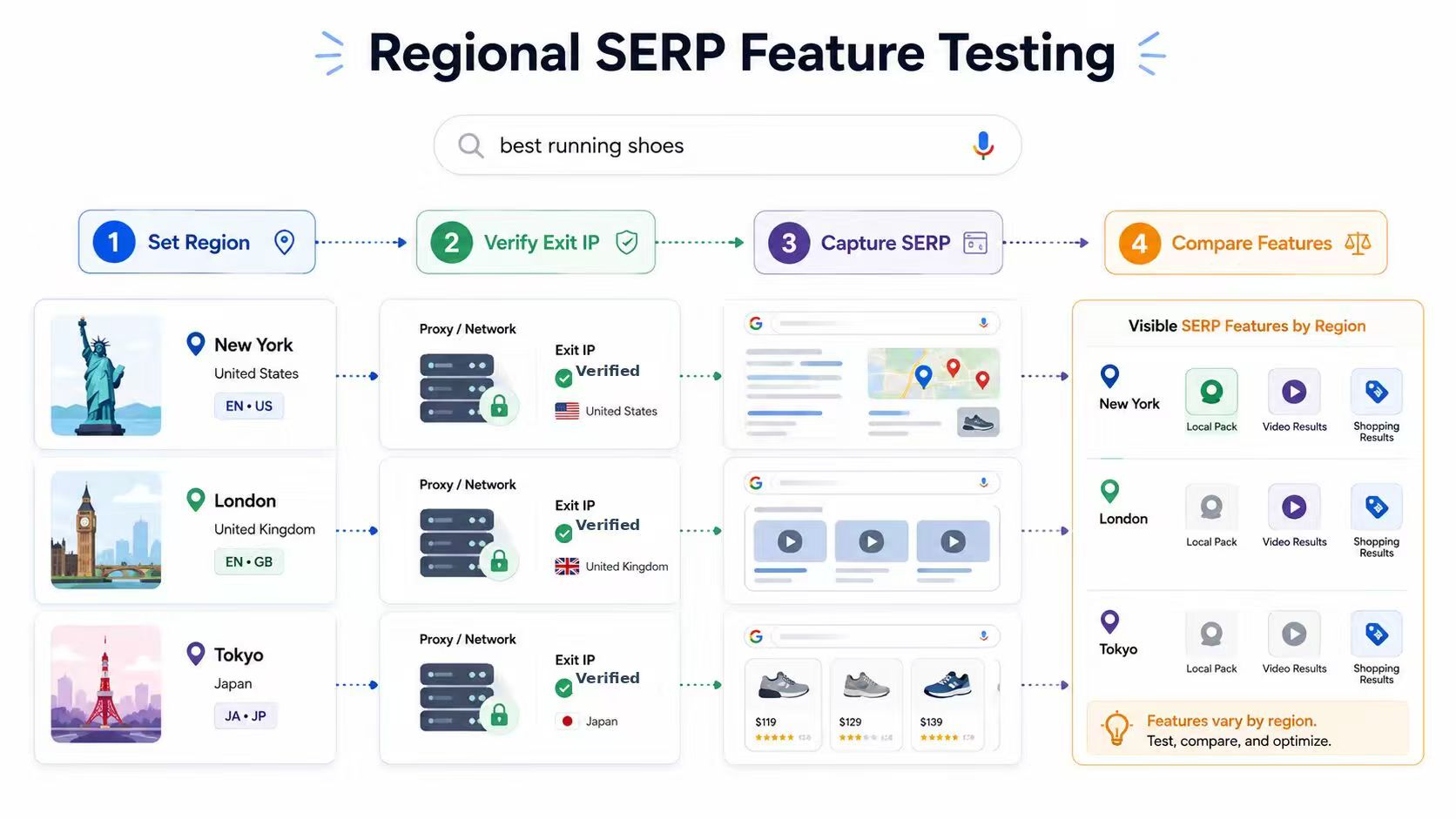
That means a regional comparison needs a controlled observation method. Record the query, target country or city, language, device type, timestamp, signed-in state, and visible SERP features. When the workflow uses a proxy, record the proxy region and exit IP as well.
For permitted regional SEO and QA checks, IPWeb dynamic residential proxies can provide country- or city-targeted network endpoints for comparing public search-result environments across multiple markets.
The proxy should be treated as one controlled variable, not as the explanation for every difference. It changes the visible network route and IP-based location signal. It does not automatically change browser language, precise device location, account history, cookies, personalization, or search-engine experiments.
A regional proxy can control the IP-based network route used for a SERP check. It cannot automatically control precise device location, browser language, signed-in account history, cookies, personalization, device type, or search-engine experiments. Treat the proxy as one controlled test variable rather than a guarantee of a specific SERP layout.
How to Analyze SERP Features Across Locations
Start with a fixed query set and define the markets you want to compare. Keep the language and device profile consistent unless one of those variables is the subject of the test.
Before capturing the SERP, confirm that the browser, script, or tool is actually using the intended network route. If the exit IP or location does not match the test plan, the resulting feature comparison may be misleading. IPWeb's Whoer IP check guide explains how to compare visible IP, ISP or ASN, DNS, browser signals, and location estimates when validating a proxy route.
Example Controlled SERP Feature Test
Suppose the goal is to compare whether the same keyword triggers a Local Pack in New York, Chicago, and Los Angeles. Keep the query, browser language, device type, signed-in state, and capture method unchanged, then change only the regional network route.
| Variable | Example test setting |
|---|---|
| Query | Same keyword in every market |
| Device | Desktop |
| Language | English |
| Account state | Signed out |
| Network location | New York / Chicago / Los Angeles |
| Feature recorded | Local Pack presence and businesses shown |
| Route verification | Record the exit IP and expected region before capture |
This setup does not assume that every user in a city will see the same result. It creates a repeatable observation method so differences are easier to interpret.
- Use the same query wording for every market.
- Keep the language and device profile consistent.
- Set the intended network region and verify the exit IP.
- Record the timestamp and signed-in state.
- Capture which SERP features appear.
- Record which domain, business, product, or source occupies each feature.
- Repeat the same process before treating a one-time difference as a pattern.
When the goal is to compare feature changes rather than network behavior, change only the market variable whenever possible. If the query, browser profile, language, and device all change at the same time, it becomes difficult to tell which condition is associated with the observed SERP difference.
Track Feature Presence vs Feature Ownership
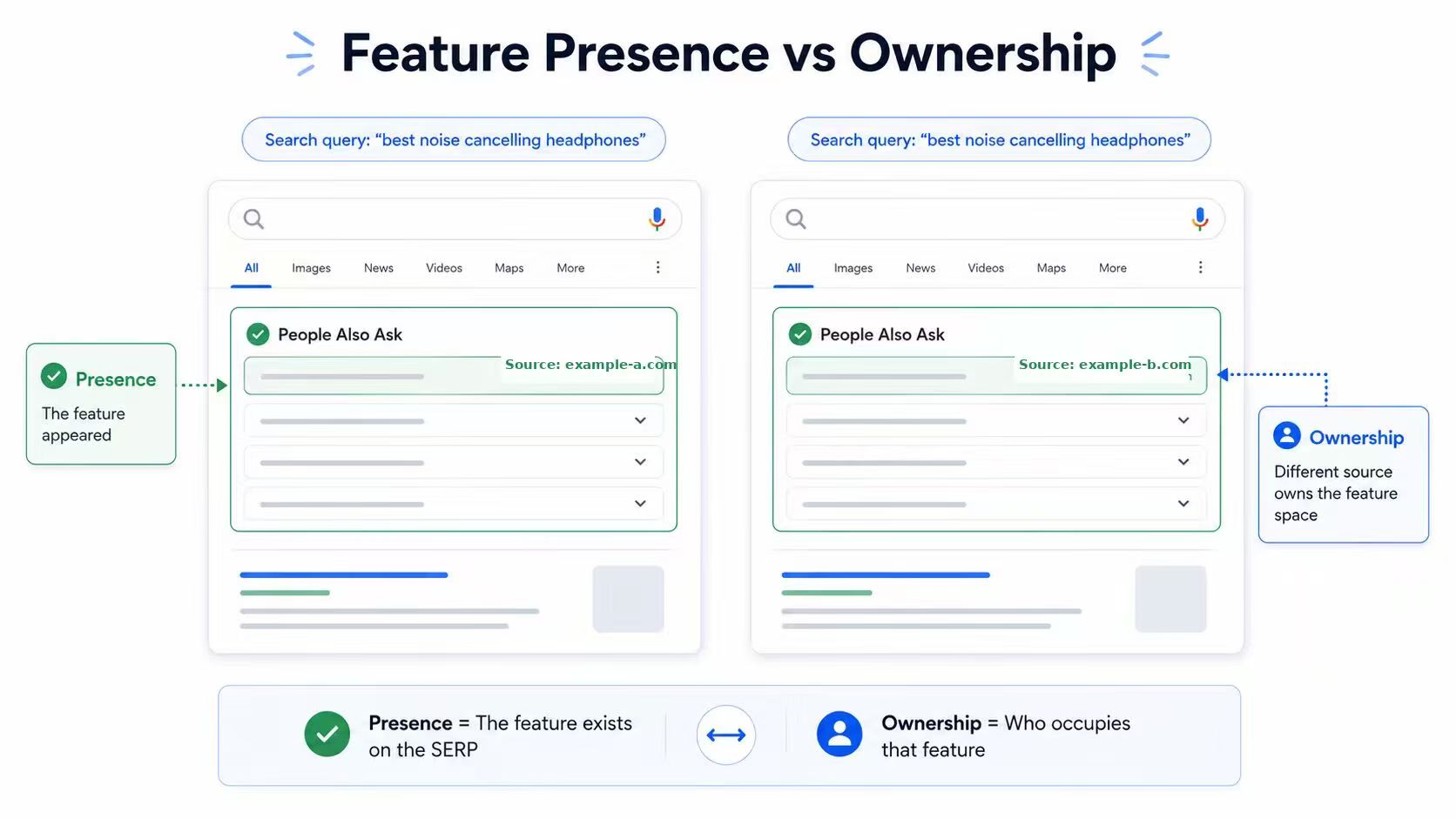
A useful SERP feature report separates two questions: Did the feature appear? and Who occupied it? Those are different measurements.
For example, a People Also Ask box may appear for the same keyword in several markets while citing different domains. A Local Pack may remain present while the listed businesses change. An AI Overview may appear in both locations but cite a different set of sources.
Four Ways a SERP Feature Can Change
Presence and ownership together create four common change patterns:
- Absent → present: a feature that was not visible appears in a later snapshot.
- Present → absent: a previously visible feature disappears.
- Present → present, owner changes: the feature remains, but a different domain, business, product, video, or cited source occupies it.
- Present → present, owner remains: the same owner remains visible, but its position, order, citation placement, or surrounding layout changes.
A report that records only feature presence will capture the first two patterns but can miss meaningful ownership and layout changes in the third and fourth.
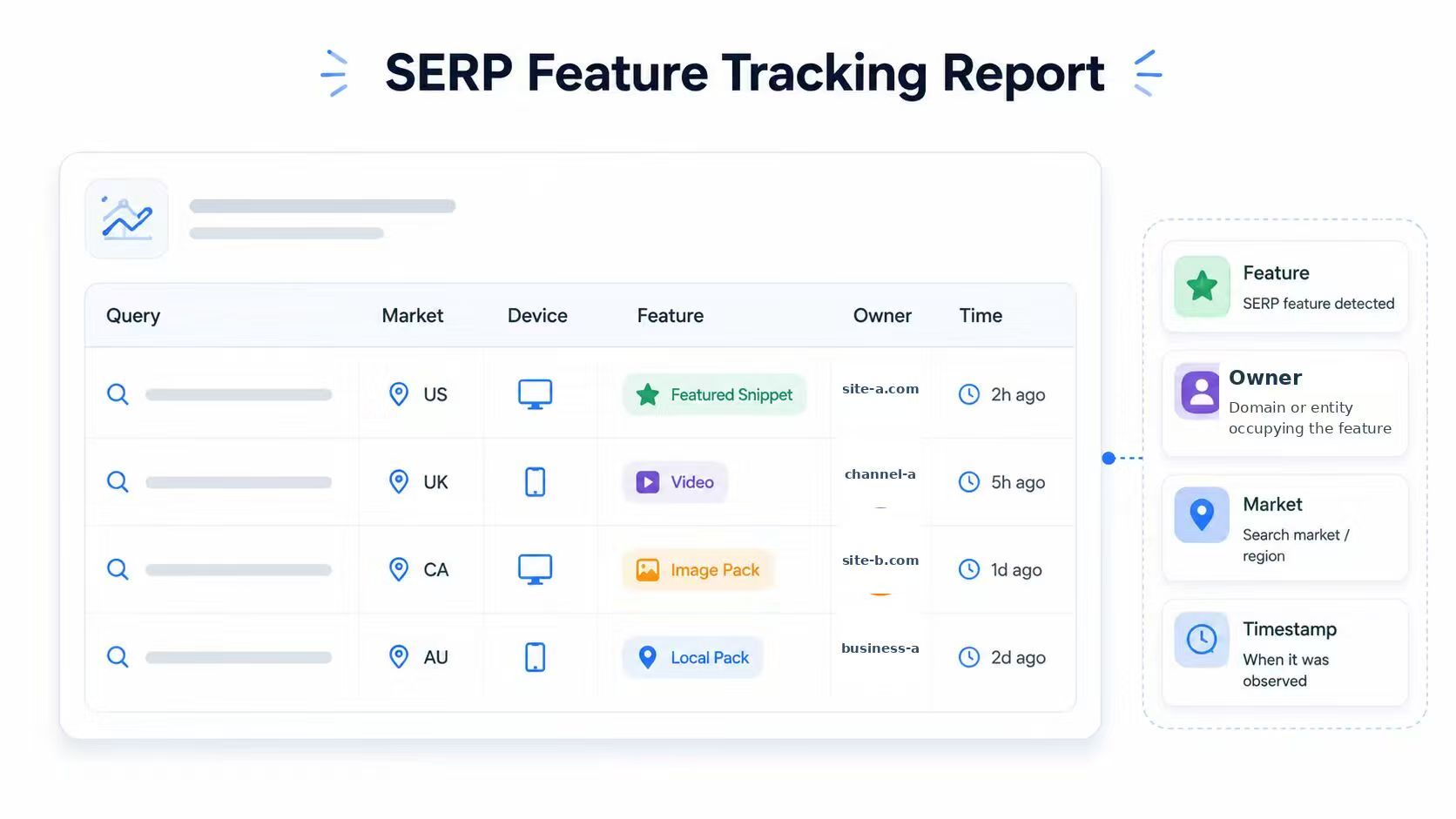
| Tracking field | Example value | Why it matters |
|---|---|---|
| Feature presence | Local Pack: Yes | Shows whether the feature existed in that snapshot |
| Feature ownership | Business A, Business B, Business C | Shows which entities received the visible placement |
| Market | New York, US | Separates regional observations |
| Device | Mobile | Prevents desktop and mobile layouts from being mixed |
| Timestamp | 2026-08-24 10:00 ET | Keeps changing search features tied to a specific observation time |
| Exit IP / route | Recorded test endpoint | Confirms which network-location condition was used |
AI Overviews are a good example of why this distinction matters. Presence alone does not show which sources were cited or whether citation visibility changed later. For a dedicated workflow, see how to track Google AI Overviews with SERP data.
How SERP Features Affect Search Visibility
SERP features can increase visibility when they include your page, product, video, business listing, or cited source. They can also reduce the amount of screen space available to traditional organic results.
That is why a position number should not be interpreted in isolation. A page may hold the same organic rank while a Local Pack, shopping unit, Top Stories block, or AI Overview changes what users see above it.
The useful metric is therefore not simply “rank unchanged.” A stronger report records whether the surrounding result layout changed and whether the tracked site gained, lost, or never owned the visible feature.
Why Two SERP Feature Checks May Not Match
Two SERP feature checks can disagree even when the keyword is the same. Before treating the difference as a ranking change, verify whether the test conditions actually matched.
| Possible cause | What to verify | Why it matters |
|---|---|---|
| Unexpected exit IP or region | Visible exit IP, city or country estimate, and proxy session | The search engine may receive a different network-location signal than intended |
| Different device profile | Desktop vs mobile, browser viewport, user agent | SERP layouts and feature availability can differ by device |
| Different language settings | Search language and browser language | Result sources and feature composition can change with language context |
| Different account or cookie state | Signed-in status, cookies, and personalization state | Search context can change even when the network route is identical |
| Different capture time | Timestamp and freshness-sensitive features | Top Stories, shopping inventory, AI-assisted results, and other modules can change quickly |
A mismatch does not automatically mean the proxy failed or the tracking method is inaccurate. First confirm the route and environment, then compare the visible feature and its owner under equivalent conditions.
Common SERP Feature Tracking Mistakes
One common mistake is comparing snapshots that were collected under different conditions. A result captured on mobile in one city should not be treated as directly comparable with a desktop result from another country unless those differences are intentional parts of the test.
Another mistake is recording only whether a feature exists. Presence without ownership cannot tell you whether your site, competitor, product, business listing, or cited source actually gained visibility.
Do not assume that a feature will remain stable. Search engines can change layouts, eligibility, ranking systems, and experiments. Repeated observations are more useful than treating one screenshot as a permanent result.
Finally, do not assume a proxy guarantees a particular SERP feature. A proxy can help control the network-location condition used for a regional check, but the search engine still determines which features and results appear.
Frequently Asked Questions
Final Thoughts
SERP feature tracking is most useful when it measures more than a feature list. Record what appeared, who occupied it, and the market, device, language, time, and network conditions behind the observation.
For regional SEO checks, a proxy can help make the network-location variable more controlled, while a separate route check confirms that the intended endpoint is actually in use. Keep those network measurements separate from the search engine's own decisions about which features appear. That produces cleaner comparisons without duplicating basic SERP definitions or treating a single result page as permanent.