
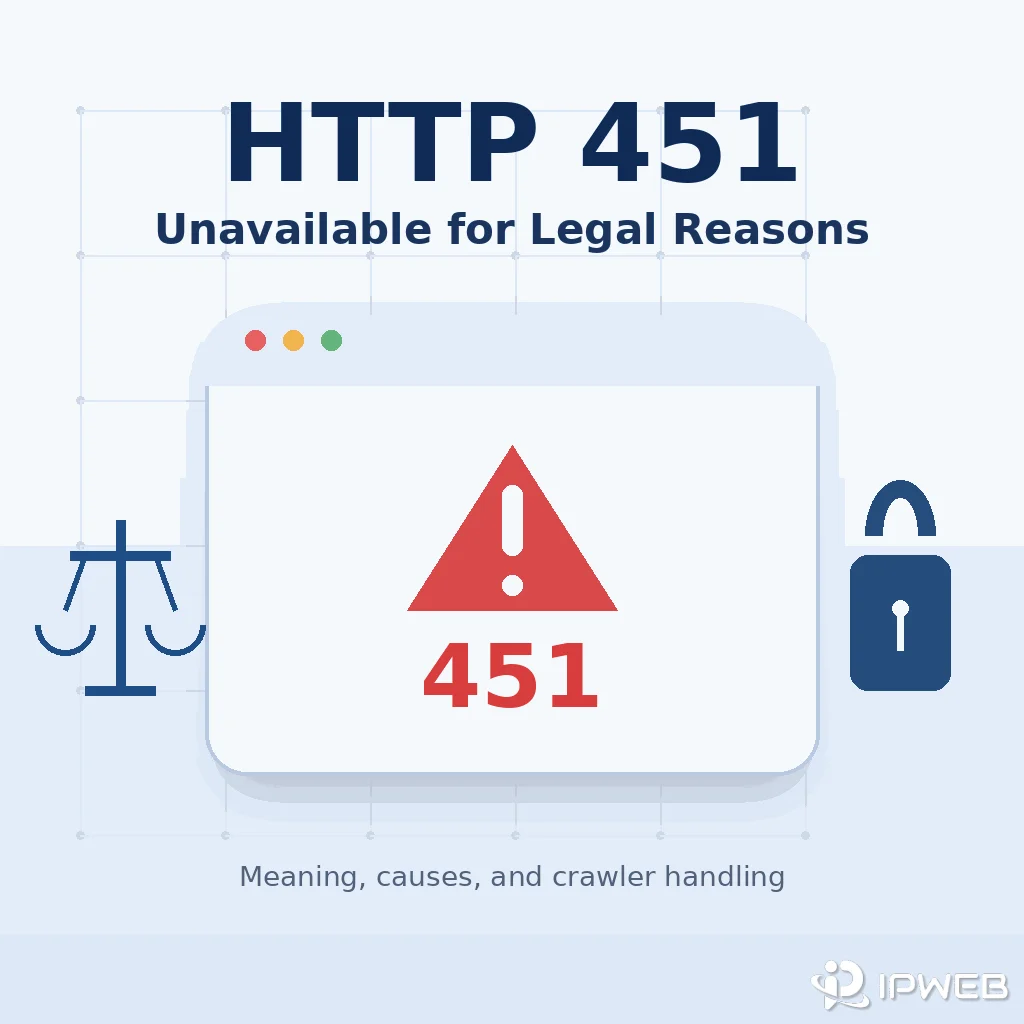
HTTP 451 Unavailable for Legal Reasons means that a website, CDN, internet service provider, search service, or another intermediary is refusing to provide a resource because of a legal demand. It is not an ordinary connection failure, authentication error, or proxy error.
An IP address can affect the response when the restriction is applied according to the requester's country, jurisdiction, or network location. In that case, the IP helps the service decide whether the legal rule applies, but it is not the underlying cause of the restriction.
HTTP 451 indicates that a resource is unavailable because access is being denied as a consequence of a legal demand. A proxy IP may help an authorized team confirm whether the response differs by region, but changing the IP does not remove the legal restriction or make access permissible.
- HTTP 451 identifies a legal availability restriction rather than a normal server, connection, authentication, or proxy failure.
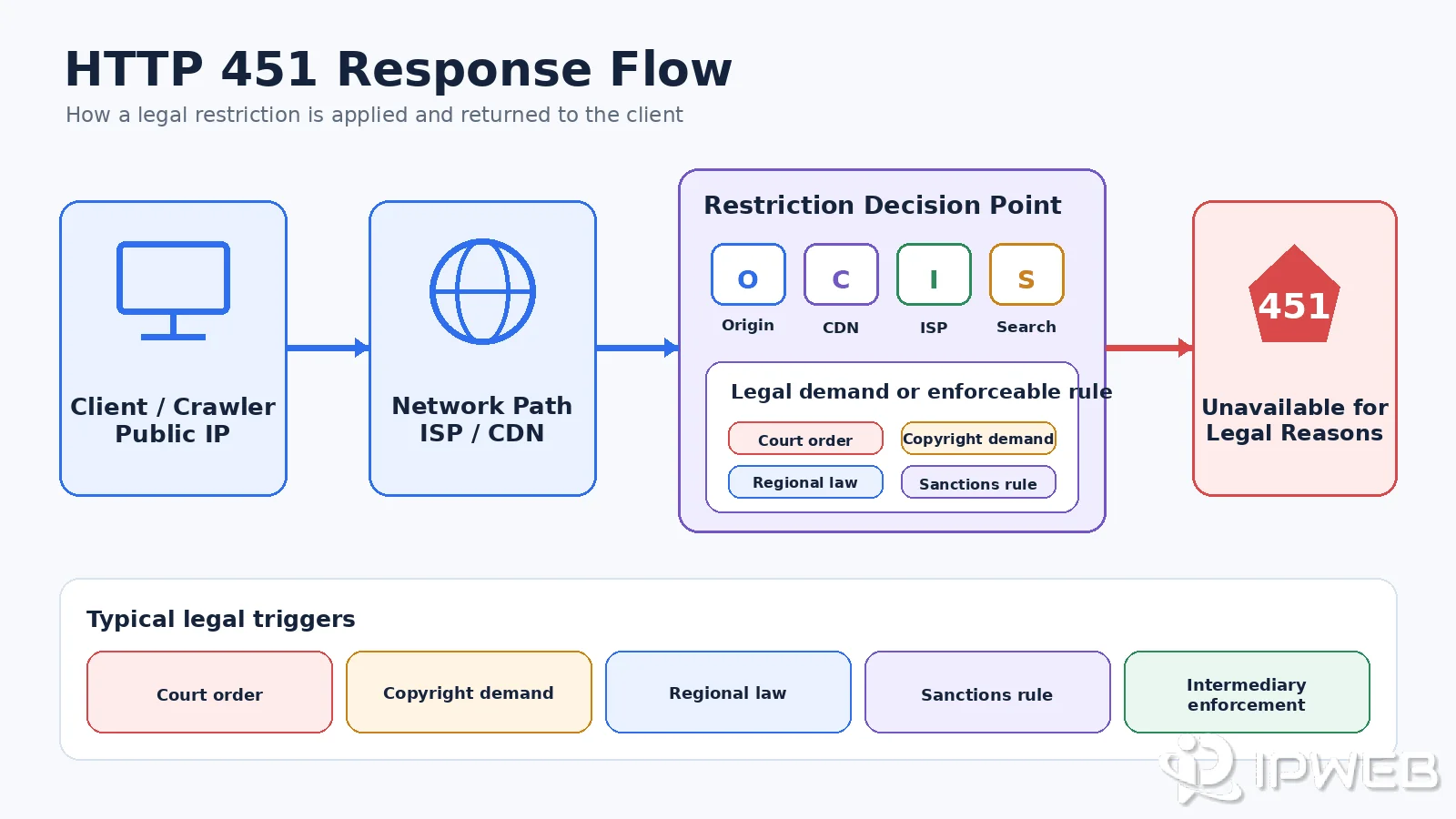
- The response may be returned by the origin website or by an intermediary such as a CDN, internet service provider, or search service.
- An IP address matters only when the restriction is applied by country, jurisdiction, or network location.
- A proxy can support authorized regional availability testing, but it should not be treated as a way to fix or override HTTP 451.
- Crawlers should usually log HTTP 451, stop automatic retries, preserve the response details, and route the URL to a compliance review.
What HTTP 451 Means
HTTP 451 is standardized in RFC 7725. It is used when a server or intermediary cannot provide a requested resource because access is being denied as a consequence of a legal demand.
The status code is named after Ray Bradbury's novel Fahrenheit 451. Its purpose is to communicate a legal obstacle more clearly than a general 403 Forbidden or an unexplained 404 response. However, websites are not required to use HTTP 451 in every legally restricted situation, so some services still return a different status code or a custom restriction page.
The response body may explain the applicable legal demand, affected jurisdiction, restricted resources, or requesting authority. A response can also include a Link header with rel="blocked-by", which identifies the entity implementing the restriction rather than necessarily identifying the authority that requested it.
Common Causes of HTTP 451
HTTP 451 can appear in several legal and regulatory situations. The exact reason should be determined from the response body, headers, publisher notice, or another authoritative explanation rather than from the status code alone.
Government or Court-Ordered Restrictions
A website operator, hosting provider, or intermediary may receive a legal demand requiring it to restrict a page, file, domain, or group of resources. The restriction may apply globally or only within a particular jurisdiction.
Copyright and Content-Removal Demands
A publisher or platform may return HTTP 451 after receiving a legally enforceable copyright or content-removal demand. This is different from a page that was voluntarily deleted, moved, or temporarily unavailable.
Regional Legal and Distribution Boundaries
Some content is legally available in one country but unavailable in another. A service may use the public IP address to estimate the requester's location and determine whether a jurisdiction-specific rule applies.
Sanctions and Regulatory Obligations
A provider may restrict access when sanctions, export controls, sector-specific regulations, or another enforceable legal obligation prevents it from serving a resource to certain regions or users.
Restrictions Implemented by an Intermediary
The origin website is not always the system returning the response. A CDN, internet service provider, search service, cache provider, or another intermediary in the request path may implement the legal restriction.
HTTP 451 vs 403 Forbidden
Both status codes indicate that access was denied, but they communicate different reasons. HTTP 403 is a broad refusal, while HTTP 451 specifically signals that a legal demand is preventing access.
| Status Code | What It Means | Typical Causes | Best Next Step |
|---|---|---|---|
| 403 Forbidden | The server understood the request but refuses to authorize it. | Permissions, account policy, security rules, request configuration, or access controls. | Check authentication, permissions, request headers, site rules, and traffic patterns. |
| 451 Unavailable for Legal Reasons | The resource is unavailable because access is being denied as a consequence of a legal demand. | Court orders, legal takedown demands, jurisdiction-specific restrictions, sanctions, or another enforceable legal obligation. | Preserve the response, identify the restriction, stop automatic retries, and review permitted alternatives. |
For broader permission and access-denial troubleshooting, see our guide to HTTP 403 Forbidden. Authentication failures follow a different path, which is explained in our HTTP 401 vs 403 comparison.
How to Check an HTTP 451 Response
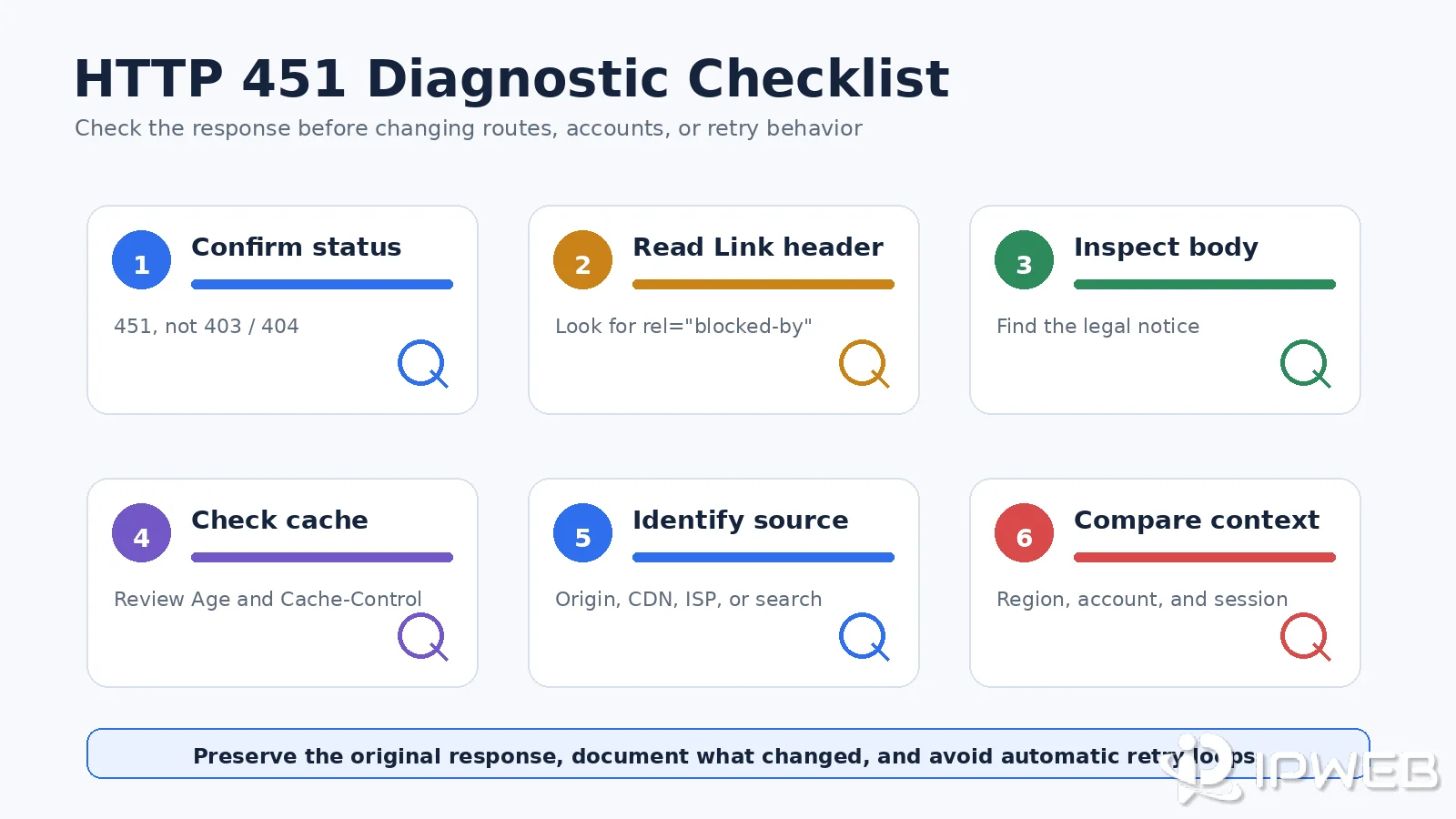
Start by preserving the original response. Record the requested URL, timestamp, request method, status line, response headers, and body. Avoid immediately following redirects or running repeated retries because the first response may contain the clearest evidence of where the restriction was applied.
- Confirm whether the status is actually 451 rather than 403, 404, or a redirect.
- Inspect the response body for a legal notice, affected jurisdiction, or restricted-resource explanation.
- Look for a
Linkheader containingrel="blocked-by". - Check CDN, server, cache, and routing headers to identify where the response originated.
- Compare the result with a normal browser, an authenticated session, and another public page on the same domain.
- Document any regional comparison without attempting to force access to the restricted resource.
Use this command to inspect response headers without downloading the page body:
curl -sS -D - -o /dev/null https://example.com/restricted-pageThe command above uses the Unix null device. In Windows Command Prompt or PowerShell, use NUL instead:
curl.exe -sS -D - -o NUL https://example.com/restricted-pageUse this version when you also need the response body:
curl -sS -i https://example.com/restricted-page| Response Detail | What It Can Tell You |
|---|---|
| Status line | Confirms whether the request returned HTTP 451 directly or another status such as 403, 404, or a redirect. |
Link header with rel="blocked-by" |
May identify the website or intermediary implementing the restriction. |
| Response body | May explain the legal demand, applicable jurisdiction, affected users, or covered resources. |
Cache-Control and Age |
Help determine whether the response may have been served from a cache. |
| Server and CDN headers | May indicate whether the response came from the origin website or an intermediary. |
MDN's HTTP 451 reference provides a standard response example and explains how the blocked-by relationship should be interpreted.
Can an IP Address Affect HTTP 451?
Yes, but only indirectly. A website or intermediary may estimate the requester's country or jurisdiction from the public IP address and return HTTP 451 where a location-specific legal restriction applies. In that situation, the IP affects which rule is selected; it does not create the legal restriction.
| Observed Result | Likely Interpretation | Recommended Check |
|---|---|---|
| One region returns 200 and another returns 451 | The restriction may be jurisdiction-specific. | Compare the detected country, response body, headers, and published availability notice. |
| Every tested region returns 451 | The restriction may apply broadly rather than only by IP location. | Review the legal notice and stop location-based retries. |
| Only one proxy route returns 451 | The result may involve IP geolocation, account context, cache behavior, or an intermediary. | Verify the IP location and compare the same request without the affected route. |
| Many unrelated websites fail through the same route | The issue is more likely a general proxy or network problem than HTTP 451. | Check the route using a separate proxy error troubleshooting process. |
Residential and ISP proxy IPs can support authorized regional QA and content-availability testing for compliance documentation. They cannot override legally enforced restrictions, resolve the underlying legal issue behind an HTTP 451 response, or authorize access to restricted resources.
Switching between different IPs in the same restricted country or jurisdiction may still return HTTP 451 because the rule can apply to the entire region rather than to one individual IP address.
How Crawlers Should Handle HTTP 451
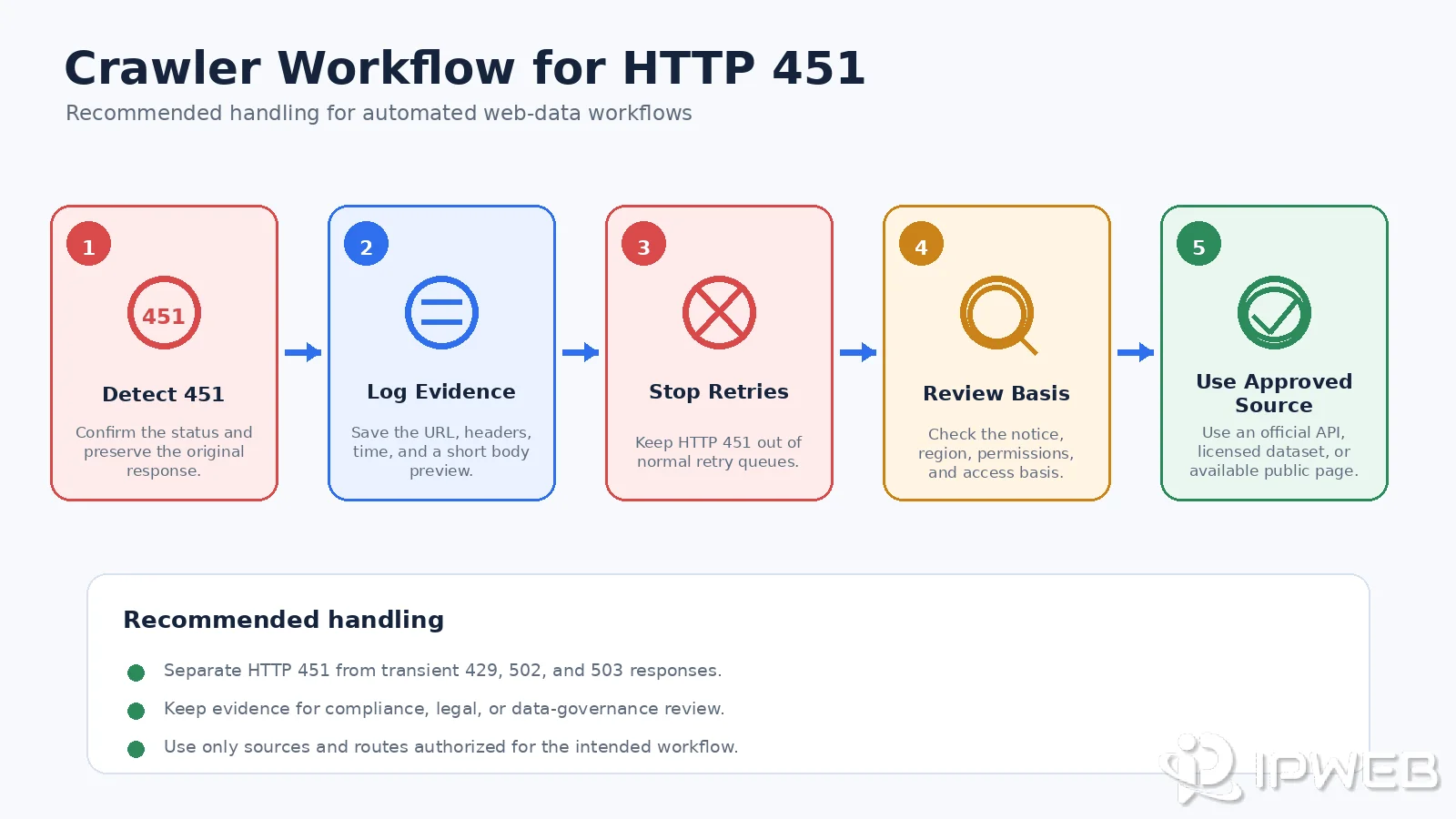
For automated web-data workflows, a practical default is to treat HTTP 451 as a stop condition rather than a retryable server error. This is an operational recommendation rather than a requirement of RFC 7725. Repeated retries are unlikely to resolve a legal restriction and can obscure useful diagnostic context if the request path, cache, or IP location changes.
- Log the URL, timestamp, response status, headers, and a limited body preview.
- Separate HTTP 451 from retryable responses such as 429, 502, and 503.
- Remove restricted URLs from recurring crawl queues until the access basis has been reviewed.
- Route the item to a compliance, legal, or data-governance review.
- Use official APIs, partner feeds, clearly available public pages, or pre-built structured datasets when they satisfy the same data need and their provenance, licensing terms, and permitted uses match the project.
- Document excluded records so downstream users understand why the dataset is incomplete.
This Python example records relevant response details and stops instead of retrying:
import requests

url = "https://example.com/restricted-page"
response = requests.get(
    url,
    timeout=20,
    allow_redirects=False,
)

if response.status_code == 451:
    record = {
        "url": url,
        "status": response.status_code,
        "blocked_by": response.links.get(
            "blocked-by",
            {},
        ).get("url"),
        "body_preview": response.text[:300],
    }

    print(record)
    raise SystemExit(
        "Stop: route this URL to compliance review."
    )
This minimal example is suitable for simple inspection workflows. For production crawlers, add exception handling, set response-size limits, avoid unnecessary full-page downloads, and send the result to structured logs rather than relying on console output.
Before collecting public web data, review the target site's rules and the broader legal considerations covered in our guide to web scraping legality.
Frequently Asked Questions
rel="blocked-by" link relation may identify that implementing entity.Final Thoughts
HTTP 451 is a legal availability signal, not a normal proxy, authentication, or server error. The most useful response is to preserve the evidence, identify whether the restriction came from the origin or an intermediary, and determine whether it applies globally or only within a specific jurisdiction.
Proxy IPs have a limited but legitimate role in authorized regional testing because a service may use the public IP to select a location-specific rule. That comparison does not remove the restriction. For automated web-data workflows, HTTP 451 should normally stop collection and trigger a review of permitted sources, APIs, licensed datasets, or other compliant alternatives.
For authorized cross-region content-availability checks, IPWeb's rotating residential proxies and long-session ISP proxies support location-specific verification for documented QA and compliance audits. They do not change the legal status of restricted content.