
LLMs do not become useful for current business questions just because someone gives them a pile of web pages. Raw HTML is noisy. Search results change. JavaScript pages may hide the content until a browser renders them. Documents need metadata, deduplication, chunking, and refresh rules before they can support a reliable AI workflow.
This guide explains what LLM data means, how public web content becomes AI-ready, how RAG differs from fine-tuning, and what to check before using an LLM scraper or web data platform.
LLM data is the text, metadata, documents, examples, and structured records used to train, fine-tune, evaluate, or ground large language models. LLM-ready web data is not raw HTML copied from a page; it is cleaned, permission-aware, well-formatted content with source metadata, quality checks, deduplication, and a refresh plan. For many RAG and agent workflows, freshness, relevance, and traceable sources matter at least as much as dataset volume.
- Raw web pages usually need cleaning before they are useful for LLMs, RAG systems, or AI agents.
- LLM training data, fine-tuning data, RAG data, and evaluation data have different quality requirements.
- An LLM scraper should preserve useful structure, remove boilerplate, capture metadata, and return stable formats such as Markdown or JSONL.
- RAG is generally better suited to fresh or source-grounded information, while fine-tuning is generally better suited to behavior, style, formatting, and repeatable task patterns.
- Crawlers, proxies, and scraping APIs can support permitted public data workflows, but they do not remove legal, contractual, privacy, or site-policy obligations.
What Does LLM Data Mean?
LLM data is any content used to build, adapt, evaluate, or ground a large language model. That can include books, documentation, public web pages, code, product catalogs, support tickets, transcripts, search results, and labeled examples. The important question is not only where the data comes from, but whether it is clean, relevant, permitted, and formatted for the job.
For a broad model, data volume and diversity matter. For a company RAG system, the better goal is usually traceable, current, high-quality documents. For fine-tuning, the dataset should teach the model a behavior or task pattern, not simply dump more facts into it.
That distinction matters for IPWeb readers because web collection is only one layer of the pipeline. You still need content extraction, normalization, metadata, deduplication, chunking, storage, retrieval, and review.
Where Do LLMs Get Their Data?
LLMs can be trained or grounded with many data sources: licensed datasets, public web corpora, documentation, code repositories, internal knowledge bases, human-written examples, synthetic data, and user-approved business records. Public web data is common because it is broad and current, but it is also messy.
Common Crawl is one well-known public web crawl corpus; its overview describes a regularly collected corpus containing raw web page data, metadata extracts, and text extracts. That type of corpus is useful for research and large-scale language work, but many business teams do not need to train a foundation model from scratch. They usually need a narrower workflow: collect relevant public pages, clean them, preserve source context, and feed them into RAG, analytics, or evaluation pipelines.
Robots and access rules also matter. Google Search Central explains that a robots.txt file tells crawlers which URLs they can access and is mainly used to manage crawler traffic. MDN similarly describes robots.txt as a file that specifies crawler access to a website or resources. These rules are not the whole legal analysis, but they are part of responsible crawl planning.
What Makes Web Data LLM-Ready?
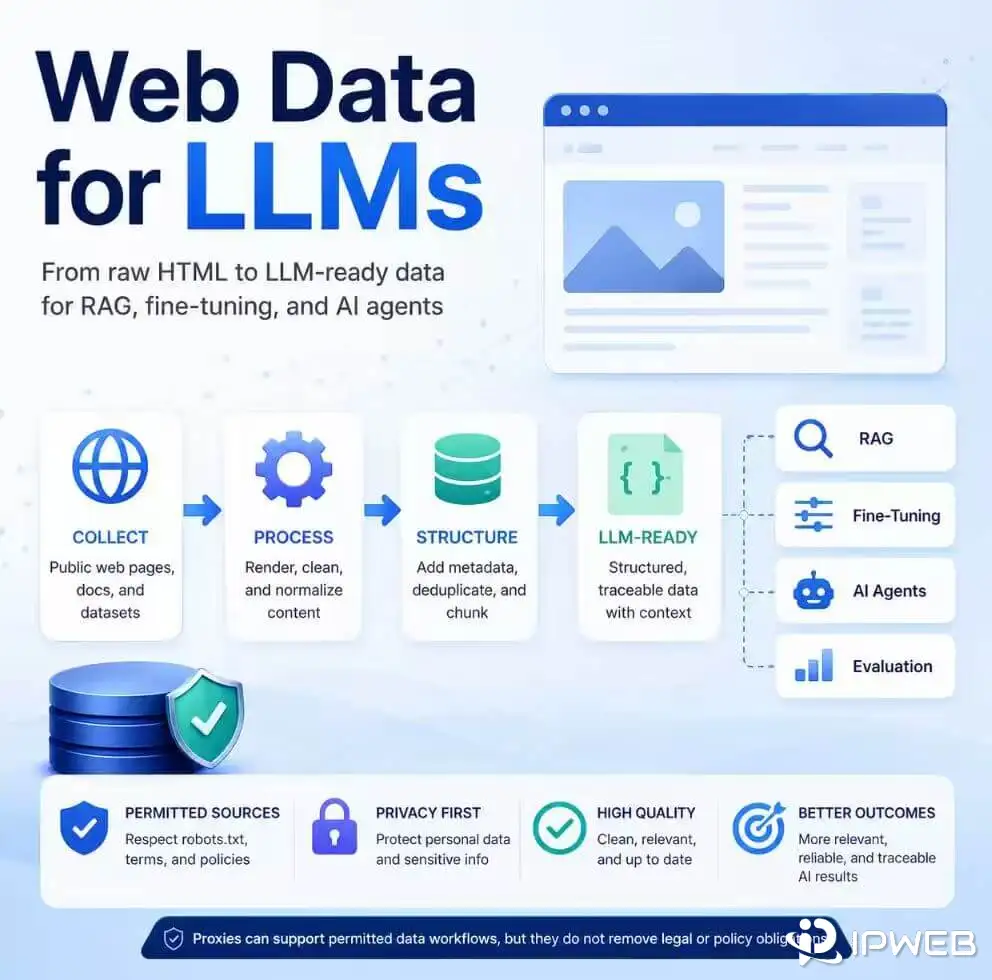
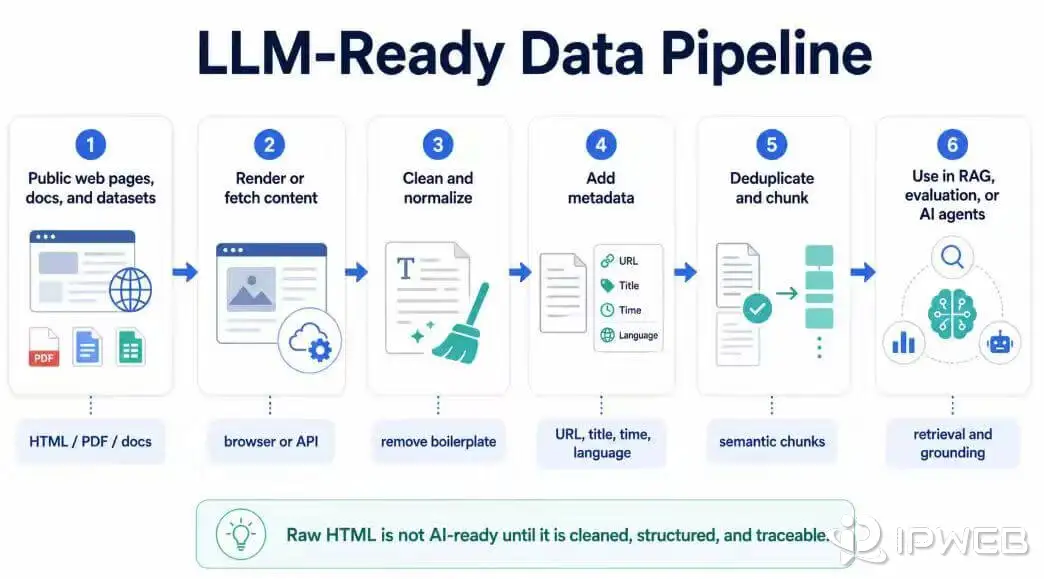
Web data becomes LLM-ready when it is understandable, traceable, and usable by downstream AI systems. A page copied as raw HTML may contain navigation, ads, cookie banners, duplicate templates, scripts, hidden text, and unrelated links. Feeding that directly into an LLM wastes tokens and can weaken retrieval quality.
LLMs usually do not parse a live web page by themselves. A collection pipeline first fetches or renders the page, identifies the main content, removes irrelevant elements, preserves source metadata, converts the result into a stable format, and divides it into usable passages or records. The model then receives selected content through a prompt, retrieval system, training dataset, evaluation workflow, or agent tool.
Good LLM-ready data usually has five properties:
- The main content is extracted without irrelevant boilerplate.
- The source URL, title, crawl time, language, and content type are preserved.
- The format is predictable, such as Markdown, JSONL, structured JSON, or clean text.
- Duplicate, thin, broken, or low-value pages are filtered.
- The data can be refreshed when the source changes.
| Format | Best For | Limitation |
|---|---|---|
| Raw HTML | Reprocessing pages later with full source context | Noisy, token-heavy, and harder to use directly |
| Clean text | Simple embedding or search workflows | May lose headings, tables, links, and code structure |
| Markdown | RAG, documentation ingestion, and LLM prompts | Needs consistent conversion and chunking rules |
| JSONL | Training, evaluation, and structured batch pipelines | Requires a clear schema and validation |
| Embeddings | Similarity search and retrieval | Not a replacement for source text or metadata |
LLM Scraper vs Web Scraper vs Scraping API
An “LLM scraper” is an informal marketing label, not a standardized web extraction protocol. It usually refers to a web scraper configured to return AI-friendly output such as Markdown, clean text, structured JSON, metadata, or document chunks. A conventional web scraper may extract fields for a database, while a scraping API may provide hosted retrieval, rendering, retries, and output formatting behind an endpoint.
The boundary is practical. If your workflow needs clean documentation pages for RAG, the output format and metadata may matter more than the scraper's raw ability to load a page. If your workflow needs e-commerce fields, the structured extraction schema matters more. If the site uses JavaScript rendering, you may need a browser-based workflow or a managed API that supports rendering.
When evaluating an LLM-ready data platform, check its rendering support, output formats, metadata fields, deduplication controls, refresh options, source traceability, and data-use boundaries instead of relying on the product label alone.
For the broader collection concept, use IPWeb's guide to what web scraping is. If the target page loads data after JavaScript runs, the existing guide on web scraping dynamic content explains how to diagnose rendered pages, pagination, and infinite scroll. For permitted workflows that need JavaScript rendering and structured outputs such as HTML, JSON, or Markdown, review the IPWeb Web Scraping API.
RAG LLM vs Fine-Tuning: Different Data Needs
RAG and fine-tuning both use data, but they solve different problems. RAG retrieves external documents at answer time so the model can respond with fresher or source-grounded context. Fine-tuning changes model behavior or task performance by training on examples.
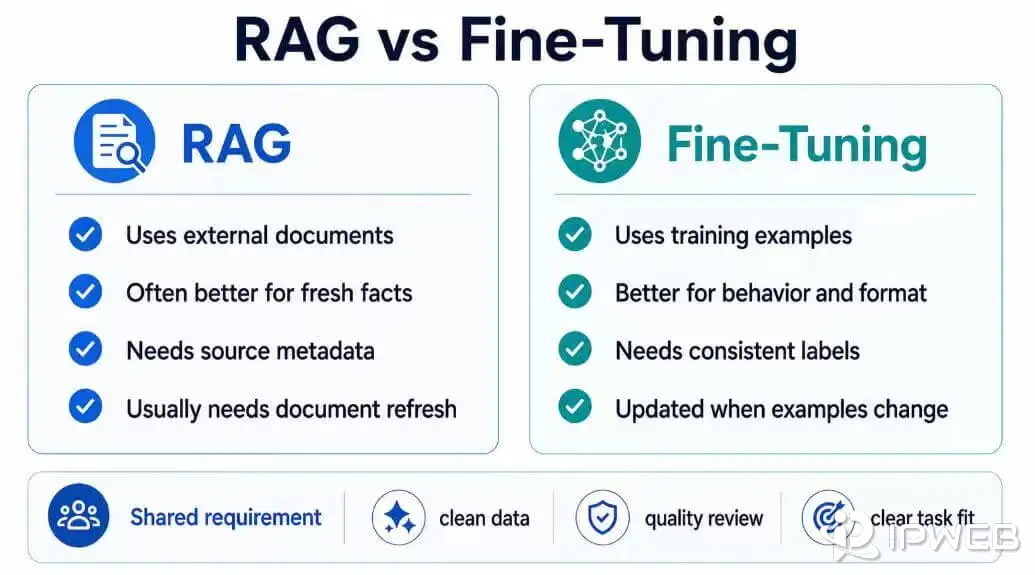
The original Retrieval-Augmented Generation paper describes RAG as a combination of parametric model knowledge and external non-parametric memory. This separation can make retrieved knowledge easier to inspect, update, or replace than facts stored only in model parameters.
| LLM Use Case | Primary Data Need | Better Data Quality Focus | Refresh Pattern |
|---|---|---|---|
| Pretraining | Massive broad corpus | Scale, diversity, deduplication, safety filtering | Large historical snapshots |
| Fine-tuning | Labeled examples or domain task data | Correct examples, consistent format, task fit | Occasional updates |
| RAG | Source documents and passages | Freshness, metadata, chunk quality, retrieval relevance | Continuous or scheduled refresh |
| AI agents | Live pages, tools, and state | Current page state, action boundaries, validation | Real-time or near real-time |
| Evaluation | Test prompts and expected outputs | Coverage, difficulty, traceability, repeatability | Updated when use cases change |
For many business teams, RAG is a more practical starting point when the required knowledge changes frequently. Source documents can be refreshed, corrected, or removed without retraining the base model. Fine-tuning is generally better suited to teaching consistent behavior, output formats, classification patterns, tone, or domain-specific task execution.
How to Build a Safer LLM Data Pipeline
A safer LLM data pipeline starts with scope, not code. Decide which public sources are permitted, what fields are necessary, how often the data should refresh, and what should be excluded before crawling begins.
- Define the allowed source list and business purpose.
- Review robots.txt, terms, privacy requirements, and internal compliance rules.
- Decide whether static HTML, rendered pages, documents, or APIs are the right source layer.
- Extract the main content and remove navigation, ads, cookie banners, duplicate templates, and unrelated sidebars.
- Preserve URL, title, timestamp, language, content type, crawl status, and redirect information.
- Convert content into Markdown, JSONL, clean text, or another format that matches the downstream system.
- Deduplicate pages and filter thin, broken, low-quality, or off-topic content.
- Chunk documents by semantic boundaries, not arbitrary character counts only.
- Validate retrieval quality with real user questions before scaling.
- Schedule refreshes and keep an audit trail of source changes.
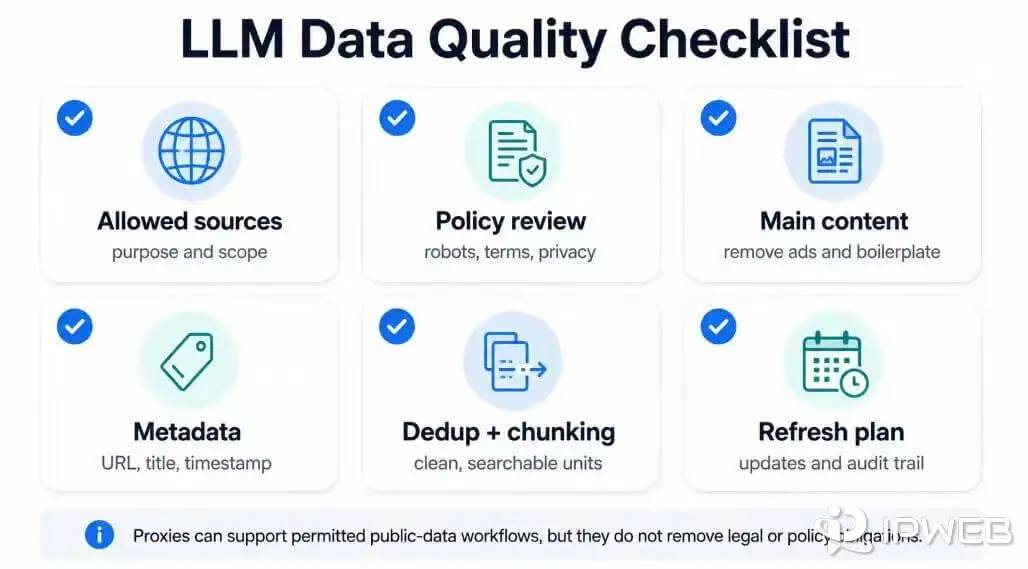
Proxies can support network-layer testing, regional QA, and distributed public-data requests when the workflow is permitted. They do not grant access to restricted content, replace source permissions, remove legal obligations, or fix a poor data-quality pipeline. For compliance context, read IPWeb's guide on whether web scraping is legal.
Common Mistakes in LLM Web Scraping
The first mistake is treating raw HTML as AI-ready data. Raw HTML is useful for archival or reprocessing, but most LLM workflows need cleaned content, source metadata, and predictable formatting.
The second mistake is ignoring freshness. A RAG system built on stale pages may answer confidently with outdated information. If the source changes often, the crawl schedule, cache policy, and document update logic matter as much as the first extraction.
The third mistake is overusing fine-tuning for facts that should live in retrieval. If the information changes, RAG is usually easier to update. Fine-tuning is better when the goal is behavior, classification, style, or task format.
The fourth mistake is forgetting policy and permission boundaries. Public availability does not automatically mean every use is allowed. Review site terms, robots instructions, privacy obligations, and the purpose of collection before building a dataset.
Frequently Asked Questions
Final Thoughts
LLM data is not just more scraped content. The useful work happens after collection: cleaning, preserving structure, attaching metadata, deduplicating, chunking, validating, and refreshing the dataset.
For IPWeb readers, the safest angle is to treat web collection as one layer in a larger AI data pipeline. Start with permitted sources, choose the right collection method, and measure whether the resulting content actually improves retrieval, evaluation, or model behavior.