

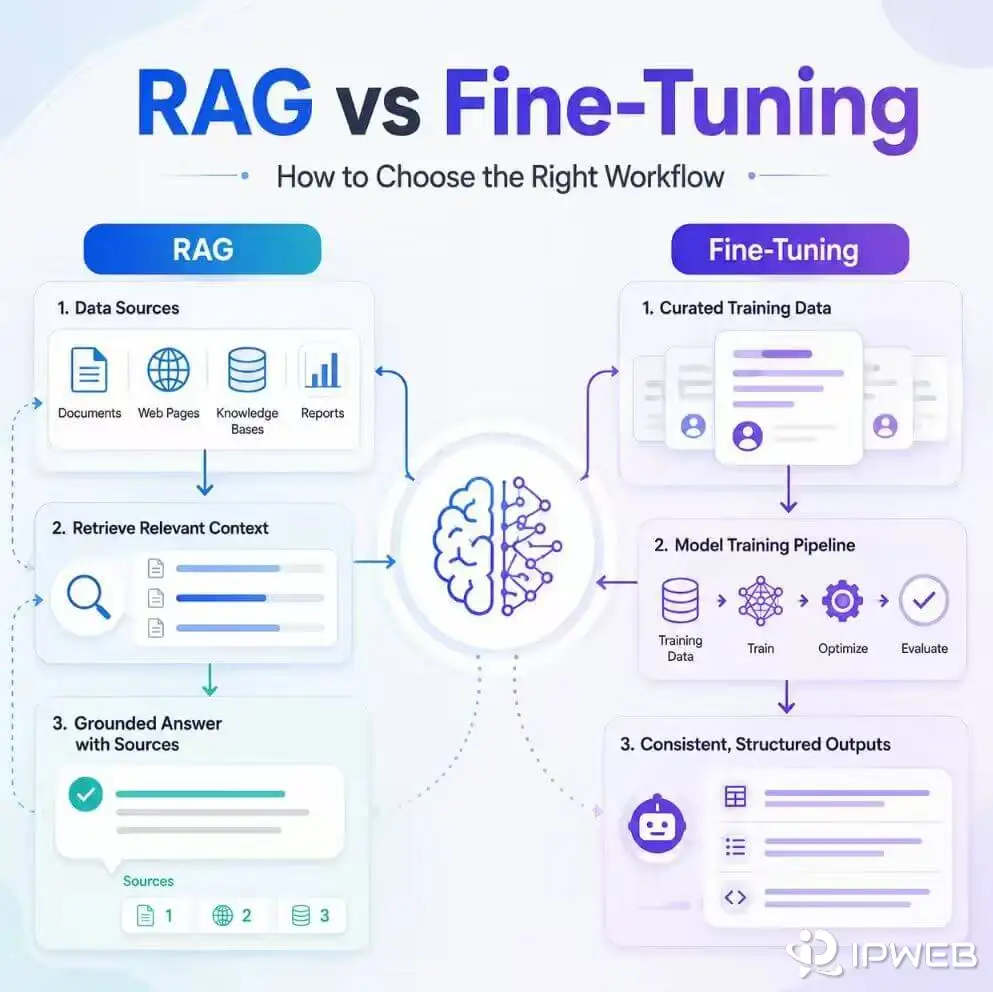
Choosing between retrieval-augmented generation and fine-tuning is not simply a choice between two model techniques. It is a decision about where knowledge should live, how quickly it must change, whether answers need traceable sources, and what type of data your team can maintain.
For web data projects, this distinction matters even more. Product pages, news, search results, policies, and market data can change frequently. A model may also need to classify records, follow a fixed schema, or produce consistent outputs. Those requirements point to different workflows.
Choose RAG when the system needs current or source-grounded information. Choose fine-tuning when the model needs to perform a stable task more consistently, such as classification, extraction, routing, tone, or structured output. Use both when the application needs current facts and repeatable behavior.
- RAG changes the context supplied to the model at answer time; it does not normally change the model weights.
- Fine-tuning changes model behavior through training examples and requires a separate evaluation process.
- Frequently updated web content, source attribution, and document-level permissions usually favor RAG.
- Stable classification rules, output formats, terminology, and repeated task patterns may favor fine-tuning.
- Neither approach repairs poor data. Retrieval quality, labels, permissions, freshness, and evaluation remain essential.
RAG vs Fine-Tuning at a Glance
The fastest way to decide is to identify the part of the system that must change. RAG is mainly a knowledge-access workflow. Fine-tuning is mainly a model-behavior workflow.
| Decision Factor | RAG | Fine-Tuning |
|---|---|---|
| Main purpose | Supply relevant external knowledge at answer time | Teach a repeatable task or response pattern |
| Best fit | Current facts, document Q&A, research, catalogs, policies | Classification, extraction, routing, style, fixed formats |
| Updating information | Update, replace, or re-index documents | Prepare new examples and run another training cycle |
| Source attribution | Can return document URLs and metadata with the answer | Does not inherently identify the source behind a statement |
| Data requirement | Clean source documents, metadata, chunking, and retrieval tests | Representative training examples with consistent target outputs |
| Typical latency | Adds retrieval and often increases prompt context | May avoid retrieval, although performance depends on deployment |
| Main failure mode | Wrong, stale, missing, or irrelevant retrieved context | Inconsistent labels, overfitting, weak coverage, or task drift |
| Common starting point | Knowledge-heavy applications with changing documents | Narrow, stable tasks that prompting does not solve reliably |
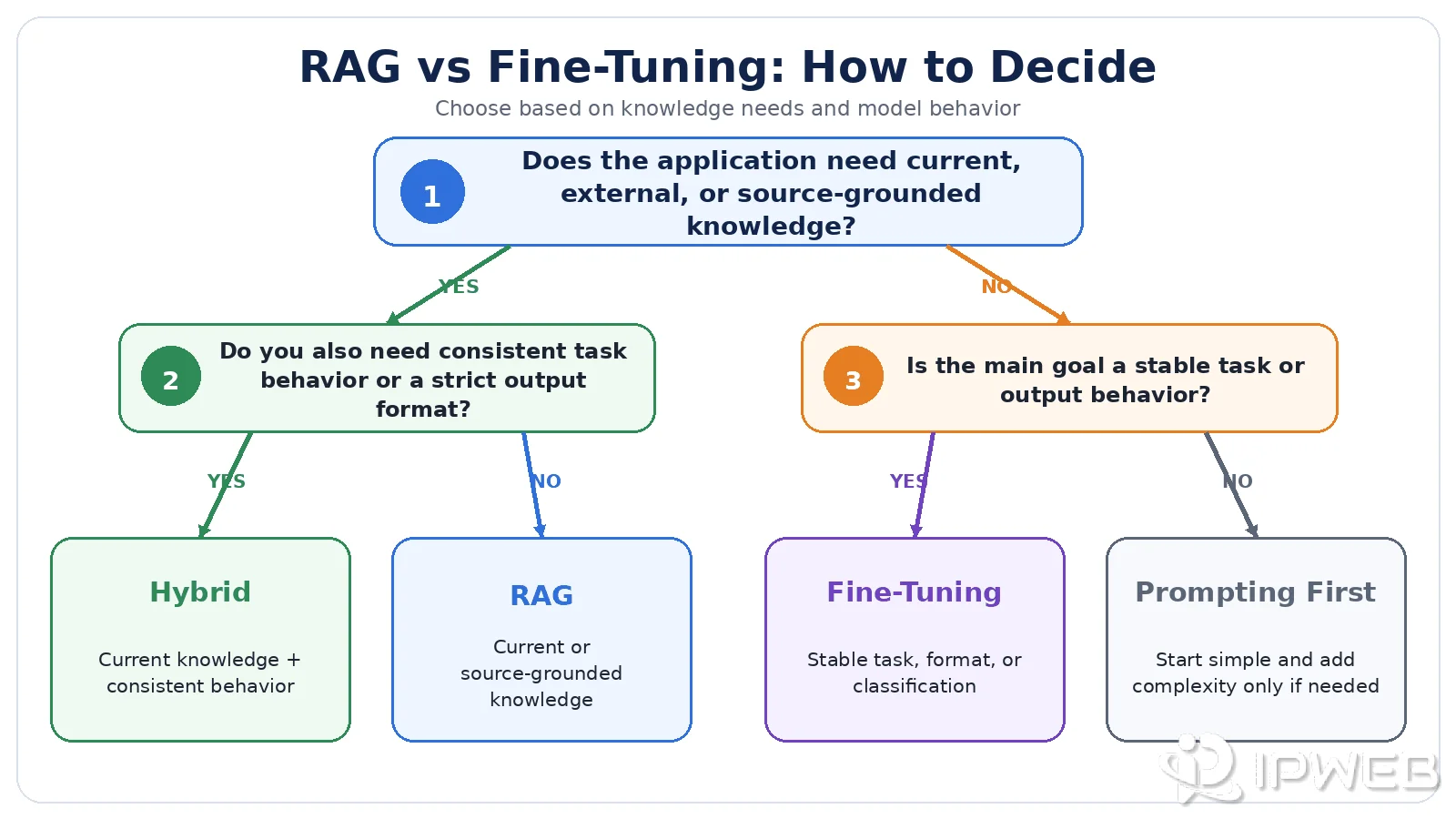
- If the missing capability is knowledge, start with retrieval.
- If the missing capability is behavior, test prompting before fine-tuning.
- If both are missing, separate the knowledge and behavior problems before combining the approaches.
What RAG Changes
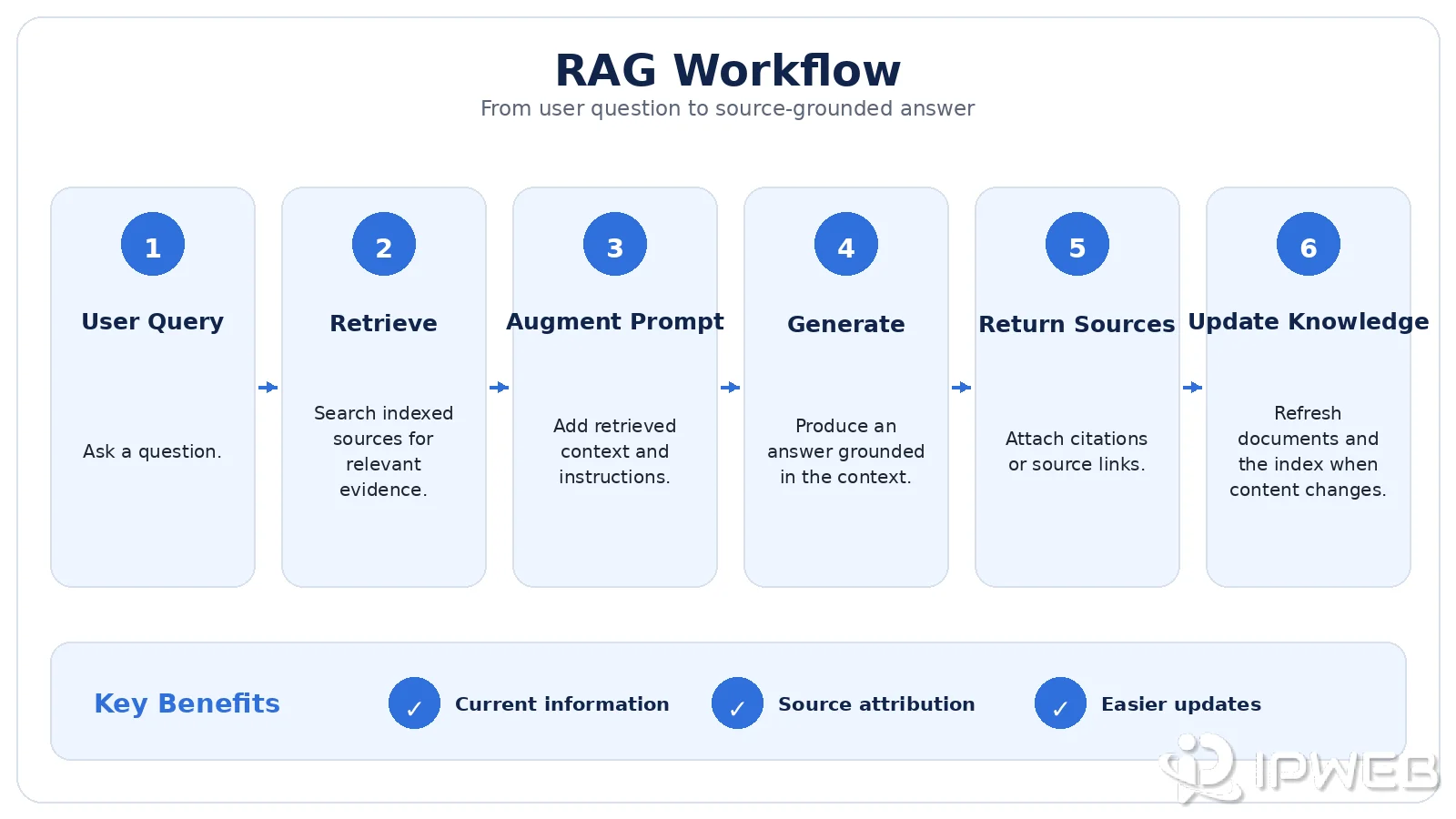
Retrieval-augmented generation connects an LLM to an external knowledge source. A typical system stores searchable representations of documents, retrieves relevant passages for a user query, and adds those passages to the prompt before the model produces an answer.
The source information remains outside the model. That makes it possible to update a price, policy, article, product record, or support document without retraining the model. AWS describes RAG as a workflow that can incorporate recent documents and provide references to retrieved sources, while also noting that retrieval quality still affects the result. See the AWS comparison of RAG and fine-tuning.
RAG does not guarantee a factual answer. The model can still misread retrieved text, combine unrelated passages, or answer beyond the available evidence. A production system therefore needs document freshness, chunking, metadata filters, access controls, retrieval evaluation, and answer-level grounding checks.
Data RAG Needs
A RAG pipeline usually needs more than a folder of raw pages. Useful inputs include clean text, stable document IDs, canonical URLs, timestamps, language or location fields, access permissions, and content-type metadata.
Chunk boundaries also matter. A chunk that is too small may lose essential context. A chunk that is too large may contain several unrelated ideas and reduce retrieval precision. Tables, headings, lists, and page relationships should be preserved when they affect meaning.
What Fine-Tuning Changes
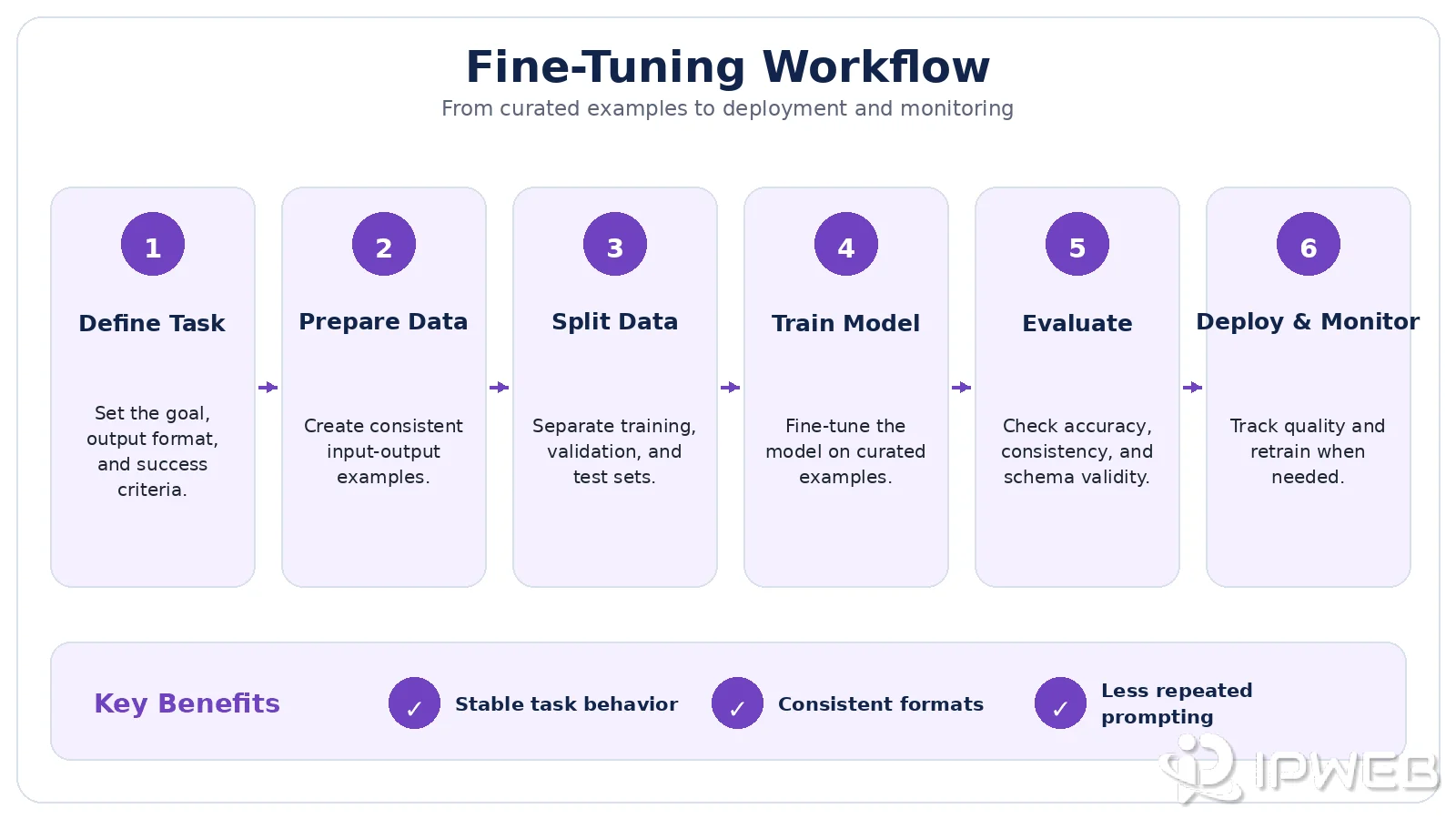
Fine-tuning continues training a pretrained model on task-specific examples. Instead of attaching documents to each request, the workflow adjusts model parameters so the model is more likely to follow the demonstrated pattern.
Supervised examples commonly contain an input and the desired output. Depending on the provider and method, fine-tuning can improve classification, structured extraction, routing, terminology, tone, or compliance with a repeatable response format. OpenAI's fine-tuning documentation, for example, requires fine-tuning data to follow supported training formats such as JSONL. See the OpenAI fine-tuning API reference.
Fine-tuning is not an efficient substitute for a frequently changing database. Training examples can influence how the model responds, but they do not provide a simple mechanism for replacing one changed fact or tracing every generated statement back to a source document.
Data Fine-Tuning Needs
Fine-tuning data should represent the real distribution of requests the model will receive. Repeating near-identical examples may improve a narrow demo while failing on production inputs. The dataset should include normal cases, difficult cases, edge cases, and examples that show when the model should refuse, abstain, or return an error.
Consistency matters more than raw volume. If two examples give different target outputs for the same input pattern, the model receives a conflicting signal. Training and evaluation examples should also be separated so the team can measure generalization rather than memorization.
When to Choose RAG
RAG is usually the stronger starting point when the application answers questions from information that changes independently of the model.
- The information changes frequently. Examples include product availability, prices, news, search results, policies, documentation, and market records.
- Answers need source links. Retrieved metadata can be returned with the response so users can inspect the supporting page.
- Different users have different permissions. Retrieval filters can limit which documents are eligible for each request.
- The knowledge base is too large for one prompt. Retrieval selects a smaller set of relevant passages at request time.
- The team needs targeted updates. A single document can be corrected or removed without running another model training job.
A web research assistant is a typical example. It may need the latest public pages, the date each page was retrieved, the canonical source, and a record of which passages supported the answer. Those are retrieval and data-governance requirements rather than model-style requirements.
When to Choose Fine-Tuning
Fine-tuning becomes more attractive when the required knowledge is relatively stable but the model still handles a narrow task inconsistently after careful prompting and testing.
- Classification: assign records to a stable taxonomy using examples approved by domain reviewers.
- Structured extraction: map varied inputs to a consistent schema when prompt-only results remain unreliable.
- Routing: choose an action, queue, or workflow based on recurring input patterns.
- Terminology and style: apply domain-specific language or a controlled response pattern across many requests.
- Repeated instructions: reduce the need to include the same lengthy demonstrations in every prompt.
Start by establishing a prompt-only baseline. Fine-tuning adds dataset preparation, training, model versioning, regression tests, and monitoring. It is justified when the expected improvement is measurable and valuable enough to maintain that additional lifecycle.
How Web Data Fits Each Workflow
Web data can support RAG, fine-tuning, or both, but the preparation step is different. The original page should not be sent directly into a production pipeline without cleaning, metadata, and usage checks.
| Web Data Type | Better Starting Point | Reason |
|---|---|---|
| Current documentation and policy pages | RAG | Content changes and users may need the current source |
| News and market updates | RAG | Freshness and publication timestamps are central to the answer |
| Product catalogs, prices, and availability | RAG | Records can change faster than a practical training cycle |
| Approved category labels for product records | Fine-tuning | The goal is a repeatable mapping from input to label |
| Examples of valid structured extraction | Fine-tuning | The examples teach a stable output schema and task pattern |
| Current records plus consistent classification | Hybrid | Retrieval supplies the records while tuning reinforces the task behavior |
Preparing Web Content for RAG
- Collect only data your organization is permitted to access and use.
- Remove navigation, duplicate templates, cookie banners, and irrelevant page elements.
- Preserve headings, tables, lists, and relationships that carry meaning.
- Attach the source URL, retrieval time, language, location, content type, and permission metadata.
- Deduplicate documents and define a policy for replacements, deletions, and stale records.
- Chunk and index the content, then test whether relevant passages are retrieved for realistic queries.
For teams that need recurring public web content in JSON, HTML, CSV, or Markdown, a Web Scraping API can supply the collection and normalization stage. The retrieved output still needs validation, source metadata, deduplication, and an update policy before it enters a RAG index.
Preparing Web Data for Fine-Tuning
- Define one measurable task and a clear target output.
- Create examples from reviewed records rather than treating every collected page as a training example.
- Normalize labels, field names, units, missing values, and refusal behavior.
- Separate training, validation, and final test sets.
- Remove duplicates and near-duplicates that could distort evaluation.
- Record dataset versions so model behavior can be traced to a specific training set.
Pre-built or custom datasets may support training and evaluation when their fields, provenance, permitted uses, coverage, and labeling rules match the task. A large dataset is not automatically a suitable fine-tuning dataset; the examples must express the behavior the model should learn.
When to Use Both
Many production systems use RAG and fine-tuning for separate responsibilities. Retrieval supplies current evidence. Fine-tuning helps the model perform a stable operation on that evidence.
Consider a product intelligence assistant. RAG can retrieve the latest catalog records, price observations, and source URLs. A fine-tuned model may then classify each record into an approved taxonomy or return a consistent JSON structure. The current facts stay in the data layer, while the repeated transformation belongs to the behavior layer.
- Do not fine-tune the model merely to hide stale or poorly retrieved documents.
- Do not add retrieval merely because the output format is inconsistent.
- Evaluate retrieval and generation independently before judging the combined system.
- Keep source permissions and sensitive-data controls outside the model prompt whenever possible.
A hybrid design is more complex than either approach alone. It adds two data pipelines, more failure points, and more evaluation work. Use it when tests show that both current knowledge and trained task behavior are necessary.
How to Evaluate the Result
The final choice should be based on evaluation rather than architecture preference. Build a representative test set before implementation and compare the simplest viable options.
| System Layer | What to Measure | Example Failure |
|---|---|---|
| RAG retrieval | Relevant-document recall, ranking quality, freshness, permission filtering | The correct page exists but is not retrieved |
| RAG answer | Groundedness, citation accuracy, completeness, unsupported claims | The answer cites a page that does not support the claim |
| Fine-tuned task | Task accuracy, schema validity, consistency, generalization | The model follows the format but assigns the wrong label |
| Operational quality | Latency, cost per successful task, update effort, failure recovery | Quality is acceptable but the workflow is too expensive to maintain |
| Hybrid system | Retrieval quality and task behavior measured separately and together | A retrieval error is incorrectly blamed on the fine-tuned model |
Use the same realistic test cases for the prompt-only baseline, RAG version, fine-tuned version, and hybrid version. This makes the trade-off visible. A more complex architecture is only better when it produces a meaningful improvement in the metrics that matter to the application.
Frequently Asked Questions
Final Thoughts
The most useful distinction is not whether RAG or fine-tuning is more advanced. It is whether the application needs to change what the model knows at request time or change how the model performs a recurring task.
Choose RAG for changing web information, source links, document permissions, and targeted updates. Choose fine-tuning for stable behaviors supported by consistent examples. Combine them only when evaluation confirms that the system needs both current evidence and repeatable task execution.