

A proxy scraper can turn public proxy pages into a large list of IP addresses and ports in seconds. The harder part is deciding which entries are still alive, correctly labeled, and suitable for your workflow. Public lists can contain stale endpoints, duplicate records, inaccurate protocol or location claims, and proxies with unclear ownership or reputation.
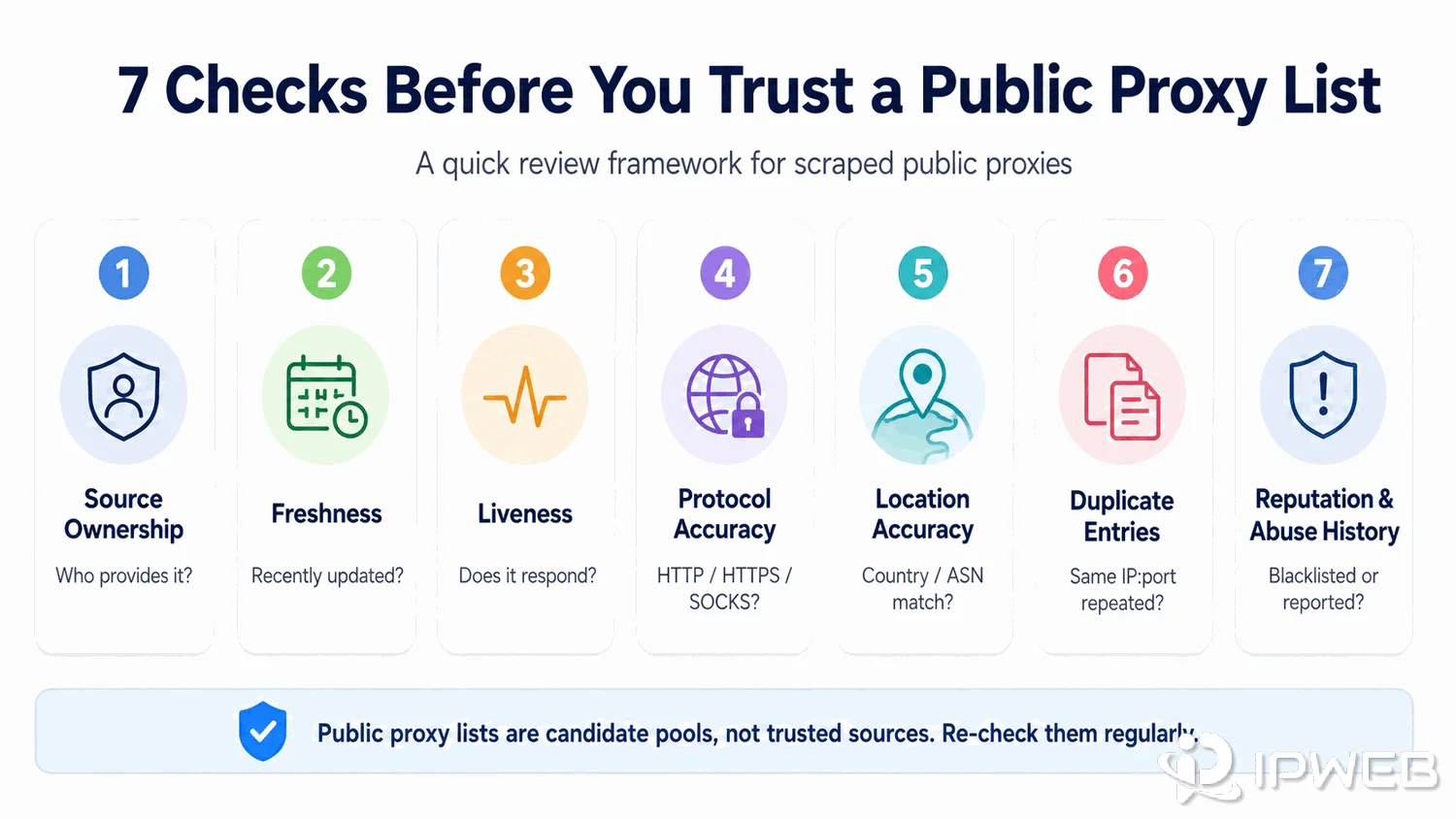
Before using a scraped proxy list, validate the endpoints instead of trusting the source page alone. Check the source, freshness, liveness, protocol, location, duplicates, and reputation signals, then decide whether maintaining the list is practical for repeated use.
A proxy scraper is a tool that discovers proxy IP addresses and ports from public pages, feeds, repositories, and other published sources. The source matters because a large list can still contain stale, duplicated, mislabeled, or poorly documented endpoints. Treat every scraped list as untrusted input: identify where the entries came from, then verify freshness, liveness, protocol, network location, duplicates, and reputation before deciding whether the list is usable.
- A proxy scraper can collect public proxy endpoints, but collection does not prove that the proxies are current, reliable, or suitable for your workflow.
- Validate seven areas before use: source, freshness, liveness, protocol, location, duplicates, and reputation or abuse signals.
- Public proxy lists can change quickly, so a proxy that worked earlier may fail or behave differently later.
- The quality of a scraped list depends heavily on its source path: an original publisher, a maintained feed, an open repository, or an aggregator can have very different freshness and provenance.
- For repeatable workflows, compare the ongoing validation and maintenance cost of public lists with the clearer sourcing and controls of a managed proxy service.
What Is a Proxy Scraper?
A proxy scraper collects proxy endpoints—typically an IP address and port—from public proxy-list pages, feeds, repositories, or other published sources. Depending on the source, the scraper may also collect labels such as protocol, country, anonymity level, response time, or last-seen date.
The term can be confusing because some people also use “proxy scraper” to describe a web scraper that connects through proxies. A proxy scraper focused on public proxy sources specifically discovers proxy endpoints such as IP addresses and ports.
Finding an endpoint is only the first step. A collected record does not confirm who controls the proxy, whether it is still online, whether its protocol or location label is correct, or whether the connection is appropriate for a production workflow.
What Types of Sources Do Proxy Scrapers Use?
“Proxy scraper sources” usually means the pages, feeds, repositories, or published lists from which a scraper discovers proxy endpoints. It is a generic description of where proxy data comes from; it does not necessarily refer to a specific service named ProxyScraper.
The important distinction is not just how many IP:port pairs a source exposes, but how directly the source can be traced and how often it is maintained. Common source types include:
- Public proxy-list pages: websites that publish endpoints in tables or downloadable lists.
- Published feeds or APIs: structured sources that return proxy records in a predictable format.
- Open repositories: community-maintained files or scripts that collect and refresh public endpoints.
- Community-maintained lists: shared collections updated by individuals or groups, with varying verification standards.
- Aggregated lists: collections that combine entries copied from multiple public sources, which can increase duplication and make provenance harder to trace.
Use source provenance as the first filter. An original publisher with a visible update process is easier to evaluate than an aggregator that republishes the same endpoint without showing where it came from. After that, validate freshness and behavior yourself because even a clearly sourced endpoint can go offline or change characteristics.
Why Public Proxy Sources Look Useful
Proxy scrapers look attractive because they can produce a list of IP addresses without a purchasing or account setup step. For a quick experiment, that can feel convenient. A typical public list may include IPs, ports, protocol labels, country claims, response-time estimates, and a last-checked timestamp.
The tradeoff is that a public list is only a collection of candidates. Availability can change quickly, ownership may be unclear, and a copied timestamp does not guarantee that the endpoint still behaves the same way when you use it.
A 30-month academic study of more than 640,000 free web proxies found substantial instability and security concerns, reinforcing why public proxy entries should be validated rather than trusted by default. See the longitudinal study of free proxy services for the underlying research.
7 Checks for a Scraped Proxy List
After identifying the source type, validate each endpoint rather than relying only on the labels published by the source page. The seven checks below separate source provenance from endpoint behavior so you can judge whether a list is usable rather than merely large.
| Check | Why it matters | Practical signal |
|---|---|---|
| Source | Unknown ownership or unclear sourcing makes the connection harder to evaluate. | Identify the list publisher, provider, terms, or documented source path. |
| Freshness | Public proxy entries can become stale quickly. | Use a recent verification timestamp and retest the endpoint yourself. |
| Liveness | An IP and port can remain listed after the service stops responding. | Run a connection test with a short timeout and record failures. |
| Protocol | A published HTTP, HTTPS, or SOCKS label may be wrong or outdated. | Test the protocol you actually plan to configure. |
| Location | Country and city labels can be stale or inconsistent across databases. | Compare the visible IP, country, ASN, and organization with independent lookup data. |
| Duplicates | The same endpoint may appear multiple times across aggregated lists. | Normalize IP:port values and remove duplicate records before testing. |
| Reputation / abuse signals | A responsive proxy can still have a poor network history or unexpected behavior. | Review reputation indicators, unexpected response changes, and connection anomalies before use. |
Public Proxy List vs Managed Proxy Service
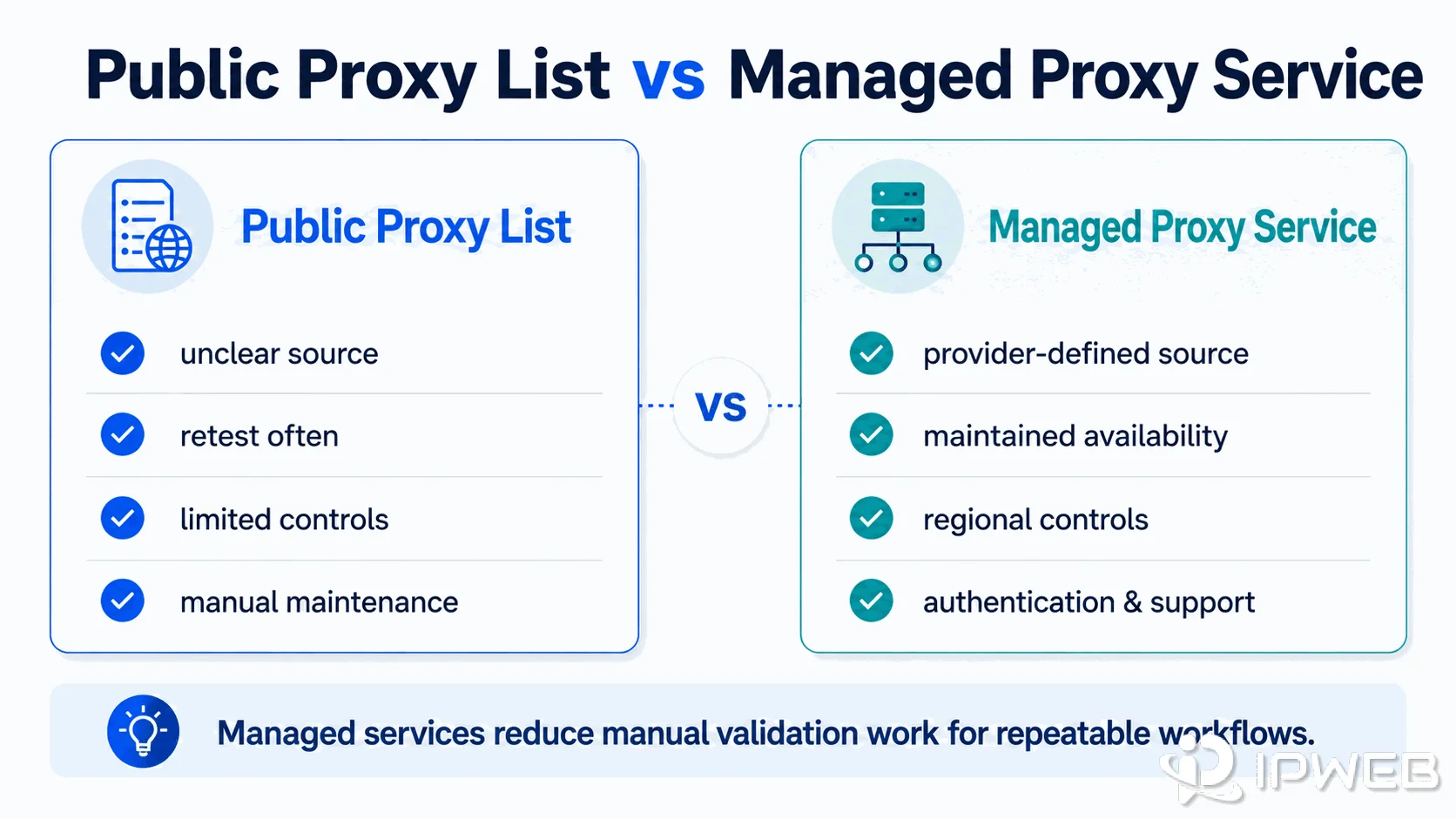
A managed proxy service is not simply a cleaner spreadsheet of IP addresses. Access is usually delivered through provider-defined endpoints or gateways with credentials, routing controls, session behavior, documented regions, and a support path.
| Decision factor | Public proxy list | Managed proxy service |
|---|---|---|
| Source clarity | May be unclear or aggregated from multiple sources | Provider-defined |
| Freshness | Requires repeated retesting | Pool or endpoint availability is maintained by the provider |
| Authentication | Often absent | Credential, allowlist, or endpoint based |
| Regional selection | Published location labels may be inconsistent | Region controls are documented by the provider |
| Session control | Usually undefined | Rotation or sticky-session options may be available |
| Support | Usually none | Provider support and product documentation |
How to Validate a Scraped Proxy
Start with a small sample instead of testing a large list blindly. Confirm that the endpoint accepts a connection, then compare the visible IP and network information with what you expected. Keep the test environment consistent so you are measuring the proxy configuration rather than a different browser, app, or network path.
The Python example below performs a minimal liveness check against an IP-echo endpoint. Replace the example host and port with a proxy you are authorized to test.
import requests

proxy = "http://HOST:PORT"

proxies = {
    "http": proxy,
    "https": proxy,
}

try:
    response = requests.get(
        "https://httpbin.org/ip",
        proxies=proxies,
        timeout=8,
    )
    response.raise_for_status()
    print("Proxy responded:", response.json())
except requests.RequestException as error:
    print("Proxy check failed:", error)
A successful response only confirms that the route worked for that test. It does not prove that the proxy is stable, correctly located, low risk, or suitable for every website. For a fuller validation sequence, use IPWeb's guide on how to check if a proxy is working to compare the visible IP, country, ISP, ASN, protocol, and test environment.
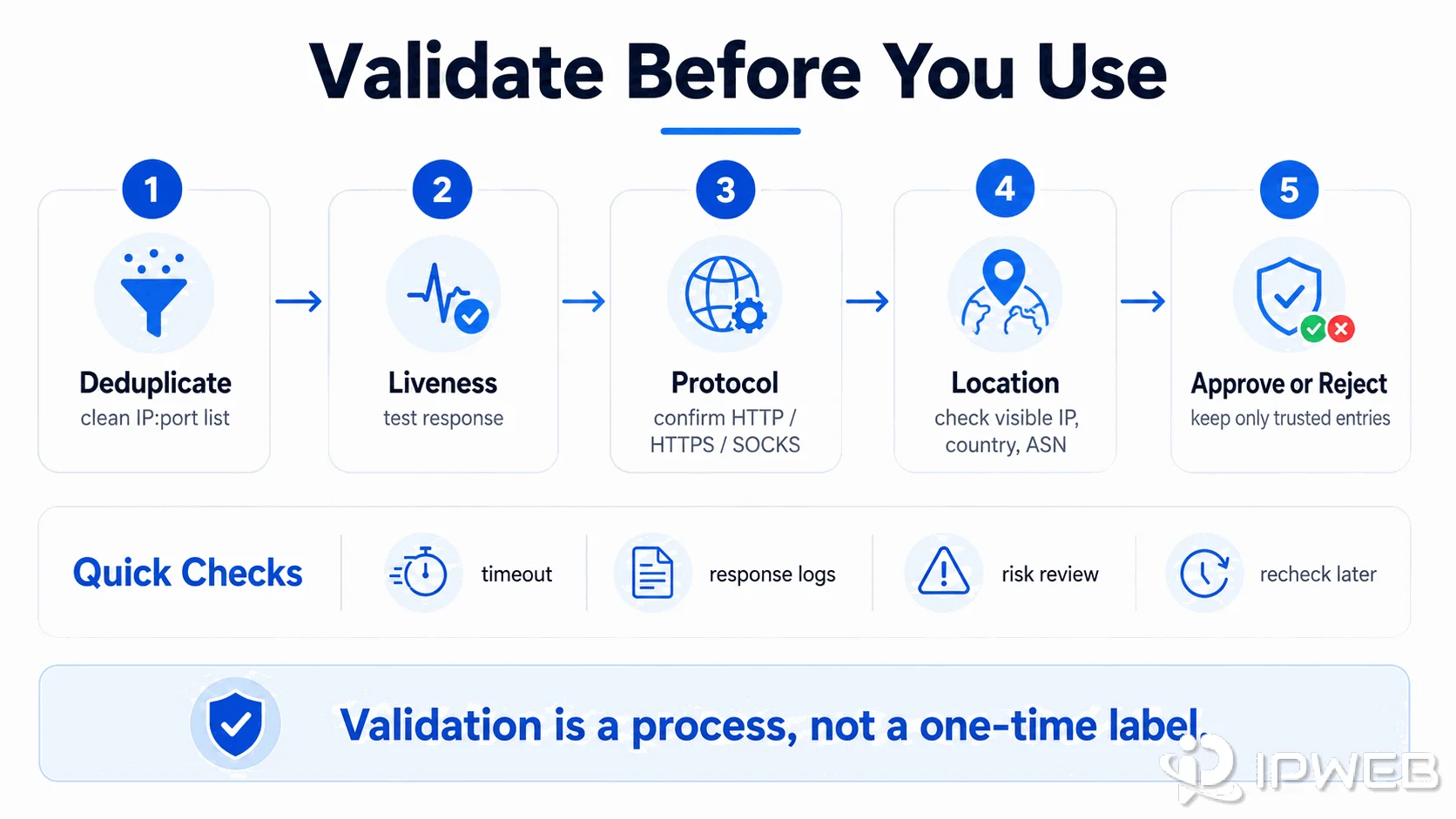
- Normalize the input: standardize IP:port records, remove duplicates, and keep the original source for traceability.
- Test the connection: use a short timeout, record failures, and avoid treating one successful response as long-term proof of availability.
- Verify the protocol: confirm the endpoint actually works with the HTTP, HTTPS, or SOCKS configuration your application needs.
- Verify network identity: compare the visible IP, country, ASN, organization, and other location signals with the source claims.
- Recheck before reuse: reject unclear or suspicious endpoints and repeat the validation later because public proxy behavior can change quickly.
When a Managed Proxy Service Makes More Sense
Maintaining a public proxy list can become expensive in engineering time once you repeatedly deduplicate endpoints, retest dead entries, confirm regions, handle authentication differences, and replace unstable routes. A managed proxy service becomes more practical when the workflow needs repeatable availability, documented location controls, session behavior, authentication, and support.
For workflows that benefit from changing routes or broader regional coverage, IPWeb's dynamic residential proxies provide managed rotating access. When a workflow needs a consistent endpoint for repeatable testing or longer sessions, static residential proxies are the closer fit.
If the goal is to evaluate a provider-backed proxy before committing to a paid plan, IPWeb's free proxy trial guide explains how a limited trial differs from relying on an anonymous public proxy list.
The proxy source does not replace application-level controls. Request timing, retries, browser settings, account state, cookies, and the target site's own rules remain separate parts of the workflow.
Frequently Asked Questions
A proxy scraper is a collection method, so legality cannot be determined from the tool name alone. Review the source terms, ownership, applicable rules, and intended use before collecting or using published proxy endpoints.
Do not assume they are safe or reliable. Public lists may contain stale endpoints, unclear ownership, inconsistent locations, unstable availability, or connections with poor reputation. Validate each endpoint before use and avoid sending sensitive credentials or private data through an untrusted proxy.
Test the proxy in the same browser, app, or script where it will be used. Confirm that the visible IP changes, then check the country, ISP, ASN, protocol, response status, and connection time. A single successful request proves only that the endpoint responded at that moment.
Common proxy scraper sources include public proxy-list pages, published feeds or APIs, open repositories, community-maintained lists, and aggregators that combine multiple sources. The source type does not guarantee quality, so keep the original source for traceability and verify freshness, liveness, protocol, location, and duplicates before use.
A managed service is usually a better fit when you need predictable sourcing, authentication, regional controls, session options, provider support, or a repeatable workflow that would otherwise spend significant time maintaining public proxy lists.
Final Thoughts
A proxy scraper can help discover endpoints from public pages, feeds, repositories, and aggregated lists, but the size of a source does not establish its quality. Trace where the records came from, then check freshness, liveness, protocol, location, duplicates, and reputation signals before trusting a public list. If maintaining and revalidating those sources becomes a recurring engineering task, a managed proxy service may provide a clearer and more repeatable operating model.