
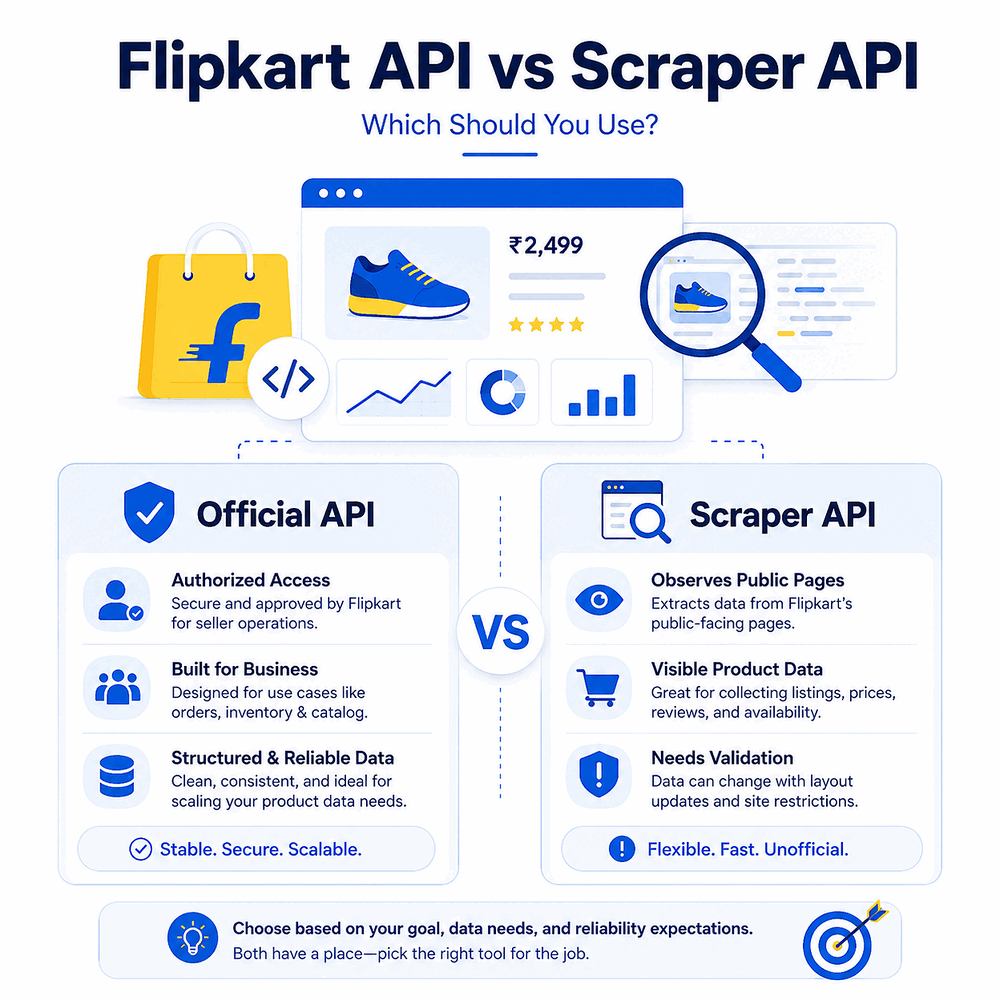
Choosing a Flipkart data source depends on what you need to measure. Seller operations, catalog enrichment, price monitoring, availability checks, and competitive research do not all belong in the same API bucket.
Use an official Flipkart API when you are an authorized seller or partner working with supported marketplace operations. A third-party data API or scraper API fits a different job. Use one only when the workflow is allowed, the source rules are respected, and the returned product, seller, price, availability, and timestamp fields can be validated.
- The term “Flipkart API” can refer to official seller APIs, affiliate APIs, third-party product data APIs, or scraper APIs.
- Official Flipkart Marketplace Seller APIs are authorization-based and mainly support seller or marketplace operations.
- Scraper APIs can help structure public product-page observations, but they do not remove legal, platform, account, or source-rule limits.
- Price data needs validation: product ID, variant, seller, stock state, delivery region, currency, and timestamp.
- A good workflow chooses the data source first, then designs validation and error handling around that source.
What Does “Flipkart API” Refer To?
The term Flipkart API can refer to several different data-access methods: official Marketplace Seller APIs, Affiliate APIs, third-party product data APIs, or scraper APIs. They can expose different fields and use different authorization models, so they should not be treated as interchangeable data sources.
That ambiguity matters because each source has a different access model. Official Flipkart Marketplace Seller API documentation is aimed at authorized seller and partner workflows. Third-party product data APIs may provide structured product observations. Scraper APIs may instead fetch and parse permitted public pages. These sources are not interchangeable.
The right starting point is to define the job: seller account operations, catalog lookup, price monitoring, competitor research, availability tracking, or page-state validation.
Official Flipkart APIs vs Third-Party Data APIs
Official APIs are usually the best source when your workflow fits the access model. Flipkart's official seller documentation describes Marketplace Seller APIs for authorized sellers and partners. Flipkart also maintains API Platform Hub documentation for marketplace API versions. These interfaces support approved marketplace workflows. They are not a public database that anyone can query for every product price on the site.
Minimal cURL Token Request for a Self-Access Seller App
For a registered seller using a self-access application, Flipkart documents the client_credentials flow. The token request uses HTTP Basic authentication with the application ID and application secret. Third-party applications use the Authorization Code flow instead.
curl -u "$FLIPKART_APP_ID:$FLIPKART_APP_SECRET" \
  "https://api.flipkart.net/oauth-service/oauth/token?grant_type=client_credentials&scope=Seller_Api"
Use credentials from a registered application and keep them out of client-side code or public repositories. Flipkart also advises against hardcoding access tokens because they expire.
What About the Flipkart Affiliate API?
Flipkart also documents an official Affiliate API for registered affiliates. It supports approved affiliate use cases involving product and offer information. It is separate from the Marketplace Seller APIs, and access depends on the Affiliate Program and its API rules.
Third-party data APIs and scraper APIs usually target external data needs such as product details, visible price, seller name, availability, ratings, reviews, and category data. They may be easier to consume in reporting workflows. You still need to verify source permission, field accuracy, update frequency, and error handling.
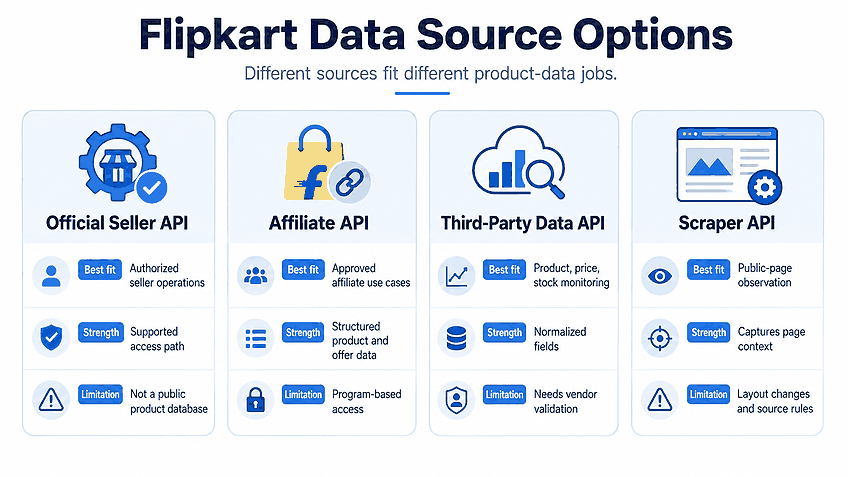
| Source type | Best fit | Strength | Main limitation |
|---|---|---|---|
| Official seller or marketplace API | Authorized seller operations | Supported access path for eligible accounts | Not a general public price database |
| Official Affiliate API / partner access | Approved affiliate or partner use cases | Can provide structured product and offer data | Access and available fields depend on program rules |
| Third-party product data API | Product, price, stock, and seller monitoring | Normalized fields and easier integration | Requires vendor due diligence and validation |
| Scraper API | Public-page observation and page-state checks | Can capture visible page context | Must respect source rules and may face layout changes |
| Manual QA | High-value exceptions | Human judgment on ambiguous changes | Does not scale |
Table takeaway: Official APIs fit approved seller or affiliate access, while scraper APIs fit permitted public-page observation and still require validation.
If your main goal is interpreting historical price changes rather than choosing a data source, see IPWeb's Flipkart price tracker guide.
For a broader framework on monitoring fields and checks, use the e-commerce price tracking API guide. For a marketplace-specific comparison in another ecosystem, see the Amazon Product API vs Scraping API article.
When a Flipkart Scraper API Makes Sense
A Flipkart scraper API can make sense when the workflow needs public-page observations that an official API or partner feed does not provide. Examples include visible offer text, page availability messages, seller display state, selected variant, or regional page response checks.
When permitted public-page checks also need location-specific routing, dynamic residential proxies can support regional product-page comparisons across selected locations.
It should not be treated as a shortcut around source rules. A scraper API still needs compliance review, request limits, error handling, and data validation. The workflow also needs a plan for redirects, consent pages, unavailable products, layout changes, and soft errors that look like successful responses.
For many teams, the practical design is hybrid. Use official or approved sources where available, use public-page checks only for permitted validation, and reserve manual review for high-value price changes or ambiguous records.
Example: Choosing a Source for Competitor Price Checks
Suppose an e-commerce team wants to compare a small set of competitor Flipkart listings each day and flag material price changes. The Marketplace Seller API is not the natural source for that job because the team is not managing those competitors' seller operations.
If the required information is visible on permitted public product pages, a scraper API or another approved data source may be more relevant. The team should still store the product variant, seller, availability, price, region, and timestamp with each observation. Large or ambiguous changes should go to manual review before they affect reporting or purchasing decisions.
Fields to Validate in Flipkart Product Data
Flipkart product data is useful only when the record describes the exact page state that was observed.
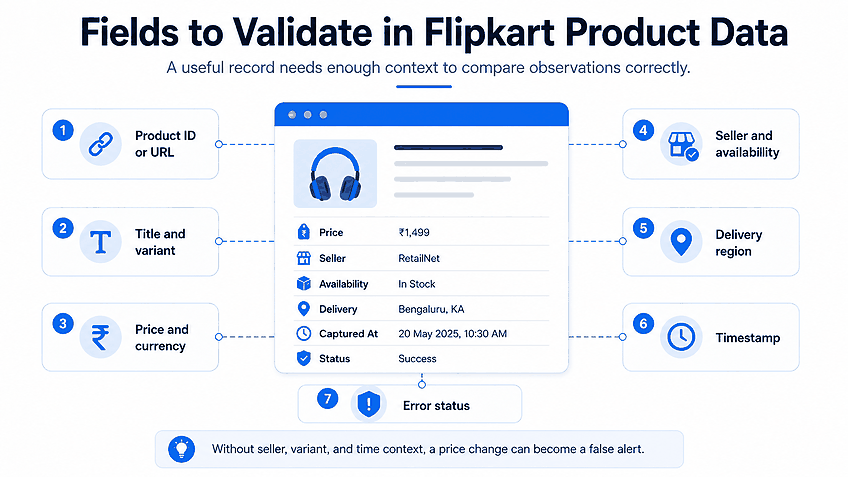
- Product URL or stable identifier
- Product title and selected variant
- Visible price, currency, discount, and coupon context
- Seller or marketplace offer
- Stock and delivery availability
- Region, pincode, or delivery context when relevant and allowed
- Timestamp and collection method
- Error status, redirect status, and parsing confidence
The goal is not only to extract a price. The goal is to know whether two observations are comparable. Without product and seller context, a price change can become a false alert.
How to Choose the Right Source
Choose the source that matches the decision you need to make.
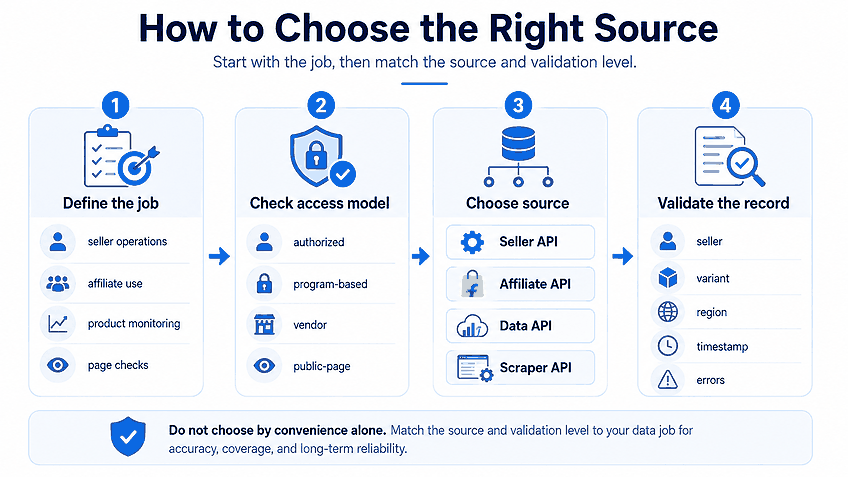
Use an official API when you are working inside a supported seller or partner workflow. Use a third-party data API when you need normalized product data and the vendor can explain source coverage, compliance posture, freshness, and error states. Use a scraper API when public-page validation is permitted and the page state itself matters. Use manual QA when the business consequence of a wrong alert is high.
Do not choose by convenience alone. A fast API response is not valuable if the record lacks seller, variant, region, or timestamp context. A visible page scrape is also weak evidence if it violates source rules or silently captures a soft-error page. For legal and ethical boundaries around public-page collection, review IPWeb's guide on whether web scraping is legal.
Frequently Asked Questions
Final Thoughts
The right Flipkart data source depends on the task you need to complete. Start with the decision you need to support, choose the most appropriate authorized or permitted source, and validate every product-price record before it reaches reporting or alerts.