
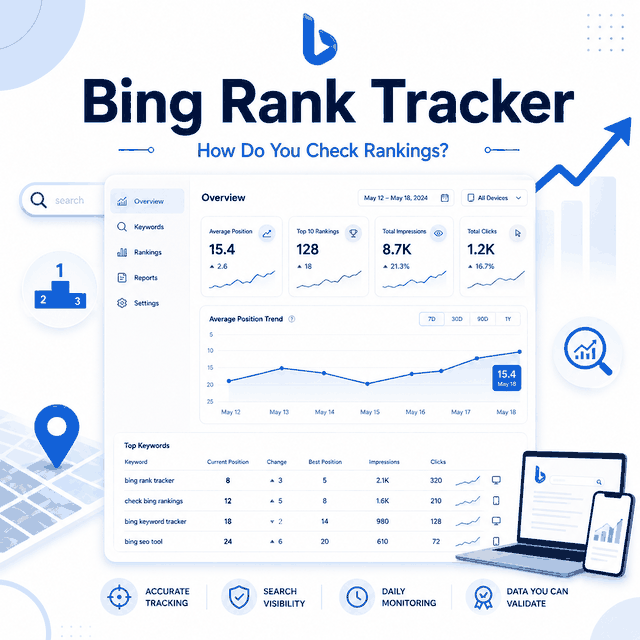
Bing rank tracking is most useful when every check uses the same query, location, language, device, and URL-matching rules. A single position can be helpful for a quick check, but recurring monitoring needs enough context to explain whether a movement is real or caused by different search conditions.
A Bing rank tracker shows where a domain or URL appears in Bing search results for a specific keyword under defined location, language, device, and date settings. For your own verified site, Bing Webmaster Tools is the first-party starting point for search-performance data. Use a Bing SERP checker for a one-off position snapshot and a Bing rank tracker for recurring history.
For repeatable reporting, keep the query, location, language, device, URL-matching rule, timestamp, and SERP-feature handling consistent between checks.
- A
bing rank trackershould capture the ranking context, not only the position. bing rank checker,bing serp checker, andbing rank trackerare related but not identical workflows.- Location, device, language, personalization, and SERP features can all change Bing rankings.
- Store timestamps, raw result evidence, and matched URLs so reports can be audited later.
- Do not treat Bing rank as a guaranteed signal for Microsoft Copilot citations or AI answers.
- What a Bing Rank Tracker Actually Measures
- 3 Ways to Check Bing Rankings
- Bing Rank Tracker vs Bing SERP Checker vs Rank Tracking API
- Inputs That Change Bing Rankings
- What Data to Store in Bing Rank Reports
- How to Validate Bing SERP Checks
- How to Check Bing Rankings From Another Location
- Common Mistakes
- Frequently Asked Questions
- Final Thoughts
What a Bing Rank Tracker Actually Measures
A Bing rank tracker measures visibility in Bing search results over time. The basic output is simple: a keyword, a domain or target URL, and the position where that page appears. The useful output is richer. It explains which Bing results were checked, under which settings, and what changed compared with the last report.
For example, "position 6" is not enough by itself. Was the query checked in the United States or Canada? Was it desktop or mobile? Did Bing show local results, ads, videos, answer modules, or related questions above the organic listing? Did the ranking match the homepage, a category page, or a specific article?
Those details decide whether a ranking movement is meaningful. A page moving from position 8 to position 5 in the same market and device is useful. A page moving because the tool switched from desktop to mobile is a measurement problem.
3 Ways to Check Bing Rankings
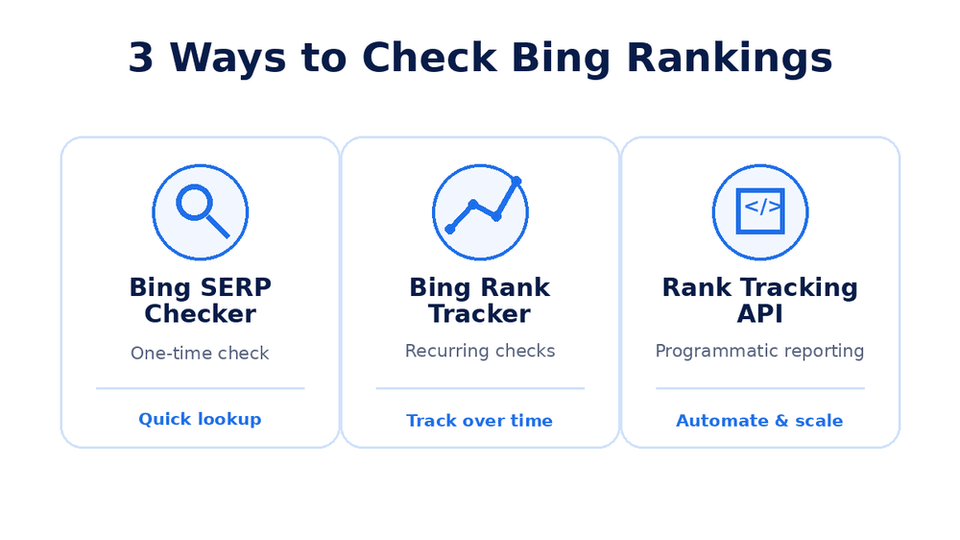
The right method depends on whether you are checking your own verified site, taking a one-off SERP snapshot, or monitoring the same keyword set over time.
1. Use Bing Webmaster Tools for Your Own Site
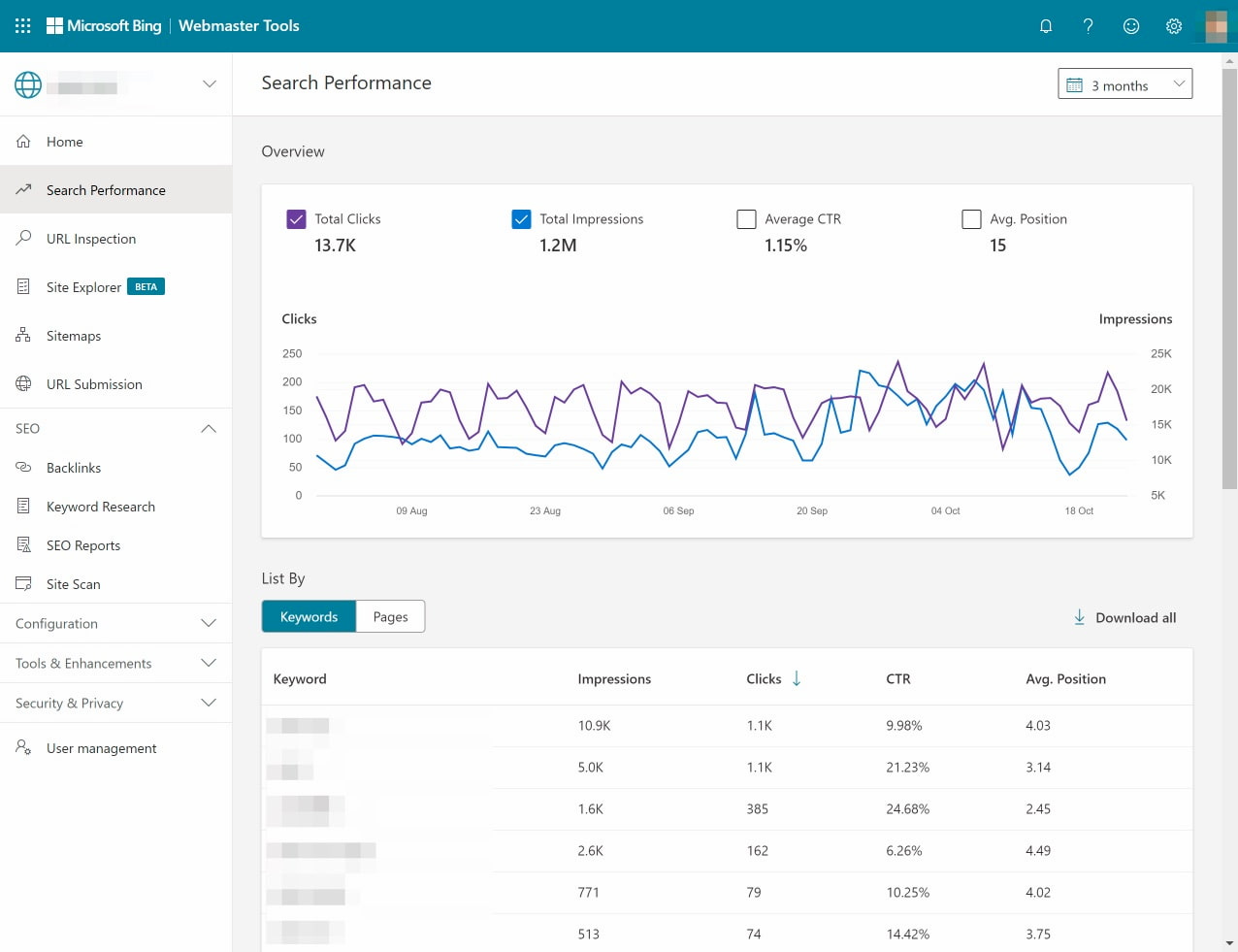
Bing Webmaster Tools Search Performance is the first-party option for a verified site. It provides search-performance data such as clicks, impressions, CTR, keywords, pages, and position-related metrics, making it a useful baseline for understanding how Bing sees your site's search visibility.
2. Use a Bing SERP Checker for a One-Off Position Check
A Bing SERP checker is useful when you need the current result for one keyword under a defined search context. Record the market, language, device, timestamp, matched URL, and visible SERP features so the result can be reproduced. For a broader one-off workflow, see IPWeb's SERP checker guide.
3. Use a Bing Rank Tracker for Recurring Monitoring
A Bing rank tracker is the better fit when you need daily or weekly history, movement trends, matched URLs, multiple keywords, or repeated checks after a page update. The value comes from comparing like with like: the same keyword, location, device, language, and URL-matching rule across every run.
Bottom line: use Bing Webmaster Tools for first-party performance data, a Bing rank checker for a current snapshot, and a Bing rank tracker when historical movement and repeatability matter.
Bing Rank Tracker vs Bing SERP Checker vs Rank Tracking API
| Workflow | Best for | Output |
|---|---|---|
| Bing SERP checker | Manual or one-off checks | Current ranking snapshot for one keyword and setting |
| Bing rank tracker | Scheduled monitoring | Keyword history, movement, URL match, and trend reports |
| Rank tracking API | Programmatic reporting at scale | Structured rank data across many keywords, locations, and projects |
A one-off Bing rank check may be enough when you only need to verify a single keyword today. Once you need historical movement, scheduled checks, client reporting, or monitoring after a page update, a recurring rank tracker becomes the better fit.
In practice: “Bing rank checker” usually describes a current lookup, while “Bing rank tracker” implies recurring measurement and stored history. A rank tracking API is the delivery layer when the same measurement needs to feed software, dashboards, or many projects programmatically.
For cross-engine architecture, see IPWeb's guide to rank tracking APIs. For the broader Bing data-source question, see what replaced the retired Bing Search API.
Inputs That Change Bing Rankings
Bing rankings are not universal. The same keyword can return different positions when the input context changes.
Important inputs include:
- Keyword spelling and exact query text.
- Country, city, or search market.
- Interface language and result language.
- Desktop or mobile device mode.
- SafeSearch or content filters.
- Whether local modules, ads, videos, shopping, or answer-style features appear.
- Whether the target is matched by domain, canonical URL, or exact URL.
Local Bing rankings need special care. A keyword such as "proxy provider" or "web scraping consultant" may behave differently across regions because Bing can blend organic, local, and commercial result features. If a report says "local ranking," the city or region must be part of the data, not hidden in tool settings.
What Data to Store in Bing Rank Reports
A clean Bing rank tracking report should be reproducible. Store enough fields that another analyst can understand the result without rerunning the search.
| Field | Why it matters |
|---|---|
| Keyword | Confirms the exact query being tracked |
| Target domain or URL | Shows what the tracker tried to find |
| Matched URL | Reveals whether Bing ranked the expected page |
| Position | Gives the numeric result |
| Location and language | Explains regional differences |
| Device | Separates desktop and mobile results |
| SERP features | Explains why visible traffic may differ from position |
| Timestamp | Supports trend analysis and audits |
| Raw result evidence | Helps resolve disputes and QA failures |
The matched URL field is especially important. If Bing starts ranking a different page from the same domain, the domain may look stable while the intended landing page is losing relevance. That is a content problem, not just a ranking fluctuation.
How to Validate Bing SERP Checks
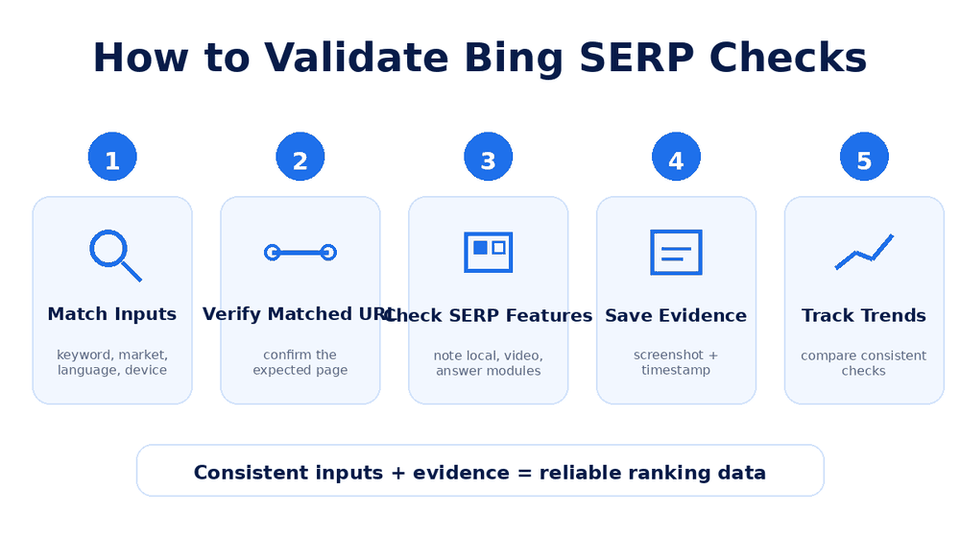
Validation should happen before a tracker feeds dashboards or client reports. Start with a small keyword set and compare automated results against manual Bing checks under the same market, language, and device assumptions.
Look for these QA signals:
- The tracker returns the expected search engine and result type.
- The same keyword settings are used in every scheduled run.
- The target URL matching rule is documented.
- SERP features are captured or explicitly excluded.
- Timestamps use one timezone.
- Missing results are labeled as missing, not silently converted to position zero.
- Large movements are checked against raw result evidence.
If two tools disagree, inspect the query context. Different locations, devices, personalization controls, and result modules often explain the gap. A ranking number without context is easy to report and easy to misread.
How to Check Bing Rankings From Another Location
Local Bing rankings are useful for regional SEO, location QA, and market comparison. They can show whether a site appears consistently across cities, whether a local landing page outranks a national page, and whether Bing displays local packs or map-style results for the query.
For a repeatable local ranking check, keep the keyword, device, language, browser state, URL-matching rule, and test window as consistent as possible. Change only the location you intend to compare. This makes it easier to tell whether a ranking difference is geographic or caused by a different measurement setup.
If a proxy route is part of an authorized regional SEO workflow, verify that the route actually exposes the expected location before recording the rank. IPWeb's proxy verification guide covers the basic IP and route checks.
For recurring checks of the same market, a static residential proxy can keep the residential network endpoint stable between runs and reduce one variable in the measurement. The proxy controls the network route and visible IP location; it does not control every Bing personalization or result-selection signal.
For one-off localized snapshots rather than recurring monitoring, the SERP checker workflow is the more direct comparison.
Bing Rankings vs Microsoft AI Visibility
It is also reasonable to monitor Bing because Microsoft search surfaces matter for some audiences. However, do not claim that a Bing keyword ranking automatically produces Microsoft Copilot visibility or an AI citation. Bing results may influence parts of the Microsoft search ecosystem, but AI answers depend on many retrieval, grounding, and citation choices that a rank tracker does not directly test.
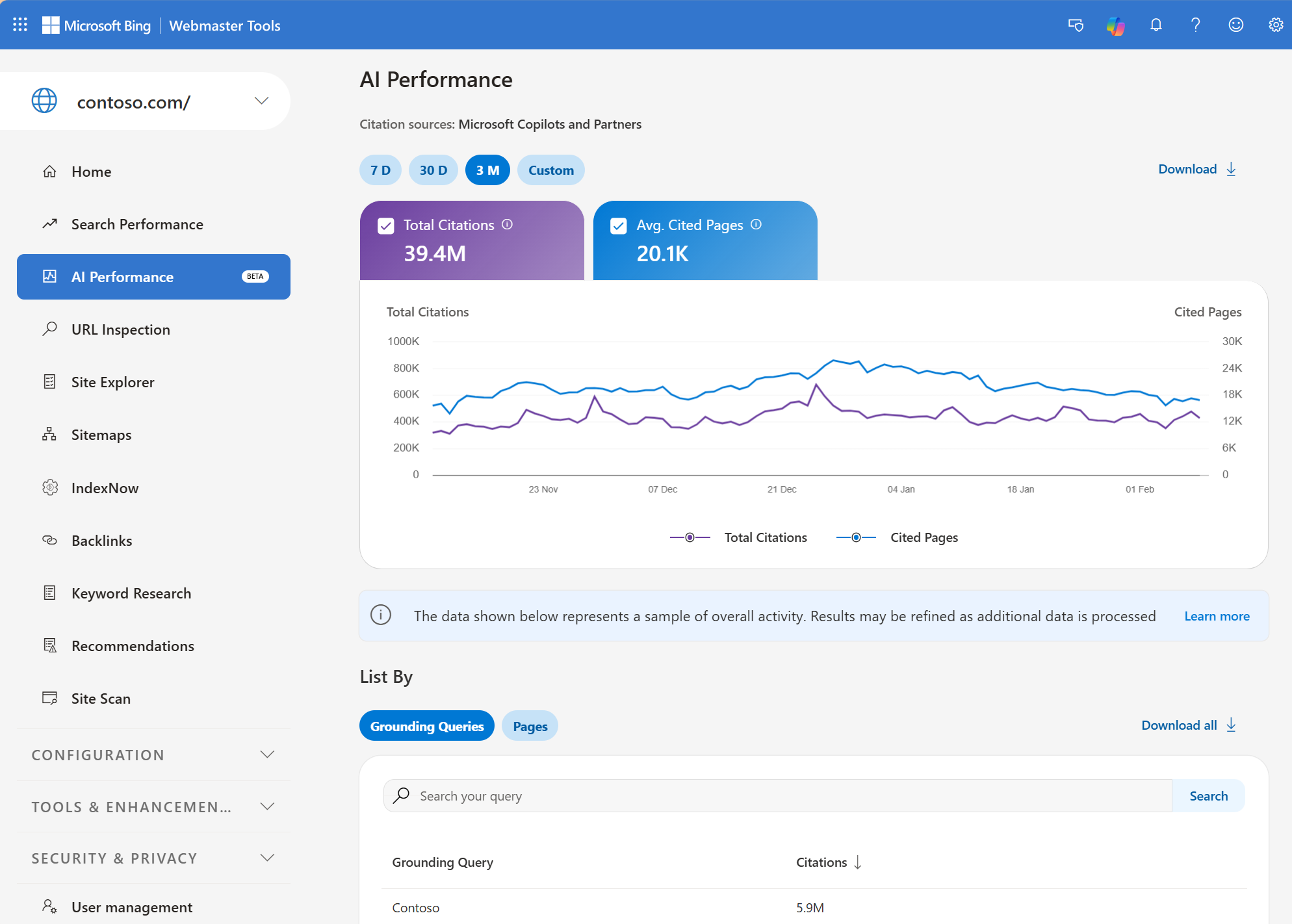
Pages are easier for search and AI systems to interpret when important claims are clear, factual, crawlable, and supported by useful context. A Bing rank tracker can show search visibility, but it cannot prove AI-answer inclusion by itself.
Common Mistakes
The most common mistake is tracking only desktop results and assuming the number represents every user. Mobile layouts can reorder or compress organic visibility.
Another mistake is mixing domain-level and URL-level matching. A domain match is useful for share-of-voice reports, but an exact URL match is better when you want to know whether a specific article, product page, or location page is ranking.
Teams also overreact to small daily movements. Bing rankings can change because of result features, data center differences, or temporary SERP tests. Focus on meaningful movement across a consistent tracking setup.
Finally, avoid treating rank tracking as traffic analytics. Ranking data explains visibility, but clicks still depend on query demand, title quality, snippet relevance, SERP layout, brand recognition, and competing features.
Frequently Asked Questions
Final Thoughts
A useful Bing rank tracker is a measurement system, not just a position counter. It should define the query, location, language, device, URL matching rule, timestamp, and SERP context before reporting movement.
That discipline keeps ranking reports honest. It helps teams separate real visibility gains from tool noise, location drift, and SERP-layout changes. When Bing rankings matter to a campaign, good data QA matters as much as the rank number itself.
For local Bing tracking, repeatability matters most: keep the measurement conditions stable, verify the intended network location, and change only the variable you are actually testing.